Elegant & manicured
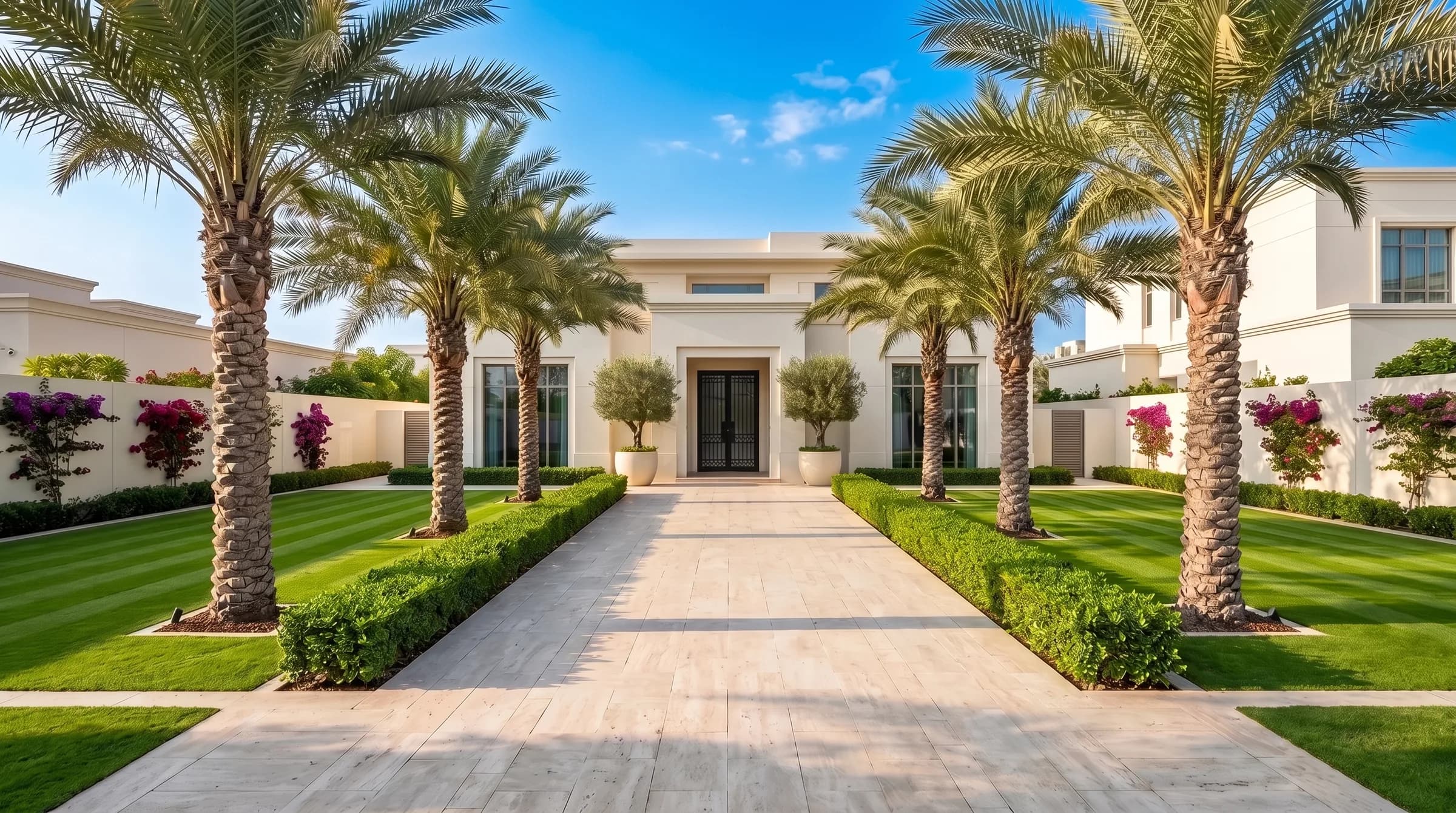
A crisp striped lawn, straight lines, and everything exactly where it should be.
Walk through the garden
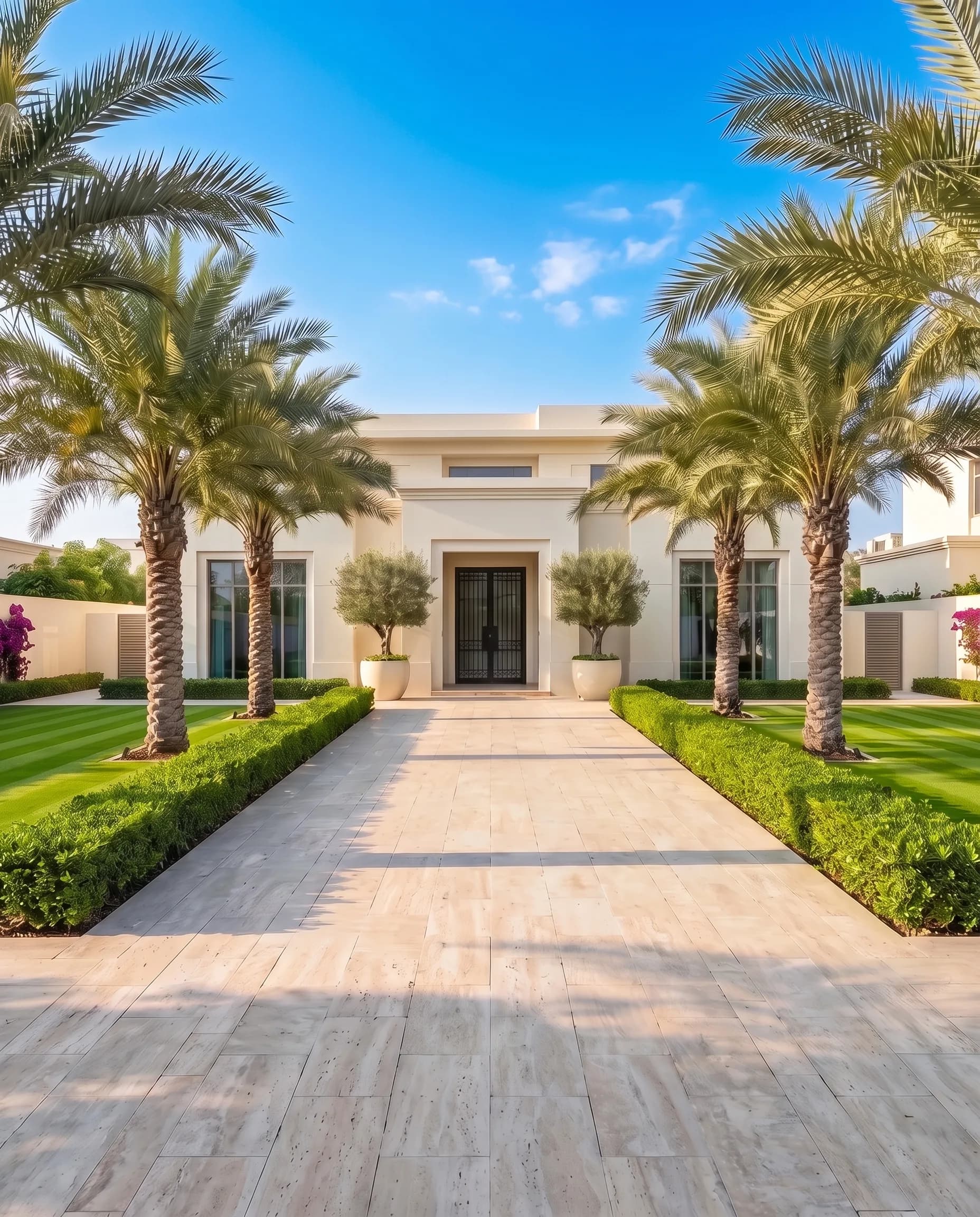
Symmetry, held to a sharp line.
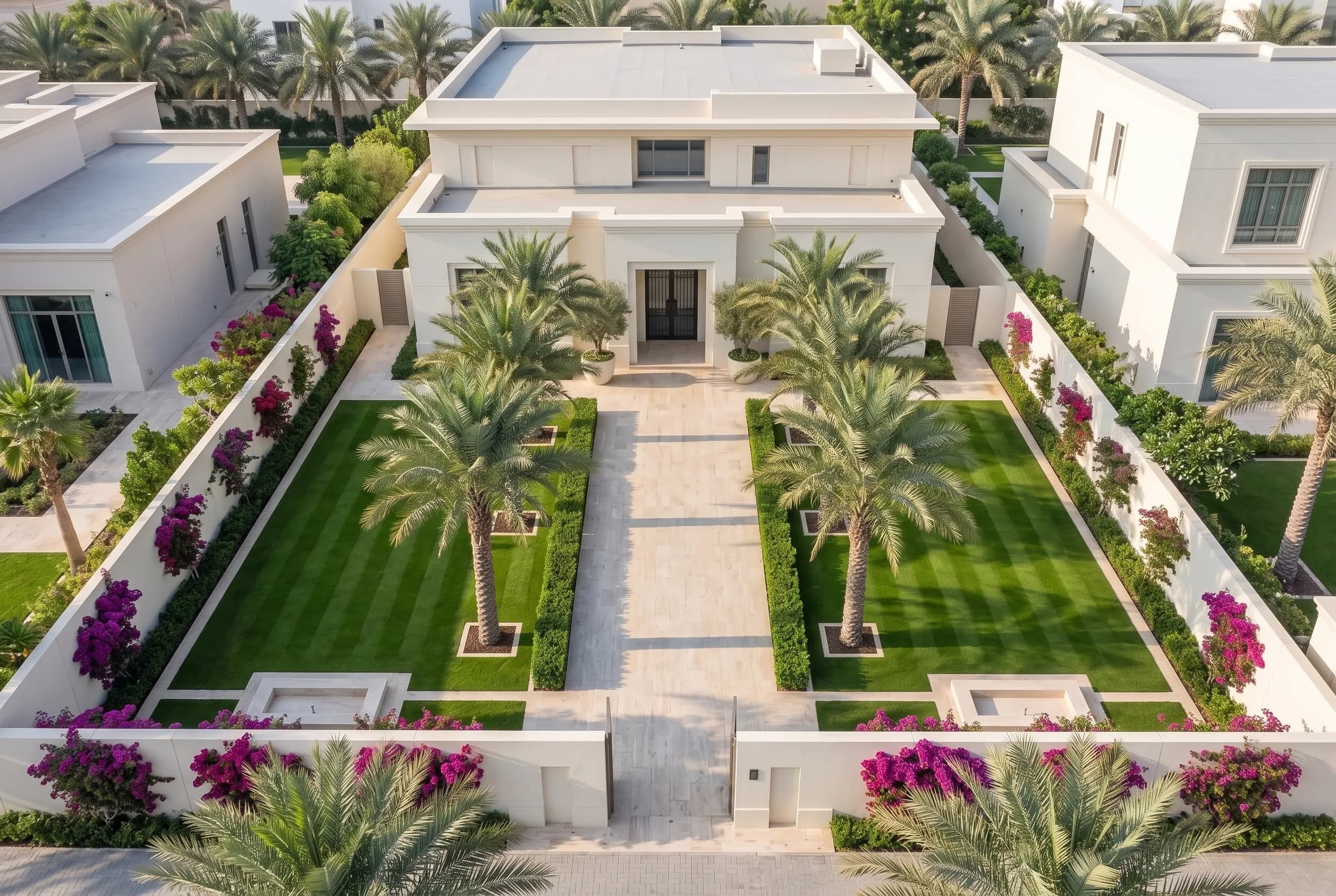
Mirrored beds and a palm allee hold the line from gate to entrance.
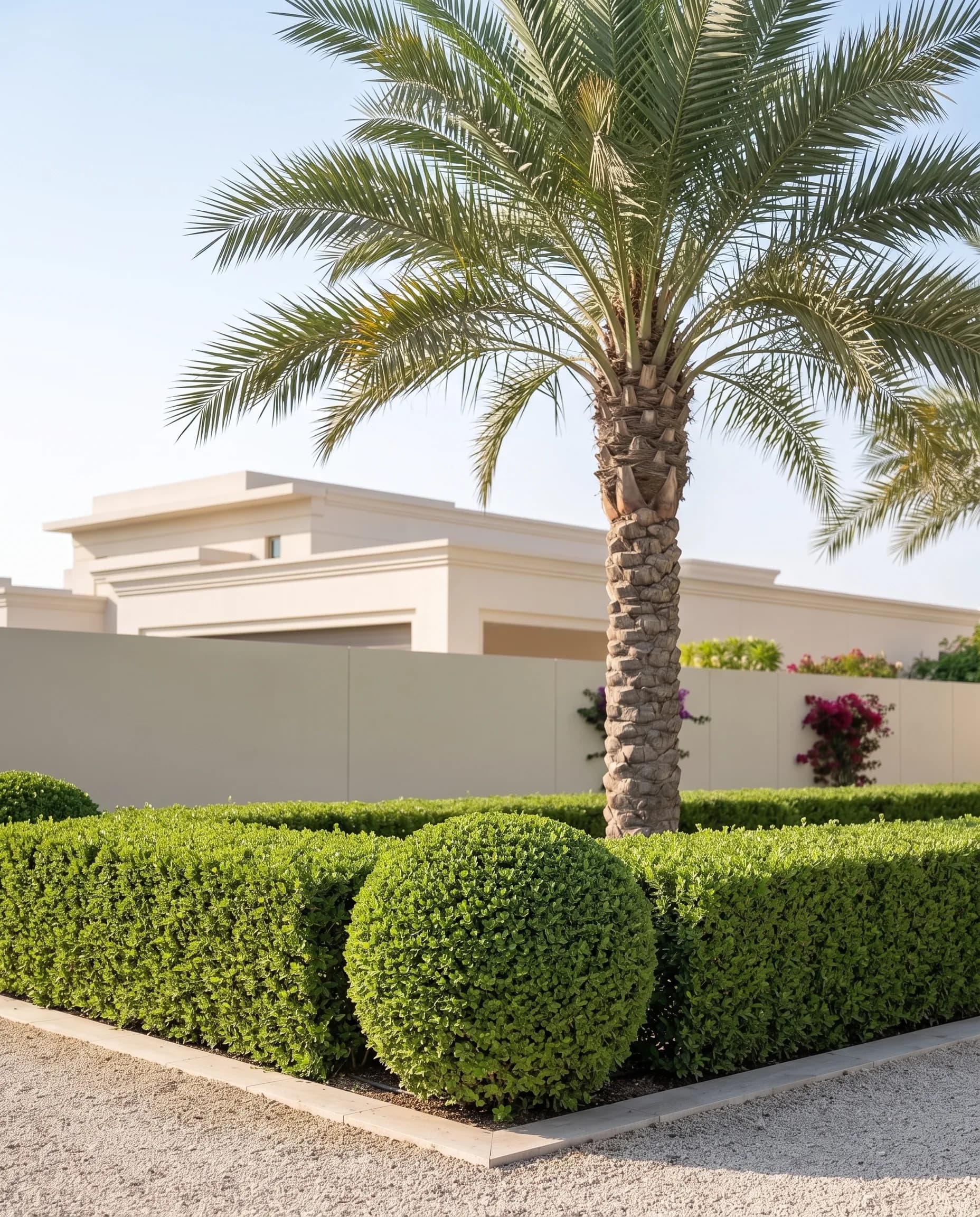
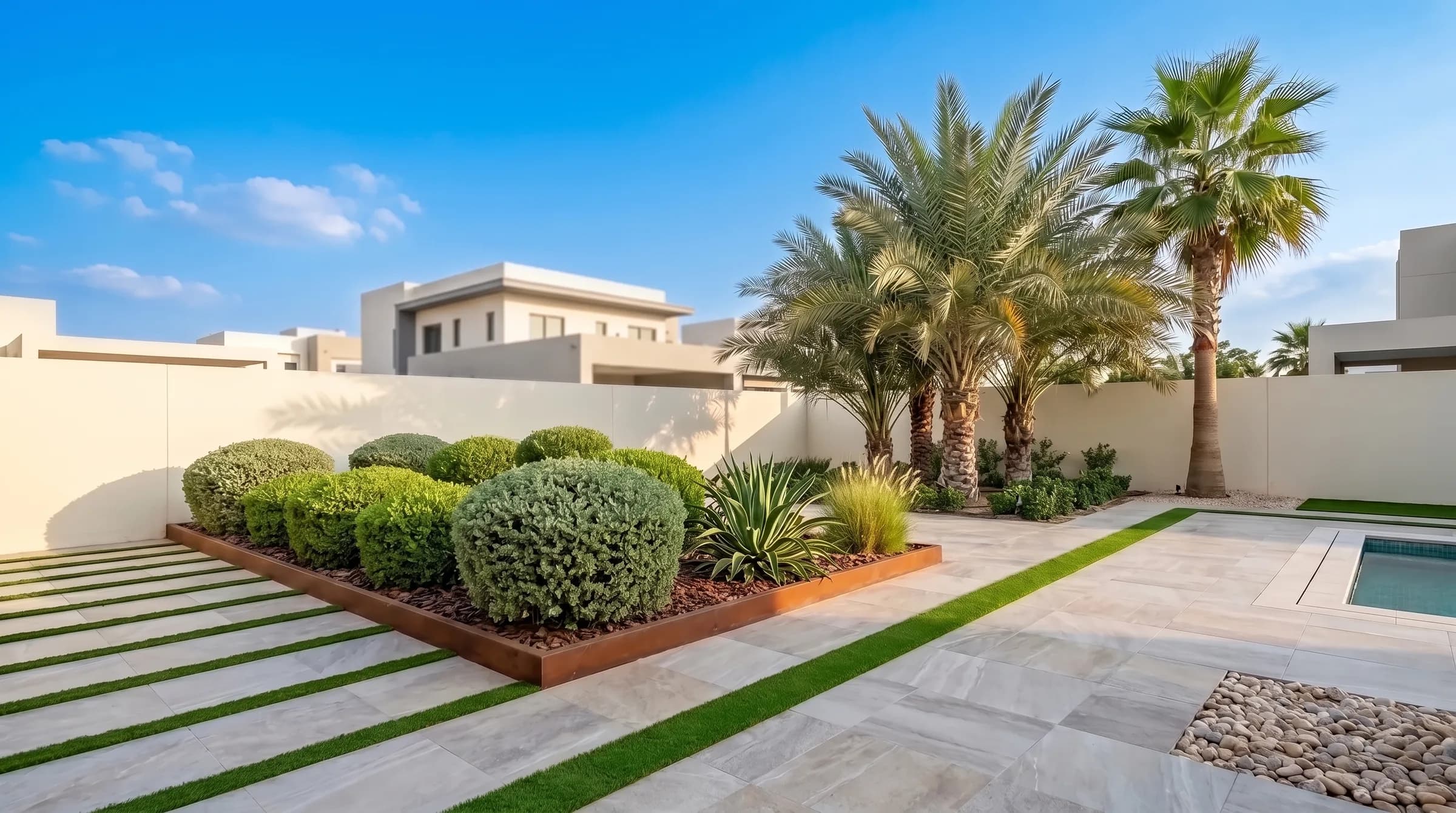
A topiary ball stands crisp beneath a date palm trunk.
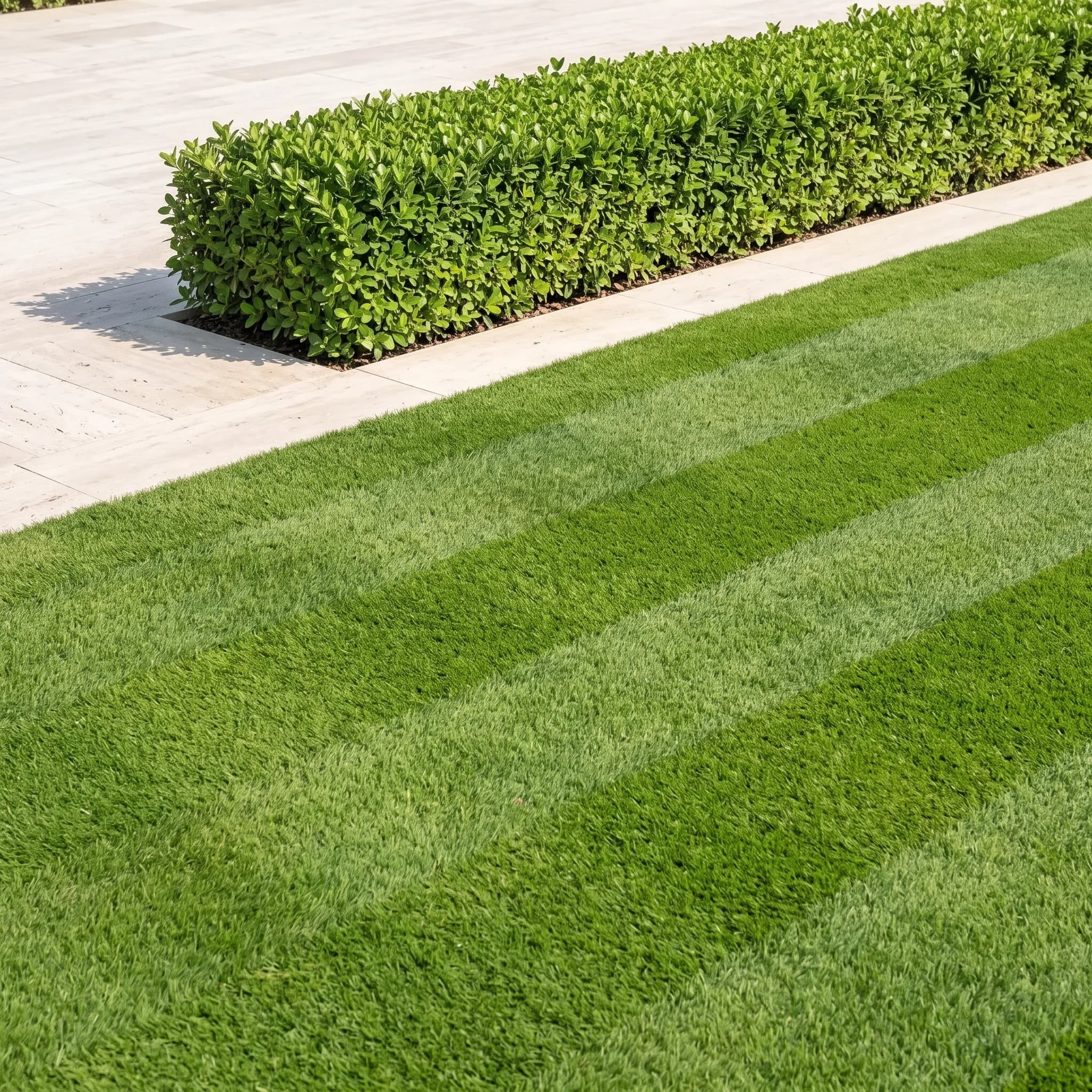
Mowing stripes meet a clipped hedge and limestone kerb.
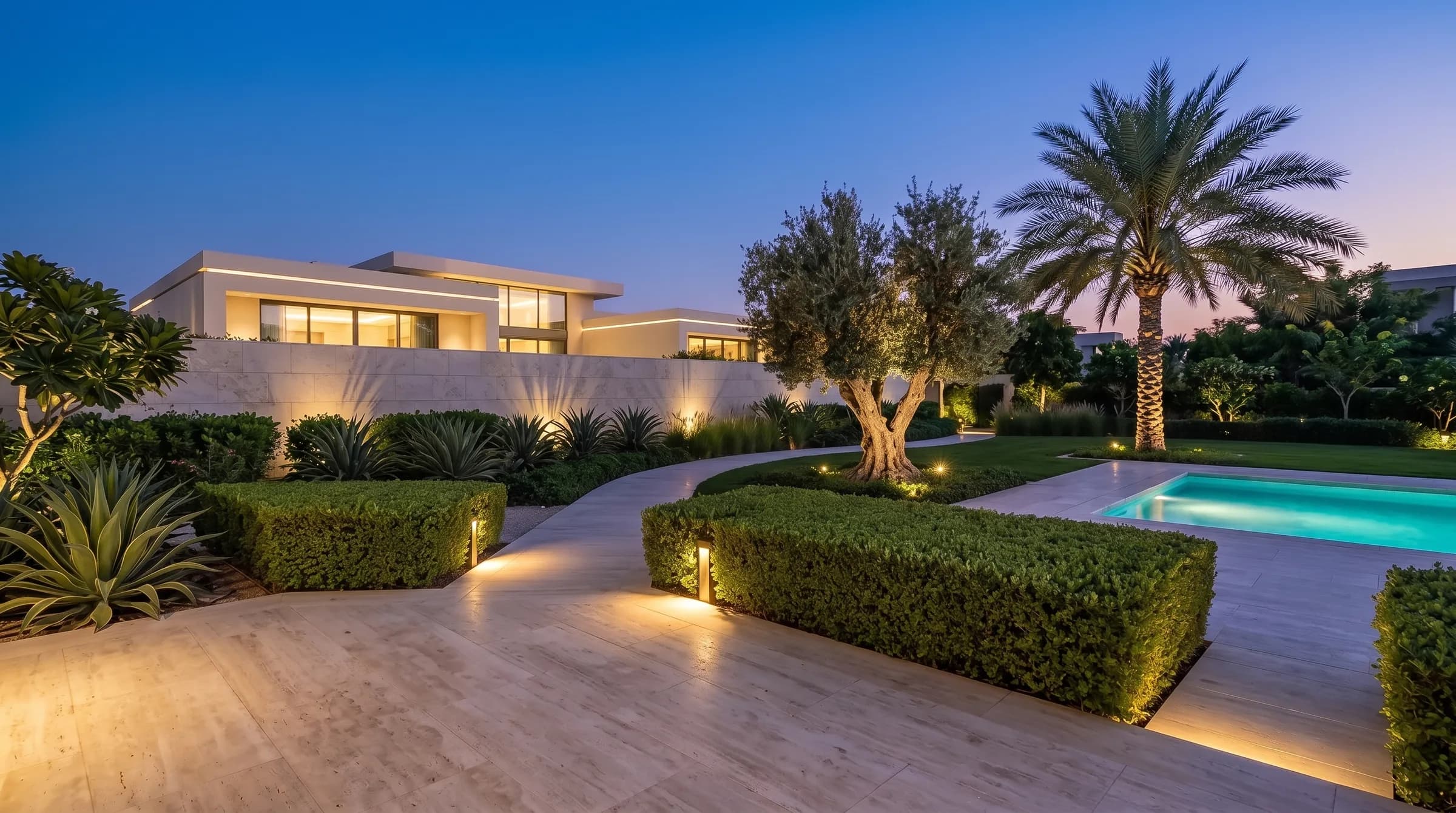
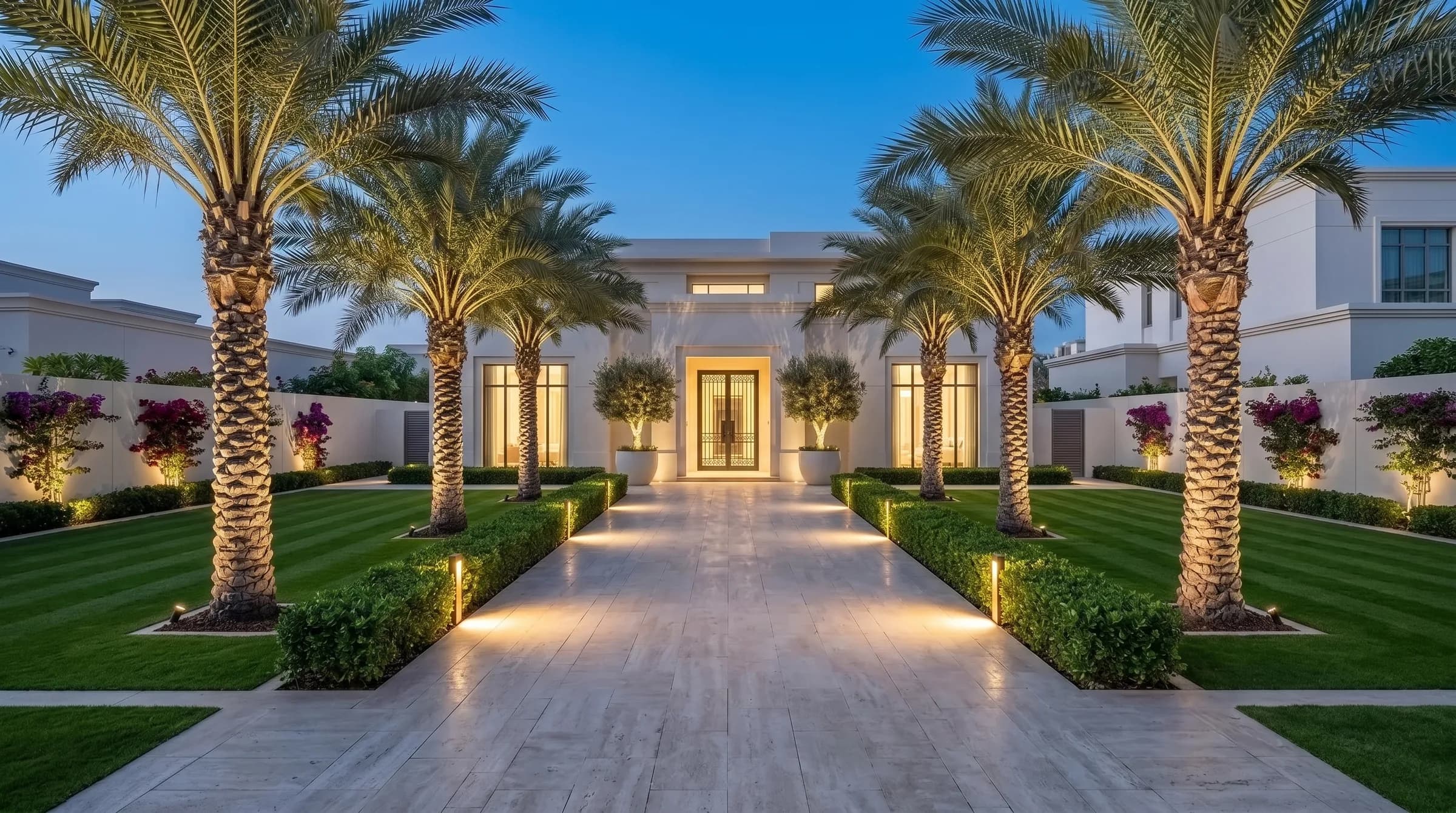
After sunset, it glows.
Materials & palette
What it's built from
Cut travertine or limestone paving · Clipped hedging (hopbush, sea jasmine or Texas sage — never Conocarpus/Damas) · Limestone kerb edging between lawn, bed and paving · Cream/white painted rendered villa walls · Cream GRC or fibreclay planters for specimen olives · Low-voltage warm-white (2700–3000K) uplighting
Key plants
What grows into the elegant & manicured look
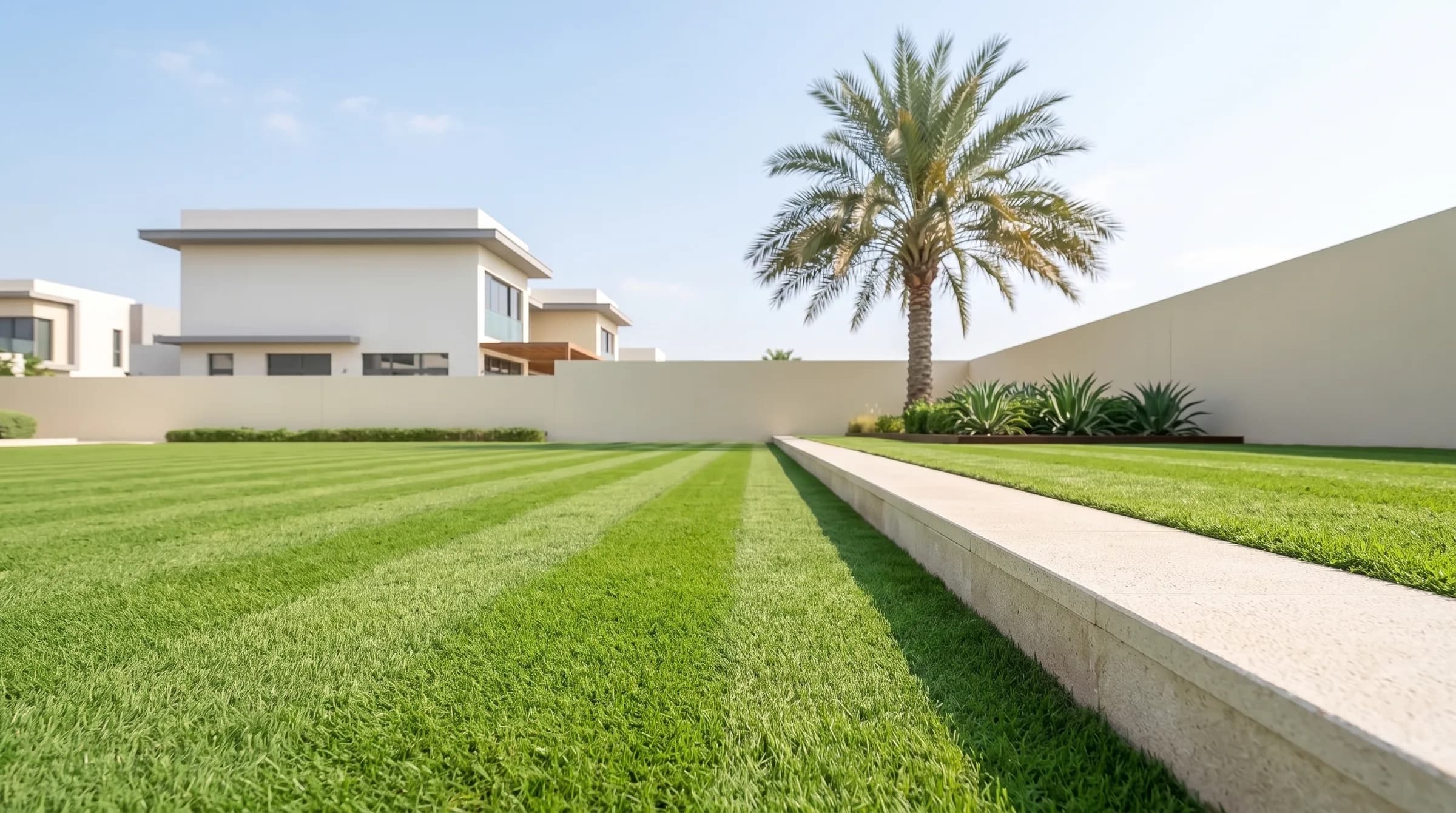
Seashore paspalum
A fine-bladed warm-season lawn grass that shrugs off saline irrigation water better than any other turf sold in the UAE, but needs full sun to stay dense.

Hopbush
A native UAE shrub found wild in wadis from Fujairah to Abu Dhabi — highly salt tolerant and useful for screening or stabilising saline, disturbed ground.

Sea Jasmine
A tough, salt-spray-tolerant hedge and screening shrub with small jasmine-like white flowers — thrives right on the coast where few other shrubs will.

Texas Sage
A silver-leaved shrub from the Texas/Mexico desert that flushes with purple flowers a few days after rain or humidity — extremely drought tolerant, but needs sharp drainage.
Date Palm
The palm the Gulf was built around: it tolerates 45°C and salty water, gives real fruit and real shade, but a mature specimen needs hand pollination, a seasonal prune and regular checks for red palm weevil.

Olive
A Mediterranean tree built for heat, drought and poor soil, now a sought-after specimen for Dubai villa gardens — though most UAE-grown trees are prized for their silvery form rather than a reliable harvest.

Bougainvillea
Dubai's most reliable colour: a thorny, sun-loving climber that flowers hardest when watered a little less, not more, and covers walls, pergolas and boundaries on very little care.

Ixora
A dense, compact shrub with clusters of red, orange, pink or yellow flowers that blooms almost continuously in heat — but it is acid-loving, and Dubai's alkaline sand needs real soil correction to stop it turning yellow.
The guide
Everything to know before you build elegant & manicured
Why choose it
The case for elegant & manicured
Mood
Formal, Crisp, Symmetrical, Tidy, Classic, Fresh
A manicured garden reads as order: a rectangular or gently-shaped lawn panel cut with visible mowing stripes, planting beds run along straight or softly curved lines, and hedges kept to one consistent height and profile the whole way along. Symmetry does most of the work — matching beds either side of a path or entrance, a date palm allée repeating evenly along the driveway, paired olive trees in matched planters at the front door.
The lawn itself is usually Seashore paspalum in the most visible front-of-villa panels — it holds a tighter canopy and shows stripes more crisply — with Bermuda grass still common in higher-traffic side and back lawns; see our paspalum vs Bermuda guide for choosing between the two. Hedges and topiary balls are clipped from Hopbush, Sea Jasmine or Texas Sage — all genuinely Dubai-viable — rather than Conocarpus ('Damas'), which is being removed across the city for root damage to pipes and pools, or Ficus, which suffers badly from whitefly here. Bougainvillea is trained flat against boundary walls for colour, and Date Palms and potted Olive trees give the entrance its structure.
A manicured garden wins by discipline, not abundance. Every line is cut straight, every hedge holds the same height for its whole run, and the planting bed reads as one or two repeated species, not because that's what a plain garden looks like, but because that discipline is what makes the whole plot read as cared-for at a glance, from the street or from a first-floor window. It's the garden that says the owner is on top of things before anyone has reached the front door.
There's a genuinely practical case underneath the formal one. Seashore paspalum gives a real, usable lawn, somewhere kids or a dog can actually be, not a symbolic patch of green, and it holds mowing stripes crisply enough that the lawn itself becomes part of the design rather than just a backdrop to it. Hopbush, Sea Jasmine and Texas Sage all take hard, repeated clipping without sulking, so the hedge lines this style depends on are achievable on a realistic maintenance schedule, not a fantasy one.
Symmetry does most of the remaining work for free. Mirror the beds either side of the entrance, repeat the date palms evenly along the driveway, and the eye is led exactly where it should go without a single extra design flourish, which is why this style photographs so consistently well and ages so gracefully. There's very little in it to fall out of fashion.
- Reads as tidy, freshly-kept and cared-for with an achievable, consistent maintenance routine
- The lawn gives genuinely usable open space, and paspalum's mowing stripes photograph especially well
- Straightforward to keep looking sharp with a regular mow-edge-and-clip schedule
- Front-of-villa presentation gardens in communities like Emirates Hills, Arabian Ranches or Dubai Hills Estate
- Owners who want a real, usable lawn for kids or pets
- Anyone who prefers crisp order and symmetry over abundance
What it feels like
A day in the garden
Morning here is about the stripes. Low sun rakes across the Seashore paspalum lawn and throws the mowing pattern into sharp light-and-dark relief, the single most photographed detail of this style, and it only reads properly in that low-angle early or late light, not at noon. Dew sits on the grass and the limestone kerb edging is cool and slightly damp underfoot; Bougainvillea on the boundary wall still holds yesterday's colour, not yet bleached by the coming heat.
By midday the lawn is doing the heavy lifting on comfort, bare paspalum runs noticeably cooler underfoot than the travertine paving beside it, simply because it's alive and losing moisture to the air. The hedges hold their line regardless of the hour, which is part of the point, this garden doesn't have a best or worst time of day the way a lighting-led style does. It looks the same, crisply, at nine and at three.
Evening brings the one real transformation: low warm uplights pick out the date palm trunks along the driveway, a still fountain or reflecting basin on the central axis goes from a sun-bright turquoise disc to a dark, glinting mirror, and the whole symmetrical layout reads as a considered approach to the front door rather than a garden you happen to walk through. Sea Jasmine hedges catch a soft graze of light along their top edge.
How the look is built
The choices behind the look
The striped lawn panel
Seashore paspalum is laid as a rectangular or gently-shaped panel in the most visible front-of-villa positions, cut with a cylinder or reel mower rather than a rotary one to produce alternating light and dark bands.
The stripes are the single most recognisable signature of this style, and they only appear with that mowing method, a rotary-mown lawn never produces them however tidy it looks otherwise.
Hedge species and profile
Hopbush, Sea Jasmine or Texas Sage are clipped to one consistent height and a flat-topped or gently rounded profile the entire run, never Conocarpus, which is being removed across Dubai for root damage to pipes, pools and walls, or Ficus, which suffers badly from whitefly here.
A correct species choice is what makes hedge maintenance realistic rather than a losing battle, the wrong hedge plant fights the climate and the infrastructure both.
Symmetry on the entrance axis
Beds, palms and specimen planters are mirrored either side of the path, driveway or front door, in a repeating rhythm rather than one-off placements.
The eye reads the whole garden as ordered in under a second, which is most of what makes a manicured garden feel effortless even though it isn't.
Date palm allee
Date Palms are planted at even spacing along the driveway, trunks kept clean and fronds groomed of dead lower growth.
It's the single most recognisable Dubai villa structural element in this style, and evenly-spaced trunks read as deliberate in a way an irregular cluster never does.
Stone kerb edging
Cut limestone or travertine kerb strips separate every material change, lawn from bed, bed from paving, rather than letting one surface bleed into the next.
Every line stays crisp regardless of how fast the lawn or planting grows, which is most of what keeps this style looking sharp between maintenance visits.
Bougainvillea trained flat
Bougainvillea is trained flat against the boundary wall or over an entrance arch rather than left to sprawl, and pruned hard straight after its main spring bloom.
It becomes the one saturated colour hit against pale render, doing the job a whole mixed border would do elsewhere without breaking the style's formal lines.
Olive trees in matched planters
Olive trees sit in large, matched cream planters flanking the entrance rather than planted directly in a bed.
The planters give each specimen a plinth-like presence, so they read as ornament rather than as part of the working planting scheme.
Warm low-level lighting
Uplights under palm canopies and hedge lines, path lights along the kerb, and submerged fountain lighting stay low-voltage and warm at 2700 to 3000K, with fittings kept hidden.
Only the light shows, not the fixture, which is what keeps the evening read as polished rather than floodlit.
Living with it
What it actually takes to keep
Moderate is the honest word for this one, not the lowest-effort style here, but a genuinely repeatable routine rather than a constant creative battle. A real lawn and clipped hedges both need attention on a schedule: mow and edge close to weekly in the growing season, clip hedges often enough to hold a flat line, and feed and overseed to a seasonal calendar. Skip a few weeks and it shows fast, in a way a looser planting style forgives more easily, but stick to the routine and it stays sharp with comparatively few judgement calls along the way.
Weekly
- Mow and edge the paspalum lawn, keeping the reel or cylinder mower sharp so the stripes stay crisp
- Check hedge lines for any stray growth breaking the flat top or straight edge
- Deadhead Bougainvillea and tidy any growth escaping its flat training against the wall
- Clear the fountain or reflecting basin of leaves and debris so the water stays a clean mirror
Monthly
- Clip Hopbush, Sea Jasmine or Texas Sage hedges back to their flat profile before growth softens the line
- Feed the lawn through the growing season to hold its colour and density
- Groom Date Palm trunks and remove dead lower fronds along the allee
- Check limestone kerb edging and joints for weeds establishing in the gaps
Seasonal
- Scarify, aerate and overseed the lawn in October, the standard Dubai window for lawn renovation
- Prune Bougainvillea hard straight after its main bloom in mid-spring, never in late summer or autumn
- Prune Olive trees in late winter to open the canopy to light and air
- Reduce mowing and hedge-clipping frequency through the cooler months as growth slows
Moderate, and the lawn is the main driver, even salt-tolerant Seashore paspalum takes real water to hold its stripe, while drip-irrigated beds use a fraction of that. Irrigate the lawn by observed need rather than a fixed timer, rolling leaf blades or footprints that stay pressed in are the signs it's time, tapering sharply in winter, when established paspalum on decent soil often needs water only every seven to ten days.
Watch-outs
- Never default to Conocarpus for hedging, it's being actively removed across Dubai for root damage to pipes, pools and boundary walls
- Ficus hedges are increasingly hit by whitefly here, which can defoliate a run within weeks once established
- Scalping the lawn below its correct mowing height stresses the grass and lets weeds establish
- A missed hedge-clipping cycle shows fast, this style has little tolerance for a soft or uneven line
Trade-offs
- A natural lawn still needs real water and near-weekly mowing to stay crisp and striped
- Hedge lines need regular clipping to hold a flat, uniform profile
- Less shade and shelter than a layered planting style
Who it's for
Is this plot, and this owner, the right fit
Good fit
- Front-of-villa presentation gardens in communities like Emirates Hills, Arabian Ranches or Dubai Hills Estate
- Owners who want a real, usable lawn for kids or pets, not just a decorative patch
- Anyone who prefers crisp order and repeatable maintenance over abundance and improvisation
- Plots with a clear entrance axis that symmetry can actually be built around
Not for
- Owners who want the lowest possible water bill, a natural lawn is the main cost driver of this style
- Anyone unwilling to commit to a near-weekly mowing and regular hedge-clipping routine
- Irregular or heavily sloped plots where true symmetry is hard to establish
- Owners who want dense shade and screening rather than an open, formal layout
Effort
3 of 5
Water
Moderate
Build cost
AED 180–400/m²
Signature features
- Rectangular lawn panel with visible mowing stripes
- Symmetrical planting beds either side of a path or entrance
- Clipped hedge borders with topiary balls or cones at corners
- Date palm allée along the driveway
- Bougainvillea trained flat on boundary walls
- Matched olive trees in planters flanking the entrance
- Fountain or still reflecting basin on the central axis
- Low-level warm uplighting for evening
What people assume
Common assumptions, checked against reality
It's the boring, default choice.
It's the style with the most design discipline behind it, symmetry, one hedge profile held perfectly, and mowing stripes are all harder to execute well than a looser, more forgiving planting scheme.
Any hedge plant will do, as long as it's clipped.
Species choice matters as much as the clipping, Conocarpus is being removed across Dubai for root damage, and Ficus here suffers badly from whitefly, so hopbush, sea jasmine and Texas sage do the same job without either problem.
A real lawn is too much upkeep for Dubai.
It's genuinely more work than artificial turf, but seashore paspalum, kept to a realistic mowing and feeding schedule, is a proven, common choice in Dubai villa gardens, not a losing bet against the climate.
Symmetrical gardens only suit large estate plots.
The structural idea, mirrored beds, one hedge line, repeated planters, scales down to a single entrance courtyard just as readily as it scales up to a full driveway allee.
It needs artificial turf to look this crisp.
The mowing stripes that define the look are only possible with real grass, cut with a cylinder or reel mower, artificial turf keeps the symmetry but loses the single most recognisable detail.
Dubai notes
Climate, salinity and approvals
A real lawn in Dubai's climate is a genuine irrigation commitment, not an afterthought. Abu Dhabi's municipal irrigation standard for turf-type planting is around 20 litres per square metre a day in summer, tapering off outside the hottest months, a useful general benchmark for what a paspalum panel in full sun actually needs to hold its stripe through June to September.
Watering timing matters as much as volume. DEWA recommends irrigating before 8am or after 6pm, when evaporation losses are lowest, a fixed early-morning cycle also happens to suit the mowing-stripe look, since the lawn dries before the first cut of the day rather than being mown wet.
Salinity is worth checking before choosing paspalum over Bermuda specifically, paspalum tolerates irrigation water salinity meaningfully better, which matters on plots using treated sewage effluent or a borehole rather than DEWA mains, where salt build-up in the soil is a real long-term risk.
As with any change to the front-of-villa landscape, boundary wall planting or a fountain build, check your community's landscaping guidelines, Emaar, Nakheel or the relevant owners' association, before work starts, since requirements and approved plant lists vary by community.
Make it yours
Three ways to adapt it
On a townhouse plot
Shrink the lawn panel to a single rectangle either side of the front path rather than a full front garden, keep one matched pair of olive planters at the door, and drop the allee to two or three date palms rather than a full driveway run. The symmetry principle holds at any scale.
Without a pool
A still reflecting basin or a simple fountain on the entrance axis does the water-feature job a pool would elsewhere, it needs far less space and upkeep, and it suits the formal, front-of-house character of this style better than a swimming pool would anyway.
A lower-water version
Keep every structural element, symmetry, hedge lines, palm allee, olive planters, but swap the natural lawn for artificial turf. The formal geometry survives the swap intact; the only real loss is the mowing-stripe effect, since that needs real grass and a cylinder mower to produce.
FAQ
Common questions
How much lawn and hedge maintenance does this style actually need?
Why not use Conocarpus (Damas) or Ficus for the hedges?
Can I do artificial turf and still get a manicured look?
Want this in your garden?
Keep it this fresh with Garden Care from AED 500/month.
Keep exploring