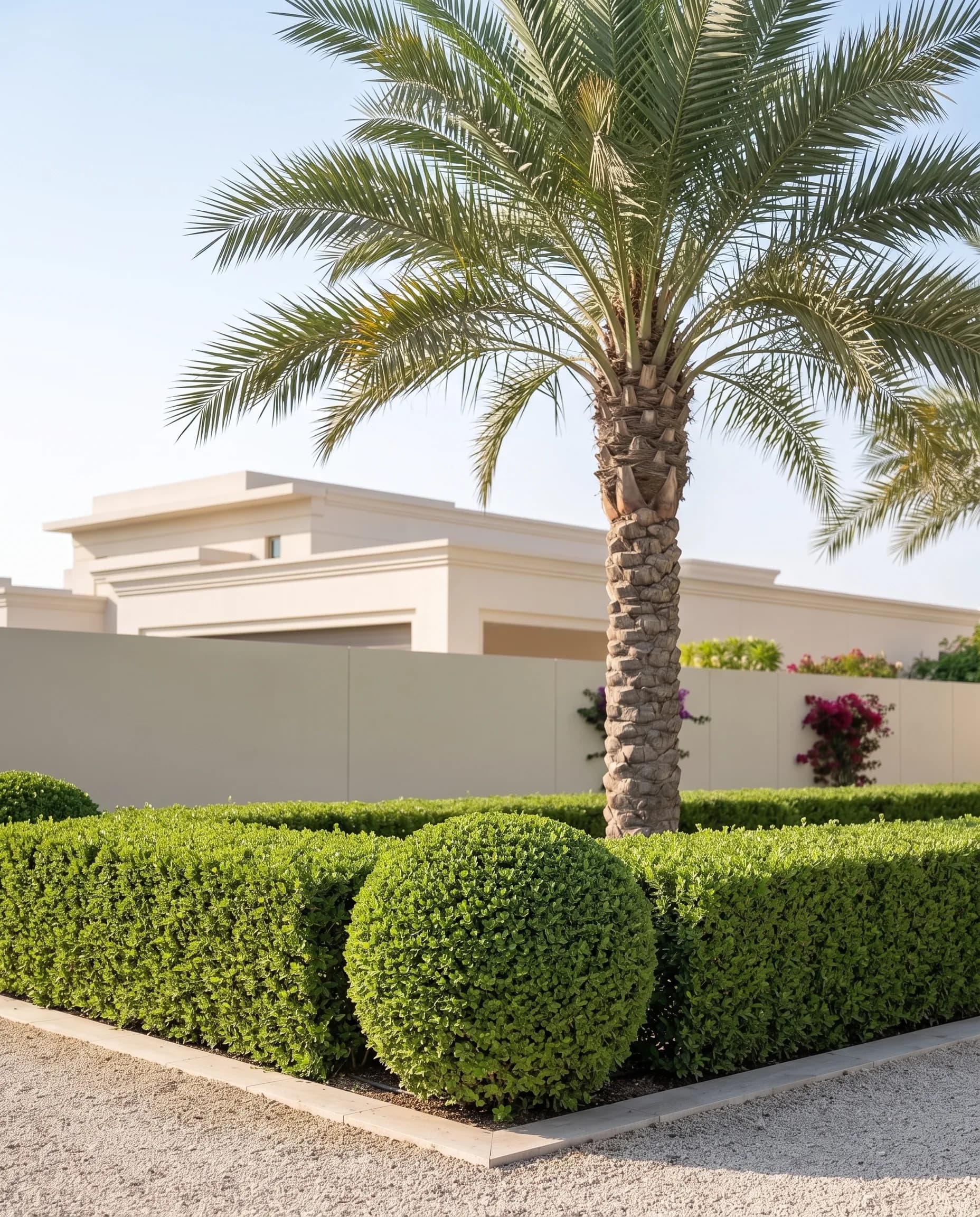

Hopbush
Dodonaea viscosa
Full sunSalt: 4 of 5
Native
Leucophyllum frutescens
A silver-leaved shrub from the Texas/Mexico desert that flushes with purple flowers a few days after rain or humidity — extremely drought tolerant, but needs sharp drainage.
See it planted
Season
How Texas Sage behaves through Dubai's seasons, month by month.
Best planting window
Spring flush
Purple-pink bloom flush
Light shaping only
Best planting window: Feb–Mar, Oct–Nov
Plant into raised or well-drained beds in the cool season.
Spring flush: Mar–Apr
Purple-pink bloom flush: Apr–May, Sep–Oct
Flowers appear a few days after rain or a spell of high humidity rather than on a fixed calendar — timing in the UAE can vary year to year.
Light shaping only: Feb
Thin lightly if needed after a flowering flush; avoid tight shearing.
Texas sage holds its soft silver-grey foliage year-round, so the framework barely changes with the seasons — what shifts is the flowering, which follows weather rather than a fixed calendar. Spring, typically April to May, and again September to October, are the most reliable windows for a purple-pink bloom flush, triggered a few days after rain or a jump in humidity rather than day length. It can flower in summer too if a humid spell arrives, though growth generally slows through the hottest months. Through winter it simply holds its shape, needing little water and no real attention beyond an occasional light thinning.
Meet the plant
Meet Texas sage, the shrub that turns rain into a performance. Most of the year it sits quietly as a soft, rounded mound of silvery-grey foliage, a cool, muted note against the greens and golds of a desert-modern planting. Then, a few days after rain or a spell of humidity, it flushes all at once with small purple-pink flowers — the plant literally responding to weather rather than the calendar, which is exactly why Texans nicknamed it the barometer bush.
That silver foliage is doing real work in a garden's mood: it cools down a hot, sun-bleached gravel bed the way green planting alone cannot, reading as calm and textural even in the flattest midday light. Left unclipped it holds a loose, natural, rounded form; forced into tight shearing it looks stiff and flowers noticeably less, so the best gardens let it keep its own shape.
It asks for almost nothing once it is settled into the right soil — no regular water, no feeding, minimal pruning — and gives back colour on its own schedule, a quietly dramatic plant for a garden that is otherwise built around restraint.
Texas sage comes from the Chihuahuan Desert of Texas and northern Mexico, a climate dry and hot enough that it transplants easily to Dubai. In the wild it grows in limestone-derived, gravelly soil with almost no organic matter, which explains exactly why it performs so well — and so predictably badly — in different parts of a UAE garden. Its soft, silvery-grey foliage is the main draw: it reads as a cool, muted contrast against green planting and gravel in a desert-modern scheme, unlike the darker greens of Hopbush or Lantana.
It has an odd, useful habit: rather than flowering on a fixed calendar, it flushes with small purple-pink tubular flowers a few days after rain or a spell of high humidity, which earned it the nickname "barometer bush" in Texas. In a UAE garden that means occasional, unpredictable bursts of colour rather than a steady bloom — genuinely tied to the weather rather than the season.
The one condition it insists on is drainage. Texas sage is extremely drought and heat tolerant once established, but it rots quickly in heavy, waterlogged soil or with frequent watering — it wants to dry out between soakings, which makes it a natural match for raised beds, berms and gravel gardens rather than a bed shared with thirsty lawn or tropical planting. Its most serious disease risk, cotton root rot (Phytophthora and Fusarium fungi that thrive wherever water pools around roots, even briefly), has no cure once established; prevention through drainage is the only real defence.
Texan growing guidance is specific enough to be worth following directly: mix the native soil with roughly 40% coarse crushed granite or decomposed granite rather than compost, peat or fine sand, and set the crown slightly proud of the surrounding grade at planting, since burying the base even a little invites crown rot. Followed properly, this is one of the lowest-input flowering shrubs available for a Dubai desert-modern garden.
Design
Plant Texas sage in raised beds, berms or gravel gardens with genuinely sharp drainage — this is the one non-negotiable condition it asks for, and the main reason it fails in a standard irrigated border. Full sun brings out the best foliage colour and the most reliable flowering flushes. Use it as a loose, informal hedge or screen where its natural rounded form can stay untrimmed, or as a specimen where its silver foliage can contrast against darker green planting. Keep it separate from beds that get frequent watering for lawn or tropical planting nearby, since shared irrigation is the easiest way to over-water it by accident.
Hopbush
Hopbush's dark, dense foliage makes a strong colour foil for Texas sage's silver-grey leaves, and both tolerate the same dry, well-drained conditions.

Yellow Bells
Yellow bells' bright yellow flowers and Texas sage's occasional purple flush give two independent bursts of colour from plants that share similar drought tolerance.

Desert Rose
Desert rose's bold pink flowers and succulent form pair well with Texas sage's soft grey backdrop in a raised, sharply draining desert-modern bed.

Rosemary
Both are Mediterranean- and desert-adapted plants that want the same sharp drainage and minimal water, making them easy companions in the same gravel bed.
Care guide
Summer: A deep soak every 2–3 weeks is enough once established; more frequent watering causes root rot and leggy growth.
Winter: Little to no irrigation needed.
Establishment: Water twice a week for the first couple of months, then taper off quickly.
Avoid these
Extra notes
Toxicity: Not known to be toxic.
FAQ
Not sure how it suits your garden?
Ask about Texas Sage on WhatsAppKeep exploring
Hopbush
Dodonaea viscosa

Lantana
Lantana camara
Yellow Bells
Tecoma stans
Desert Rose
Adenium obesum
Sources
Last reviewed 2026-09-30 by Ghaf Gardens horticulture desk.
Pool + garden care
From AED 500/month
Price depends on your garden's size, pool and complexity. Prices in AED, excluding 5% VAT.