
Washingtonia Palm
Washingtonia robusta
Full sunSalt: 3 of 5
Adapted
Phoenix dactylifera
نخيل التمر
The palm the Gulf was built around: it tolerates 45°C and salty water, gives real fruit and real shade, but a mature specimen needs hand pollination, a seasonal prune and regular checks for red palm weevil.
See it planted
Season
How Date Palm behaves through Dubai's seasons, month by month.
Best planting window for offshoots
Flowering and hand pollination
Fruit development (khalal stage)
Rutab and tamr harvest
Main frond and bunch-stalk trim
Red palm weevil monitoring
Best planting window for offshoots: Oct–Feb
Plant in the cool season so the new palm establishes before summer heat.
Flowering and hand pollination: Feb–Mar
Male pollen is dusted onto female flower clusters by hand — the traditional and still-standard method in the UAE.
Fruit development (khalal stage): Apr–Jun
Rutab and tamr harvest: Jul–Sep
Fresh dates ripen through the hottest months; timing shifts a few weeks by variety.
Main frond and bunch-stalk trim: Aug–Oct
Follows harvest. Remove only dead brown fronds and spent stalks — never cut above the horizontal or strip green fronds.
Red palm weevil monitoring: Jan–Dec
Check trunk and crown year-round for tunnels, oozing sap, frass or a fermented smell; keep or check pheromone traps.
Date palm's calendar peaks through the hottest half of the year rather than avoiding it. Flowering and hand pollination happen in February–March, fruit develops through the khalal stage in April–June, and the rutab and tamr harvest runs through the hottest months, July–September, when the fruit actually ripens. The main frond and fruit-stalk trim follows harvest, in August–October, removing only fully dead material. Plant offshoots in the cool season (October–February) so new roots have time to establish before summer heat returns, and keep red palm weevil monitoring going year-round — this is the one task with no seasonal off-switch, since the pest can strike at any time and damage stays hidden inside the trunk until it's advanced.
Meet the plant
Meet the date palm, the tree that this entire region was built around long before landscaping was a profession here. Its scale alone tells you what it means locally: the Al Ain and Liwa oases, still farmed using the same falaj irrigation channels dug centuries ago, have been a UNESCO World Heritage site since 2011, and the Al Ain Oasis alone holds more than 147,000 date palms across some 100 varieties. Planting one in a villa garden connects that grounds to something much older than the villa.
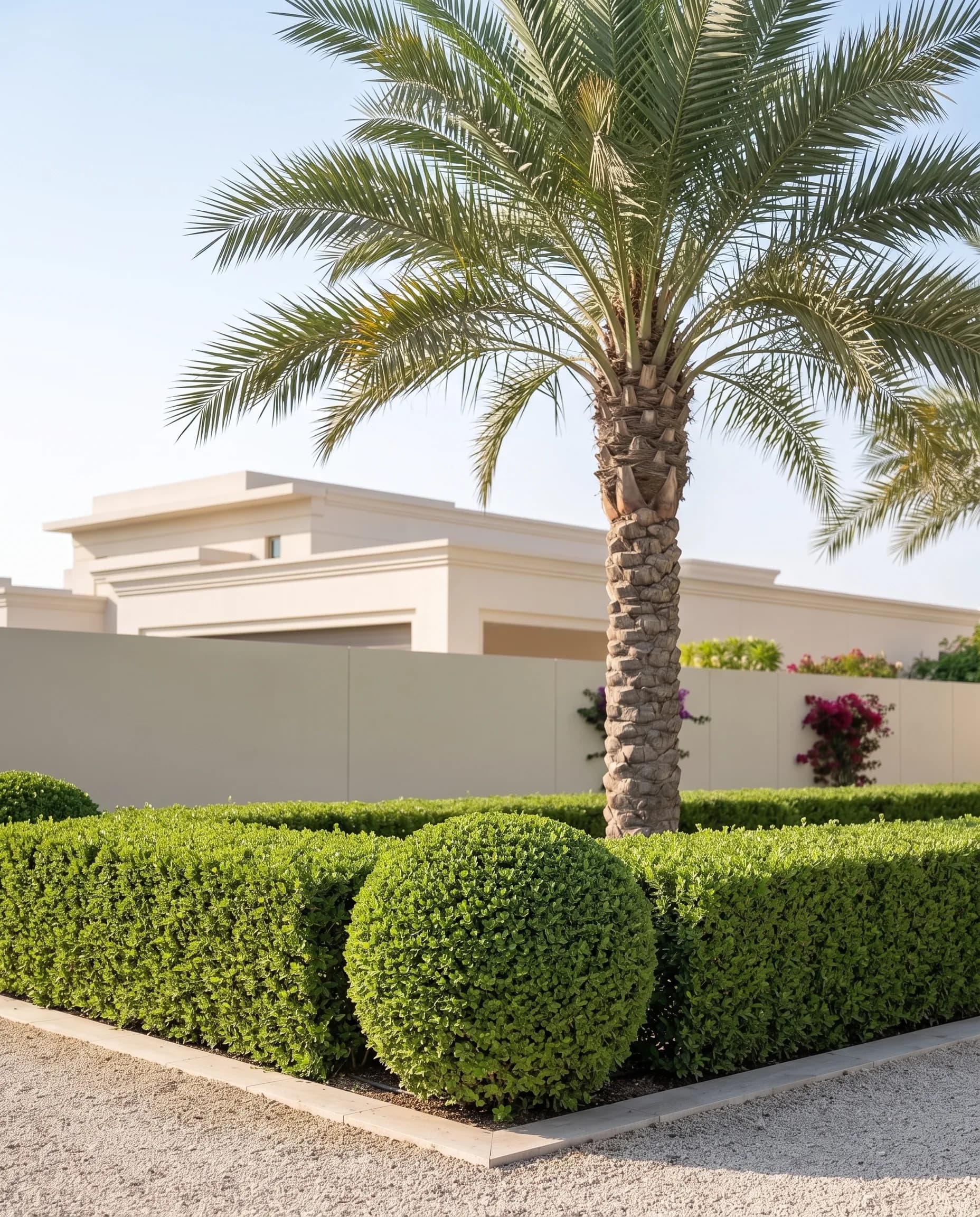
Its character in a garden is quietly dominant rather than showy. The trunk rises straight and columnar, the crown sits high, and the light it lets through underneath — dappled rather than dense shade — is part of why it can anchor a planting scheme without smothering everything beneath it. It doesn't need to be the loudest plant in the garden to be the one everyone recognises first.
What it brings beyond looks is genuine usefulness, if you want it: real fruit, ripened through the hottest months when almost nothing else in the garden is producing anything at all. Most ornamental specimens are simply left to their own rhythm, flowering and dropping fruit unattended, but a palm that's hand-pollinated and cared for properly turns a garden feature into something that actually feeds people — a small piece of the same heritage the national oases were built to preserve.
Date palm is native to the region stretching from the Gulf to Pakistan, and it has been cultivated here for millennia — it is the tree most closely tied to Emirati agricultural heritage. Left alone it is strikingly tough: a saying about the species is that it grows with "its feet in the water and its head in the fire," tolerating summer heat past 45°C as long as its roots can reach moisture. In a villa garden it works as a genuine shade and specimen tree, not just a backdrop, and it pairs well with Ghaf and Bougainvillea in a desert-modern or luxury planting.
Fruiting is the part most owners underestimate. Date palms are dioecious — separate male and female trees — and in cultivation almost all pollination is done by hand, climbing to the female flower clusters with pollen collected from a male tree. That happens in late winter, fruit develops through spring, and the rutab (fresh date) harvest runs through the hottest months of summer. A palm grown purely for looks does not need any of this, but if fruit is dropping and staining paving, removing the flower stalks in spring avoids a summer of mess.
The main risk to any Phoenix dactylifera in the UAE is the red palm weevil (Rhynchophorus ferrugineus), first recorded in the country at Ras Al Khaimah in 1985 and now a serious pest across the Gulf. It tunnels inside the trunk and crown, so damage is often well advanced before it is visible from outside — regular inspection and pheromone trapping matter more than any other single piece of maintenance.
Design
Its high, light canopy is the key design fact: plant it where dappled, moving shade overhead is wanted without blocking planting underneath, such as beside a pool deck, along a drive, or as the anchor of a desert-modern courtyard with lower shrubs and groundcover beneath it. Give it real room for its eventual 5–8 m spread and full sun. If fruit is not wanted, plan for removing flower stalks each spring rather than leaving ripening dates to drop and stain paving below.

Ghaf
Both are UAE natives suited to the same heat, drought and light-canopy role, giving a desert-modern planting genuine regional character.

Bougainvillea
Bougainvillea's colour at eye level works well under a date palm's high, dappled canopy, and both tolerate similarly lean, infrequent watering.
Washingtonia Palm
A taller, narrower palm silhouette that complements date palm's broader crown in a mixed-palm avenue or skyline planting.
Care guide
Summer: Deep irrigation 2–3 times a week for an established palm; date palms want water at the roots even though they tolerate heat well above ground.
Winter: Cut back to roughly weekly deep watering; rainfall rarely covers it in Dubai.
Establishment: Water newly planted offshoots deeply two to three times a week until new fronds emerge, usually 6–12 months.
Avoid these
Extra notes
Toxicity: Not toxic. The fruit is edible and, in the young pod stage, traditionally eaten fresh across the region.
FAQ
Not sure how it suits your garden?
Ask about Date Palm on WhatsAppKeep exploring
Washingtonia Palm
Washingtonia robusta

Foxtail Palm
Wodyetia bifurcata

Bismarck Palm
Bismarckia nobilis
Ghaf
Prosopis cineraria
Bougainvillea
Bougainvillea glabra
Sources
Last reviewed 2026-09-30 by Ghaf Gardens horticulture desk.
Pool + garden care
From AED 500/month
Price depends on your garden's size, pool and complexity. Prices in AED, excluding 5% VAT.