Seashore paspalum
Paspalum vaginatum
Full sunSalt: 5 of 5
Adapted
Cynodon dactylon
ثيل
Dubai's default lawn grass: fast-growing, heat-proof and tough underfoot in full sun, but it fades in shade and pales through the cooler months.
Season
How Bermuda grass behaves through Dubai's seasons, month by month.
Best turf-laying window
Main feeding season
Optional winter overseeding
Peak summer heat
Winter colour fade
Best turf-laying window: Mar–May, Sep–Nov
Lay sod in spring or autumn so roots establish before peak summer heat or winter's slower growth; soil temperatures of 25–30°C suit it best.
Main feeding season: Oct–Feb
Higher-nitrogen feeding through the cooler months keeps growth and colour up; cut back to little or none in summer.
Optional winter overseeding: Oct
Some gardens and most Dubai golf courses overseed with perennial ryegrass in October for a green lawn through winter; it needs its own mowing and watering and can compete with the bermuda coming out of dormancy in spring.
Peak summer heat: Jun–Aug
Thrives in the heat itself, but newly laid or thin lawns need extra watering to avoid drying out.
Winter colour fade: Dec–Feb
Growth nearly stops and colour pales in the cooler months — normal dormancy, not a dead lawn.
Bermuda grass grows fastest and needs weekly mowing through the warm months, from spring planting windows (March–May) through the peak summer heat (June–August) it genuinely thrives in. The main feeding season runs through the cooler months, October to February, with higher-nitrogen feeds keeping colour and density up as growth naturally slows. October is also when some gardens overseed with perennial ryegrass for green winter colour, a step most home lawns skip. By December through February the grass is visibly paler and nearly dormant — normal seasonal behaviour, not a sign of a dying lawn — before it greens up again as spring warmth returns and the mowing cycle restarts.
Meet the plant
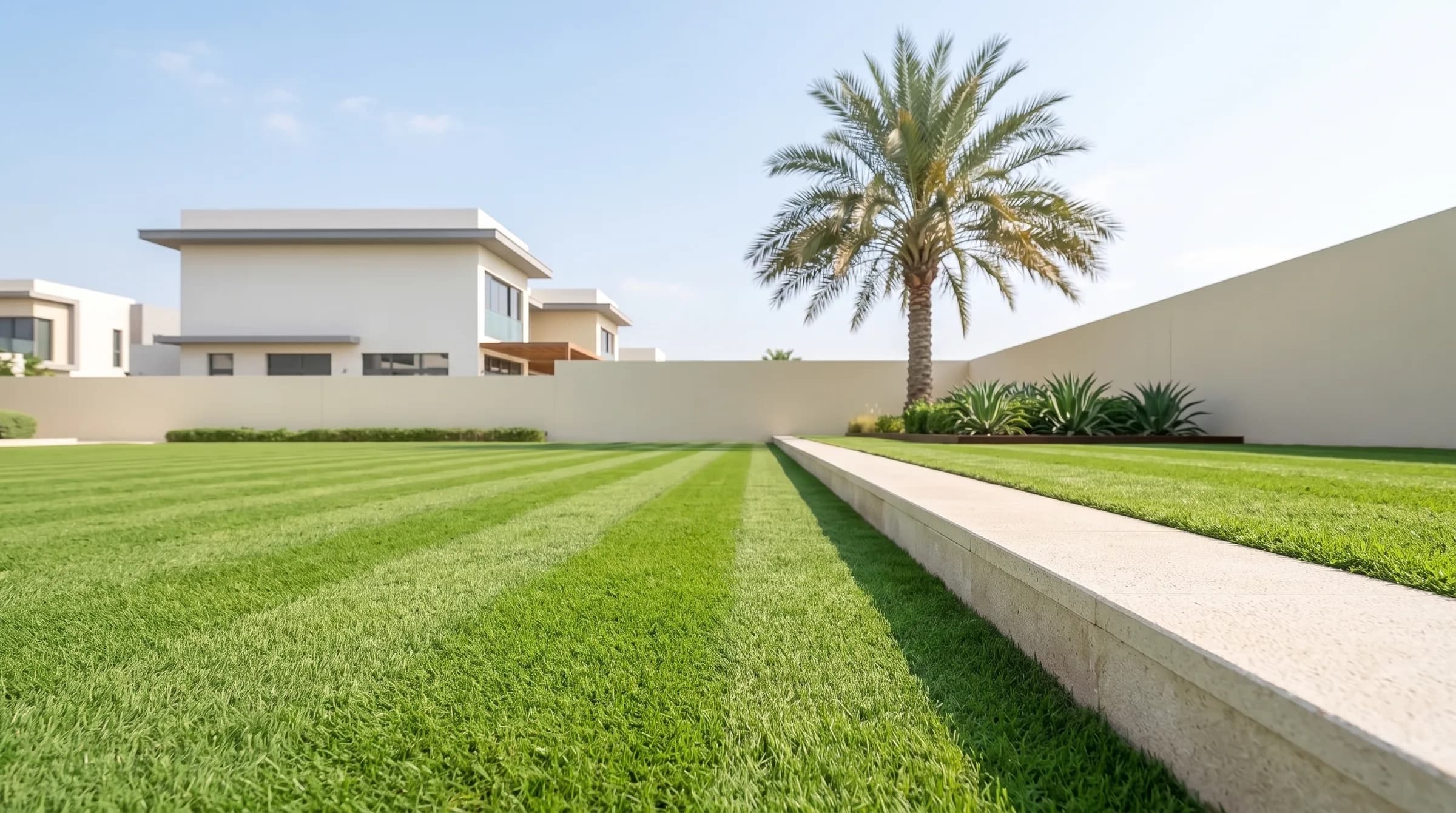
Meet bermuda grass, the plant underfoot in more Dubai gardens than any other single species. It doesn't have the individual drama of a specimen palm or a flowering climber — its whole job is to disappear into a flat, dense, walkable green surface — but it is doing genuinely hard work: absorbing ball games, barbecues, dog walks and bare feet in 45°C heat that would finish off almost any ornamental in this library.
Its character is resilient rather than fussy. Scuff it, mow it hard, let a table sit on it for a party — it recovers within weeks because it spreads both above and below ground, constantly rebuilding itself from stolons and rhizomes rather than depending on one vulnerable crown. That toughness is exactly why it became the region's default lawn, sold here simply as "American grass", rather than any more ornamental turf alternative.
What it brings to a garden's mood is openness — the uninterrupted, sunlit green that makes a villa garden feel like it has room to breathe, a space for the rest of the planting to frame rather than crowd. It asks for a genuine trade in return: full sun and decent water, or it simply won't hold that presence.
Bermuda grass is what most Dubai villa lawns are actually made of, sold locally as "American grass" and installed as turf rolls from most landscaping suppliers. It is dense, fine-to-medium bladed, spreads fast by both stolons and rhizomes, and recovers quickly from the scuffing of kids, dogs and garden furniture — which is why it is the standard choice for open lawns and play areas rather than ornamental borders.
Its weak point is water quality and light. A 2018 UAE University trial that compared bermuda and paspalum cultivars under increasingly saline irrigation water found paspalum kept a denser, higher-biomass turf at every salinity level tested, with bermuda falling further behind as the water got saltier — so on borewell, brackish or recycled water, Seashore paspalum is generally the better bet, with bermuda better suited to cleaner mains-quality irrigation. Bermuda also needs 6–8 hours of direct sun; under tree canopy it thins out fast.
It is a warm-season grass, and Dubai's winters — mild as they are — still slow it down. A season working golf courses noted that Dubai's bermuda fairways grow slowly through the cooler months, "nearly reaching dormancy", which is why courses overseed with ryegrass for a green winter playing surface. Home lawns are not dead in winter, just paler and slower; most Dubai gardens simply accept the seasonal fade rather than overseed.
Cultivars
Traits
Fine-textured, medium-to-dark green hybrid. Excellent wear tolerance and fast recovery; poor shade and salt tolerance. Cut below 25 mm.
Best for
Hard-wearing full-sun play lawns on clean mains water.
Atlas Turf lists it at Trump World Golf Club in Dubai and Saadiyat Beach in Abu Dhabi. High upkeep: it wants a reel mower and regular feeding.
Traits
Very fine, vibrant green University of Georgia hybrid. Bred for drought tolerance, with good wear tolerance and some shade tolerance.
Best for
Full-sun lawns where cutting water use matters.
Georgia trials found it used about 38% less water than Tifway; that is not a Dubai figure. Dubai Sports City began a 400 m2 trial against Princess 77 in late 2020.
Traits
Fine-leaved, dark blue-green. Cut at 25-50 mm with a rotary mower; tolerates slightly more shade and traffic than other bermudas.
Best for
Family lawns wanting hybrid quality with easier upkeep.
Bred in Australia and supplied internationally. We found no named UAE installation, so ask for local references.
Traits
Fine-textured, dark green hybrid bred for shade; University of Georgia reports it tolerates about 60% shade. Cut below 25 mm.
Best for
Bermuda lawns with partial shade where common bermuda thins.
A sterile triploid hybrid, laid as sod. No UAE installation found; trial a patch first.
Traits
Dense, fine, dark green seeded hybrid. Cut at 5-25 mm; drought and wear tolerant. Seed makes it cheaper to establish than sod.
Best for
Budget full-sun lawns grown from seed on mains-quality water.
Tested in the 2018 UAE University saline trial (with Yukon), where paspalum pulled ahead as salinity rose.
Design
Use it where it gets genuine, unobstructed sun for 6–8 hours a day and where its toughness underfoot actually matters — an open lawn, a play area, anywhere furniture, footballs or dogs are a regular feature. It needs decent-quality irrigation water to perform well, so it suits mains-quality supply better than a borehole or recycled-water setup. Edge beds and paving clearly, since its spreading runners will creep into neighbouring planting if left unchecked, and avoid it entirely under tree canopy or in a shaded courtyard, where it thins out regardless of care.
Seashore paspalum
The natural substitute on the same site when irrigation water turns brackish, since paspalum holds density better as salinity rises.

Zoysia grass
A shade-tolerant alternative for the parts of a garden bermuda can't cover, letting one property run both grasses in their respective sun and shade zones.

St Augustine grass
Another shade-tolerant option for courtyards and under-canopy areas, complementing bermuda's sun-loving open lawn elsewhere on the same property.
Care guide
Summer: Deep, infrequent watering early morning or evening is more effective than short daily bursts — DEWA recommends watering before 8am or after 6pm to cut evaporation losses.
Winter: Cut back sharply as growth slows; 1–2 waterings a week is usually enough once established.
Establishment: Keep new sod consistently moist for the first 2–3 weeks with light, frequent watering until it roots down.
Avoid these
Extra notes
FAQ
Not sure how it suits your garden?
Ask about Bermuda grass on WhatsAppKeep exploring
Seashore paspalum
Paspalum vaginatum
Zoysia grass
Zoysia matrella
St Augustine grass
Stenotaphrum secundatum
Desert grass
Pennisetum divisum
Sources
Last reviewed 2026-09-30 by Ghaf Gardens horticulture desk.
Pool + garden care
From AED 500/month
Price depends on your garden's size, pool and complexity. Prices in AED, excluding 5% VAT.