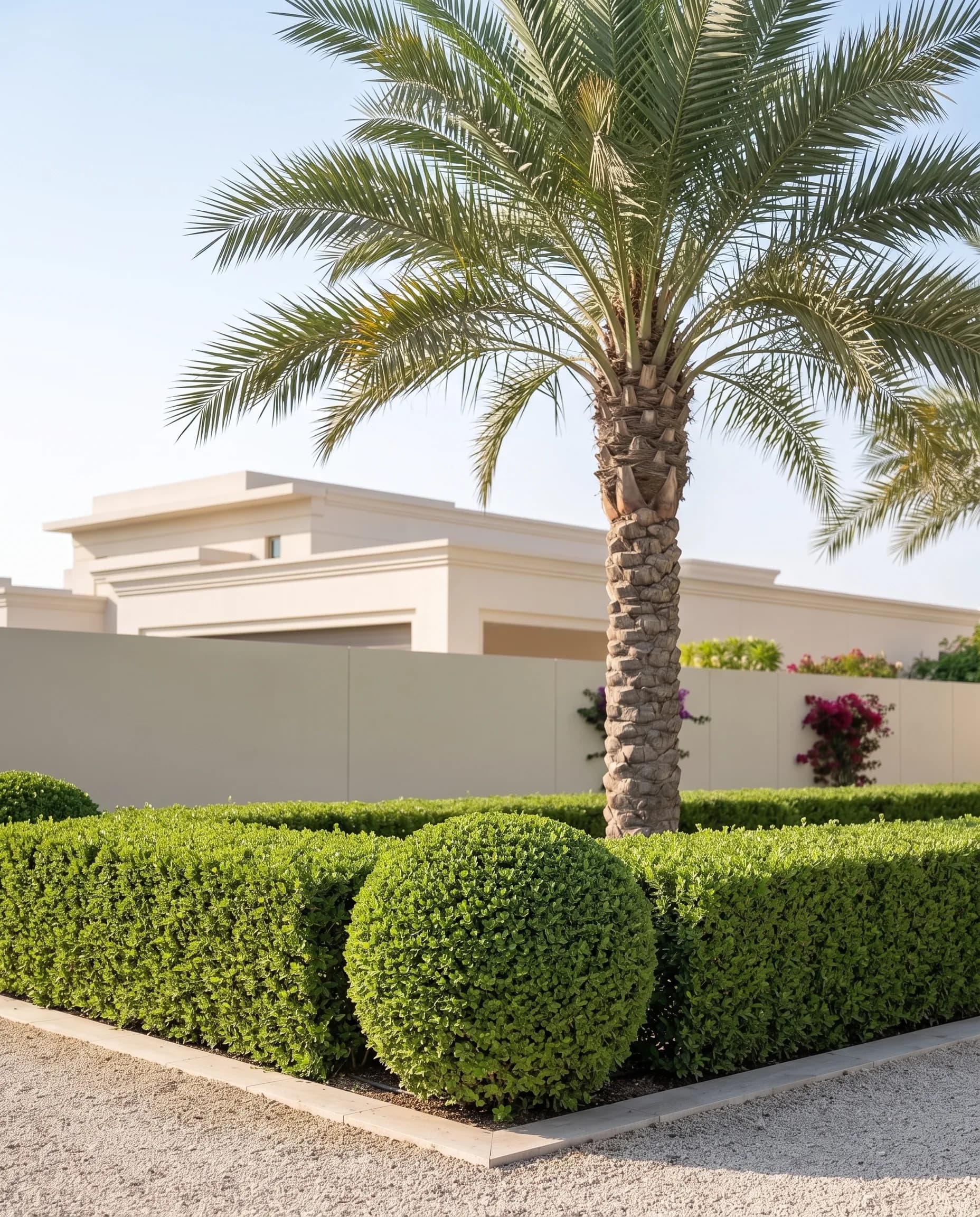

Bermuda grass
Cynodon dactylon
Full sunSalt: 3 of 5
Adapted
Paspalum vaginatum
باسبالم
A fine-bladed warm-season lawn grass that shrugs off saline irrigation water better than any other turf sold in the UAE, but needs full sun to stay dense.
See it planted
Season
How Seashore paspalum behaves through Dubai's seasons, month by month.
Best turf-laying window
Main feeding season
Autumn renovation
Peak summer heat
Winter slowdown
Best turf-laying window: Mar–May, Sep–Nov
Lay sod in the shoulder seasons so roots knit down before peak summer heat or the slower winter growth period.
Main feeding season: Oct–Feb
Low fertility needs compared with bermuda; a light feed through the cooler months is usually enough.
Autumn renovation: Oct
Dethatch, top-dress and patch bare spots rather than oversowing — paspalum's dense growth habit already crowds out winter weeds.
Peak summer heat: Jun–Aug
Handles Dubai summer well once established; watch for rolling leaf blades and footprints that don't spring back as a sign it needs water.
Winter slowdown: Dec–Jan
Growth and colour hold up better through cooler months than bermuda, though mowing frequency drops.
Seashore paspalum holds better colour through a Dubai winter than most warm-season grasses, staying green with only a modest slowdown in growth from December to February, so mowing frequency drops but the lawn rarely looks dormant. Spring and autumn are the main turf-laying and renovation windows, with growth ramping up as temperatures rise. Through peak summer heat it grows vigorously in full sun, needing attentive but not excessive watering — rolling leaf blades or a dull blue-grey tinge are the visual cue to irrigate. Its main visual risk is not season but shade: any spot losing direct sun for much of the day will thin out regardless of time of year.
Meet the plant
Meet seashore paspalum, the lawn grass that was practically written for Dubai's water. Most turf grasses tolerate a little salt before thinning and browning; this one keeps its dense, fine, dark green cover at salinity levels that would finish off almost anything else sold as a lawn here. It doesn't look tougher up close — the blades are fine, soft underfoot and genuinely attractive — but under the surface it is doing real physiological work to manage salt that most grasses simply cannot.
That resilience is what earns it a place right at the water's edge: around a pool, along a beachfront terrace, or on a villa irrigated with a borewell or treated wastewater supply that would slowly kill a less tolerant lawn. In full sun it knits into a crowded, weed-resistant sward that reads as a uniform dark green carpet rather than individual blades.
The mood it creates is precise rather than relaxed — a crisp, saturated green that looks sharpest kept mown short and regular, which is exactly the look most Dubai villa and pool-deck lawns are going for.
Seashore paspalum is the grass Dubai reaches for when the water is the problem. A 2018 trial at the United Arab Emirates University compared Sea Dwarf and Sea Isle 2000 paspalum against Princess 77 and Yukon bermuda under irrigation water salted up to 10,000 ppm — roughly a third of seawater. The paspalum types kept higher shoot density and more biomass than the bermudas at every salinity level, and the gap widened as the water got saltier. In practice that means paspalum is the safer pick on a borewell, recycled (TSE) or brackish water supply, while bermuda is fine on cleaner mains water.
It is sold in the UAE as turf rolls or sprigs, often under the local trade name "Sharjah grass" (bermuda has its own trade name here too — see American grass), and is popular right up to pool edges and beachfront gardens where salt spray and saline soil kill weaker lawns. The trade-off is light: University of Florida extension guidance is blunt that seashore paspalum has poor shade tolerance and should not be planted under a tree canopy or anywhere air circulation is poor — it thins out and becomes prone to fungal patch disease in those spots.
Grown correctly — full sun, mowed short and regularly, watered on an as-needed basis rather than a fixed schedule — it forms a dense, dark green, fine-textured lawn that resists weeds simply by crowding them out. It pairs naturally with Date Palm and other salt-tolerant plantings in villa gardens that use greywater or brackish groundwater for irrigation.
Against the other two turf-roll grasses sold in the UAE, the comparison is straightforward on paper: paspalum leads decisively on salinity, sits roughly level with bermuda on heat and wear tolerance, and loses badly on shade to both zoysia and St Augustine. For a sunny villa lawn irrigated with anything other than clean mains water, that combination usually settles the choice on its own.
Cultivars
Traits
Very fine, glossy dark green blade with a dense canopy. High salt tolerance and good low-light performance; cut from 2 to 76 mm.
Best for
Premium pool-side and coastal lawns on TSE, borewell or brackish water.
Atlas Turf lists it at Dubai Hills Golf Club, Yas Island Links and Al Zorah in Ajman, and on the greens at Emaar South.
Traits
Semi-dwarf, fine-bladed, dark green. Bred at the University of Georgia for superior salt tolerance; tolerates many cutting heights.
Best for
Sunny sites irrigated with brackish or recycled water.
Patented and sold only as certified sod or sprigs. We found no named UAE installation, so ask suppliers for local references.
Traits
Medium-fine, bright green, dwarf habit. Dense turf that tolerates very low cutting and saline irrigation.
Best for
Dense, closely mown lawns on saline irrigation.
One of two paspalum cultivars in the 2018 UAE University saline-irrigation trial; paspalum types had the highest shoot counts and biomass.
Traits
Darker green than bermuda and highly salt tolerant. Tolerates low light and low cutting; recovers quickly from wear.
Best for
Family lawns and sports turf on salty water, in sun or light shade.
Tested alongside SeaDwarf in the 2018 UAE University trial, where paspalum types beat bermuda on shoot density.
Traits
Seeded paspalum, tightly dense, dark green and upright. Excellent salt tolerance; the supplier rates its shade tolerance as very good.
Best for
Large areas where seed is cheaper to establish than sod or sprigs.
Atlas Turf lists it at Dubai Hills, Saadiyat Beach, Ahli Soccer Club (Dubai) and, with Platinum TE, on the fairways at Emaar South.
Design
Reserve seashore paspalum for open, sunny ground with no significant tree canopy — its one real weakness is shade, and it will thin and thatch anywhere air circulation is poor. It earns its premium price right where salt is unavoidable: close to a saltwater pool, near the coast, or on a villa plot irrigated from a borewell or treated wastewater supply where a bermuda lawn would slowly decline. Keep it well clear of dense shade trees; if the garden needs both a sunny lawn and a shaded one, pair it with a more shade-tolerant grass in the shaded zone rather than trying to stretch one lawn across both conditions.
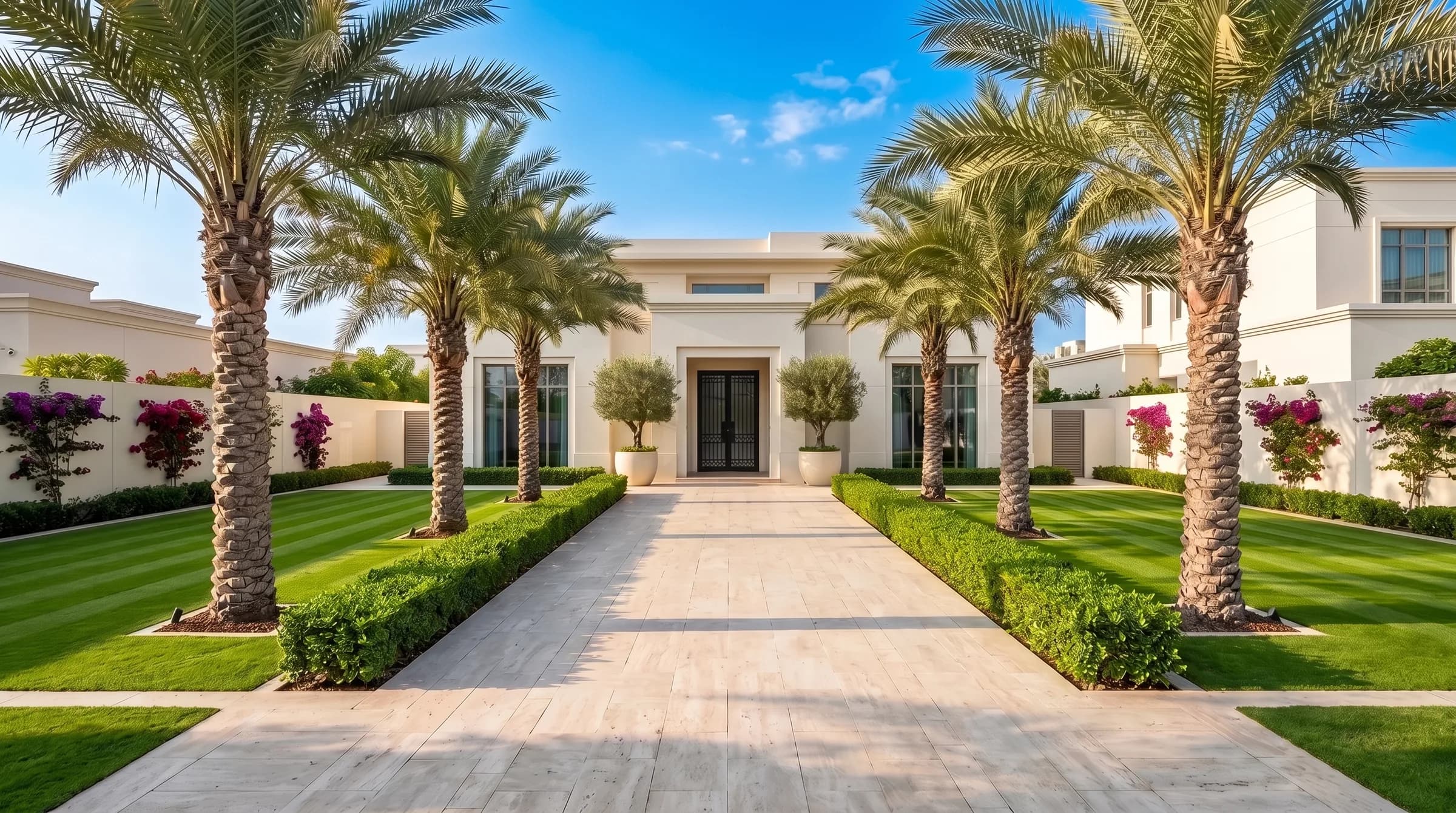
Date Palm
Date palm's high salt and drought tolerance matches paspalum's own, so both thrive on the same brackish irrigation supply without conflict.
Bermuda grass
Where part of a plot has cleaner mains water and part has saline groundwater, splitting the lawn between bermuda and paspalum lets each zone use the grass suited to its own water source.

Zoysia grass
Zoysia can take over in the one shaded corner where paspalum would thin out, giving a consistent lawn look across sun and part-shade areas.

Hibiscus
Hibiscus beds at the lawn edge bring flower colour without encroaching on the open, full-sun conditions paspalum needs to stay dense.
Care guide
Summer: Water as needed rather than on a fixed timer — rolling leaf blades, a dull blue-grey tinge or footprints that stay pressed in are the signs to irrigate. As a general guide, Abu Dhabi's municipal irrigation standards call for around 20 litres/m²/day for turf-type planting in summer, tapering off outside the hottest months.
Winter: Cut back sharply; established paspalum on decent soil often needs irrigation only every 7–10 days in the cooler months.
Establishment: Keep new sod moist with light, frequent watering for the first 2–3 weeks until roots knit into the soil.
Avoid these
Extra notes
FAQ
Not sure how it suits your garden?
Ask about Seashore paspalum on WhatsAppKeep exploring
Bermuda grass
Cynodon dactylon
Zoysia grass
Zoysia matrella

St Augustine grass
Stenotaphrum secundatum
Desert grass
Pennisetum divisum
Sources
Last reviewed 2026-09-30 by Ghaf Gardens horticulture desk.
Pool + garden care
From AED 500/month
Price depends on your garden's size, pool and complexity. Prices in AED, excluding 5% VAT.