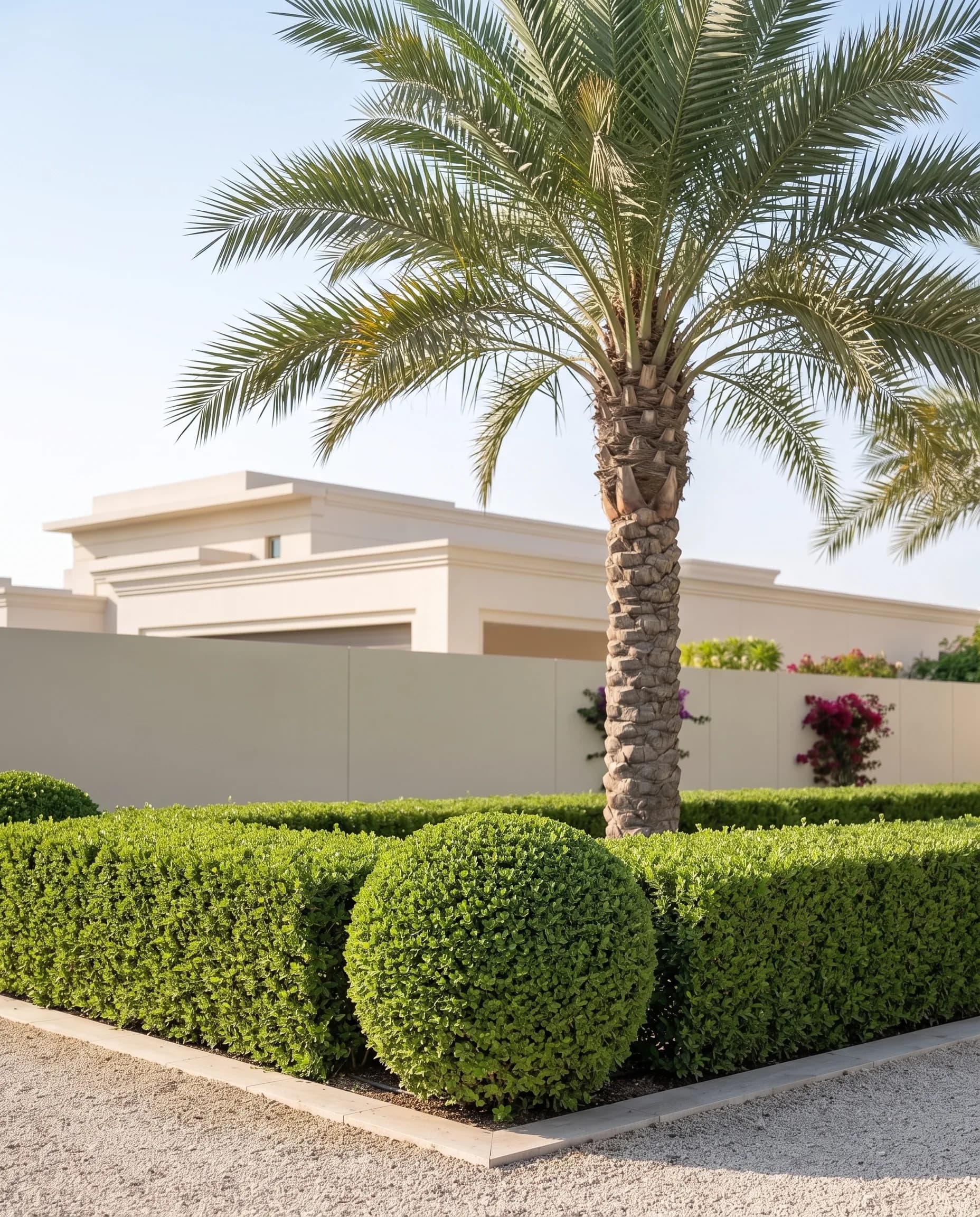

Ghaf
Prosopis cineraria
Full sunSalt: 4 of 5
Native
Olea europaea
زيتون
A Mediterranean tree built for heat, drought and poor soil, now a sought-after specimen for Dubai villa gardens — though most UAE-grown trees are prized for their silvery form rather than a reliable harvest.
See it planted
Season
How Olive behaves through Dubai's seasons, month by month.
Best planting window
Small, creamy-white, lightly fragrant flowers
Fruit forms and ripens from green to purplish-black
Olive harvest
Formative and maintenance pruning
Best planting window: Oct–Feb
Small, creamy-white, lightly fragrant flowers: Mar–May
Fruit forms and ripens from green to purplish-black: Jun–Sep
Olive harvest: Oct–Nov
Yield and reliability in Dubai depend on winter chill and cultivar; expect a light or uneven crop compared with a true Mediterranean climate.
Formative and maintenance pruning: Feb–Mar
Prune after the coldest weather has passed and before spring flowering.
Olive holds its narrow, silver-green leaves year-round, so its calendar is a matter of small changes rather than dramatic ones. Small, creamy-white, lightly fragrant flowers appear in spring, followed by fruit that sets in early summer and slowly ripens from green through purplish-black by autumn. Harvest, where a tree fruits well enough to bother, falls in October and November, though in Dubai's mild winters the crop is often light or patchy rather than heavy. Through it all the silvery canopy itself barely changes, giving the same sculptural, gently shifting texture in January as in July.
Meet the plant
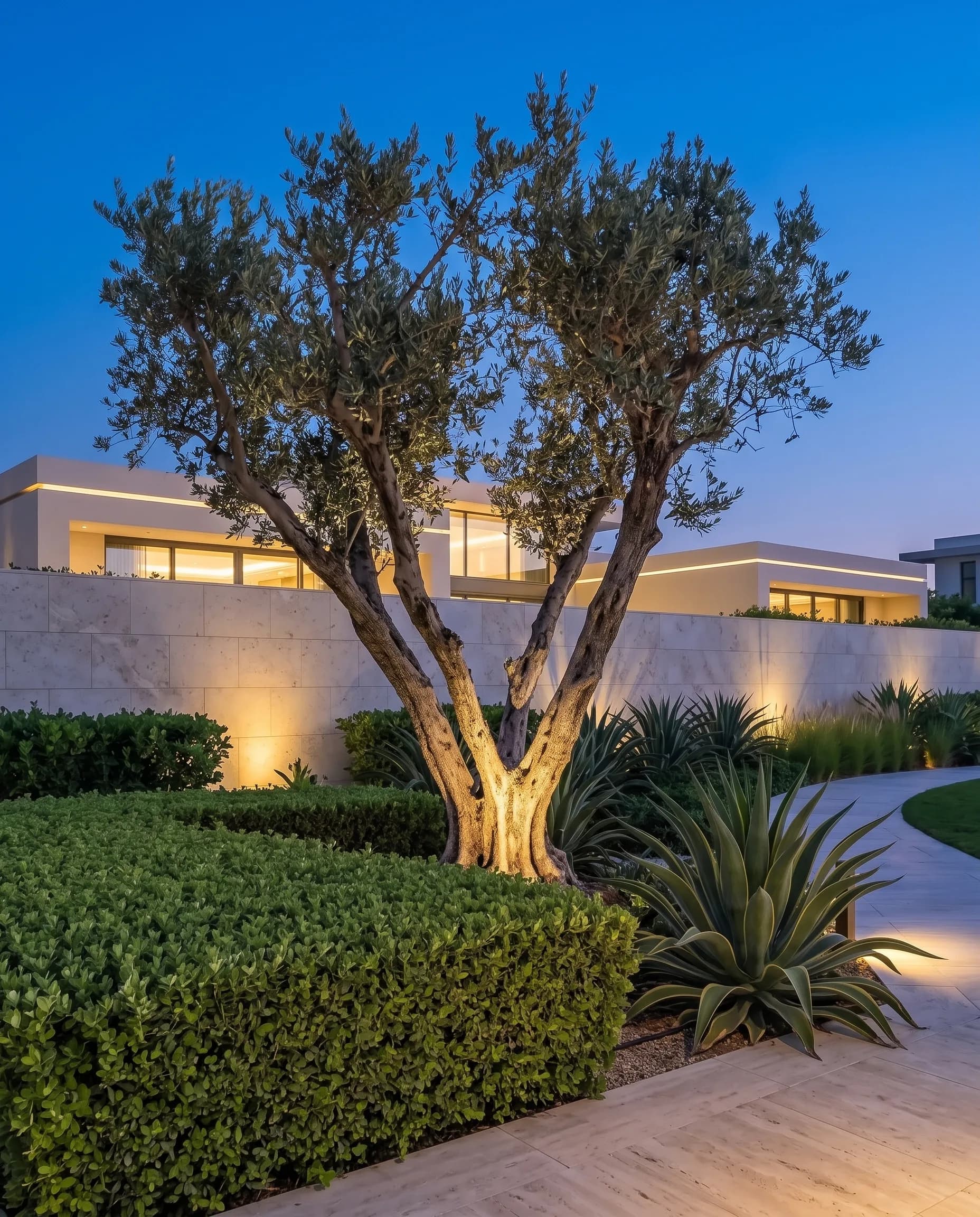
Meet the olive tree, a plant whose value in a Dubai garden has almost nothing to do with speed. Where most trees on this list earn their place by growing fast and filling space, an olive earns it by already looking like it has been there for generations — a gnarled, twisting trunk and fine, silver-green foliage that read as age and permanence even on a tree planted last year, which is exactly why centuries-old specimens have been imported whole into premium developments here rather than grown from scratch.
Its character shifts with the light in a way few evergreens manage: the undersides of its narrow leaves are a paler, almost grey silver, so a breeze through the canopy flickers the whole tree between green and silver rather than simply rustling it. That quiet, shifting texture gives a courtyard or entrance a Mediterranean gravitas that a broader, solid-green canopy cannot match, and it holds that look through every month of the year without ever going bare.
Dubai's climate suits the tree itself far better than it suits a genuine harvest — the mild winters rarely deliver enough chill for heavy fruiting, so most local olives are grown and valued for form rather than oil or table olives, a trade most owners are glad to make for a tree this low-maintenance and long-lived.
Olea europaea evolved in the hot, dry summers and rocky, alkaline soils of the Mediterranean basin, conditions that map closely onto Dubai's climate. It has become one of the most requested specimen trees in Dubai villa landscaping, valued for its gnarled trunk, silver-green foliage and sense of instant maturity: mature and even centuries-old olive trees have been imported and replanted in high-end Dubai and Abu Dhabi developments.
In a garden it wants full sun and sharp drainage, tolerates the UAE's sandy alkaline soil without complaint, and needs very little water once established. Flowering and fruiting depend on a period of cool winter temperatures ('chill hours') that Dubai's mild winters only partially provide, so home-grown trees may flower and fruit lightly or unevenly compared with a true Mediterranean climate; low-chill, self-fertile cultivars such as 'Arbequina' are more likely to fruit reliably in hot climates like this one.
One technical detail worth knowing before planting an avenue or several specimens near a terrace: olive pollen is a recognised, fairly potent seasonal allergen, most abundant in the air roughly from April to July in warm climates. It's rarely a reason to avoid a single specimen, but worth a thought for anyone in the household with pollen allergies before committing to a whole row.
It works as a single specimen, in a row as a soft screen, or clipped as formal hedging in a manicured or desert-modern scheme, and pairs naturally with Rosemary and other Mediterranean herbs at its base. Young trees need protection and regular water while establishing, after which maintenance drops right off.
Design
Olive works as a single sculptural specimen framing an entrance or courtyard, planted in a formal row along a drive, or clipped into hedging in a manicured or desert-modern scheme — its silvery, fine-textured form holds its own whether treated as a feature or as structure. Give it full sun and sharp drainage, and keep it out of a lawn's daily irrigation zone, since constantly wet soil around the root collar works against a tree built for dry Mediterranean summers. Underplant with low, equally drought-tolerant herbs rather than moisture-loving bedding.

Rosemary
Rosemary shares the same Mediterranean origin and dry, sunny needs, making it a natural underplanting at the base of an olive specimen.
Ghaf
Both are slow-growing, long-lived trees suited to a desert-modern scheme built around restraint rather than fast, lush growth.
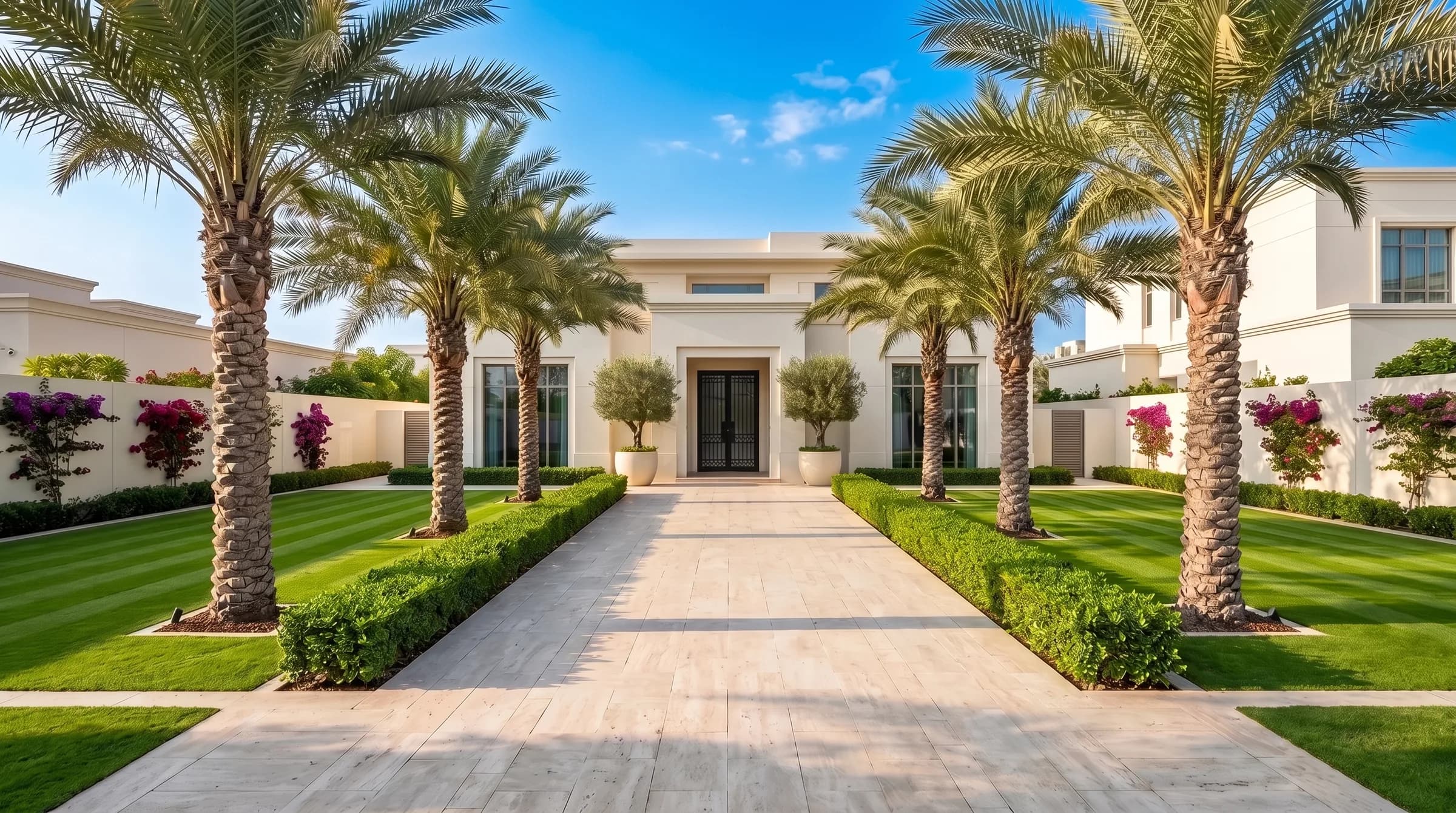
Date Palm
The vertical line of a date palm against the rounded, silvery mass of an olive gives a Mediterranean-desert planting contrasting tree forms without competing for the same root-zone moisture.
Care guide
Summer: Deep-water every 7–10 days once established; more frequent light watering encourages shallow roots and works against the tree's drought tolerance.
Winter: Minimal, beyond occasional rain.
Establishment: Water two to three times a week for the first year or two.
Avoid these
Extra notes
Toxicity: Not known to be toxic. Raw olives straight from the tree are simply too bitter to eat and need curing first.
FAQ
Not sure how it suits your garden?
Ask about Olive on WhatsAppKeep exploring
Sources
Last reviewed 2026-09-30 by Ghaf Gardens horticulture desk.
Pool + garden care
From AED 500/month
Price depends on your garden's size, pool and complexity. Prices in AED, excluding 5% VAT.
