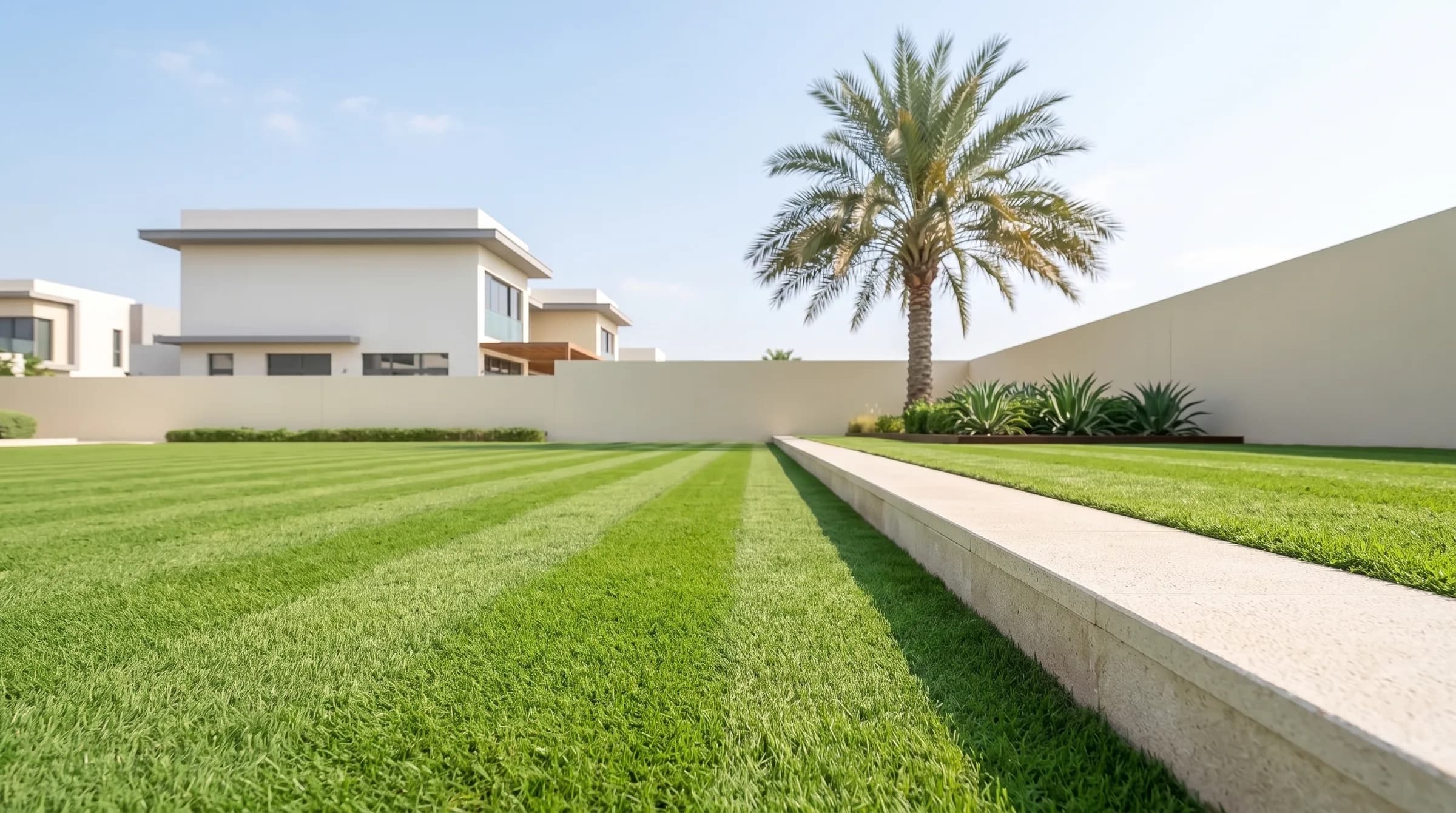
Planting
Paspalum vs Bermuda grass: which lawn suits your Dubai garden?
Paspalum, often sold locally as "Sharjah grass", handles shade and salty irrigation water better than Bermuda, sold as "American grass", which is usually cheaper to install and tougher in full sun.
Updated 29 Sept 2026 · 5 min read
On this page
The short answer
If your lawn gets part-shade from trees or a boundary wall, or your irrigation water runs salty or brackish, paspalum is the safer bet. If your lawn is in full, open sun and you want the lowest install cost, Bermuda usually wins. Both are warm-season grasses bred for exactly this kind of climate — neither is a bad choice, and the right one depends on your specific garden more than a general ranking. You can also browse all Dubai lawn grasses side by side.
Same grasses, different names on a delivery note
In the Dubai trade, paspalum (Seashore paspalum, Paspalum vaginatum) is very commonly sold as "Sharjah grass", and Bermuda (Bermuda grass, Cynodon dactylon) is sold as "American grass". Neither name marks a different species — they're local trade names, not botanical ones — but it's worth confirming the botanical name on your delivery note or supplier quote, since the trade names aren't used with perfect consistency across nurseries.
What UAE University found
A UAE University trial, run by its Department of Aridland Agriculture, compared Bermuda and paspalum cultivars under rising irrigation salinity. Paspalum types held up better as salinity increased — they kept higher shoot density and succulence than the Bermuda cultivars tested, with one paspalum cultivar reaching a shoot density of over 55,000 shoots per m². Bermuda cultivars kept higher chlorophyll content under high salinity, but the researchers concluded paspalum has the edge for turf quality once salinity is a factor — which it often is in Dubai, where irrigation water can be a blend of desalinated and groundwater sources (UAE University; Journal of Plant Nutrition).
Side by side
| Paspalum ("Sharjah grass") | Bermuda ("American grass") | |
|---|---|---|
| Salinity tolerance | High — bred for brackish and coastal irrigation | Moderate — best with cleaner irrigation water |
| Shade tolerance | Tolerates real part-shade | Needs close to full sun to stay dense |
| Underfoot feel | Softer, broader blade | Fine-bladed, wiry |
| Traffic tolerance | Good | Very good — the usual choice for heavy play areas |
| Typical install cost | Often quoted at or slightly above Bermuda | Usually the cheapest natural lawn to install |
| Mowing height | Slightly higher cut tolerated | Can be cut very low for a tight, manicured look |
Water and salinity in practice
Both grasses are far more drought- and salt-tolerant than cool-season lawns such as fescue or ryegrass — that's exactly why they're the two default lawns across the UAE. Paspalum's specific advantage shows up when irrigation water is on the saltier side, which is common where groundwater or a blend feeds the irrigation line rather than pure desalinated supply. In a fully shaded courtyard, though, both grasses thin out over time; at that point a shade-tolerant groundcover or artificial turf is usually a better fit than either.
Neither fully goes dormant here
Both are warm-season grasses that slow down and can lose some colour on Dubai's cooler winter nights, but winters here rarely get cold enough for either to brown off completely the way they would in a temperate climate.
Installation cost
Installed natural turf in Dubai — either grass — typically lands in a similar broad band once soil preparation, delivery and laying are included, commonly around AED 35–60 per m² for a standard villa lawn. Get quotes for your specific area, since site prep such as levelling, soil replacement and drainage can move the total more than the grass choice itself. Whichever you choose, budget for the same ongoing care: regular mowing, seasonal feeding, and a lawn-sized irrigation system rather than one designed for planting beds.
55,000+
shoots/m² for the top-performing paspalum cultivar in UAEU's trial
UAE University
AED 35–60/m²
typical installed cost for either grass, Dubai market
A quick decision guide
- Full sun, open lawn, budget-conscious install: lean Bermuda.
- Part-shade from trees, walls or a pergola: lean paspalum.
- Irrigation water known or suspected to be brackish: lean paspalum.
- Poolside lawn that regularly gets splashed: lean paspalum.
- Heavy foot traffic, kids or pets, full sun: either works, with a slight edge to Bermuda.
- Want the tightest, most manicured cut: lean Bermuda.
Where zoysia and St Augustine fit in
Paspalum and Bermuda are the two workhorse choices in Dubai, but they're not the only lawn grasses used here. Zoysia grass gives a denser, finer-textured lawn than either but is slower to establish and generally costs more to install. St Augustine grass tolerates more shade than Bermuda but is less traffic-tolerant and less common in the local trade, which can make sourcing and matching replacement turf harder later. For most villa gardens, the paspalum-versus-Bermuda choice above will get you most of the way there; treat zoysia and St Augustine as specialist options for a specific problem, such as heavier shade than paspalum comfortably handles.
Keeping either lawn looking its best
Both grasses benefit from an annual or twice-yearly renovation: scarifying or dethatching to remove the build-up of old runners, top-dressing with sandy soil, and overseeding or plugging thin patches, ideally timed to the cool season so new growth has mild weather to establish in. Skipping this for a few years is the most common reason a once-good Dubai lawn starts to look patchy and tired, regardless of which grass it started as.
Switching from one to the other
It's possible to convert an existing lawn from Bermuda to paspalum or back, but it's rarely as simple as overseeding on top — the incumbent grass usually needs to be killed off and largely removed first, since both spread aggressively by runners and will fight for the same ground otherwise. In practice, most conversions happen as part of a broader relandscaping project rather than as a standalone job, which is the point at which it's worth reassessing shade, salinity and traffic for the space and choosing accordingly, rather than defaulting to whatever was there before.
Compare all four Dubai lawn grasses
Seashore paspalum
Paspalum vaginatum

Bermuda grass
Cynodon dactylon

Zoysia grass
Zoysia matrella

St Augustine grass
Stenotaphrum secundatum
Pool + garden care
From AED 500/month
Price depends on your garden's size, pool and complexity. Prices in AED, excluding 5% VAT.
Frequently asked
Is Sharjah grass the same as paspalum?
Can Bermuda grass handle a pool-side lawn?
Which grass needs less water?
Can I mix the two in one garden?
Sources
Written by Ghaf Gardens horticulture desk · last reviewed 29 Sept 2026
Related guides
Costs & water
Artificial vs natural grass in Dubai: the 10-year cost, worked out
Natural grass costs less to install but keeps adding to your water bill every year; artificial turf costs more upfront but barely touches it. Here's a worked 10-year comparison for a 100 m² lawn.
29 Sept 2026 · 5 min read
Costs & water
Watering your garden through a Dubai summer
Water before 8am or after 6pm, favour drip over spray, and expect new planting to need far more water than anything established — plus what it actually costs on your DEWA bill.
29 Sept 2026 · 5 min read
Planting
The UAE planting calendar: what to plant in Dubai, month by month
Dubai's growing year runs backwards from Europe's: October to March is the cool season and the busy planting window, while April to September is mostly about keeping things alive.
29 Sept 2026 · 5 min read
Pool + garden care
From AED 500/month
Price depends on your garden's size, pool and complexity. Prices in AED, excluding 5% VAT.