Luxury
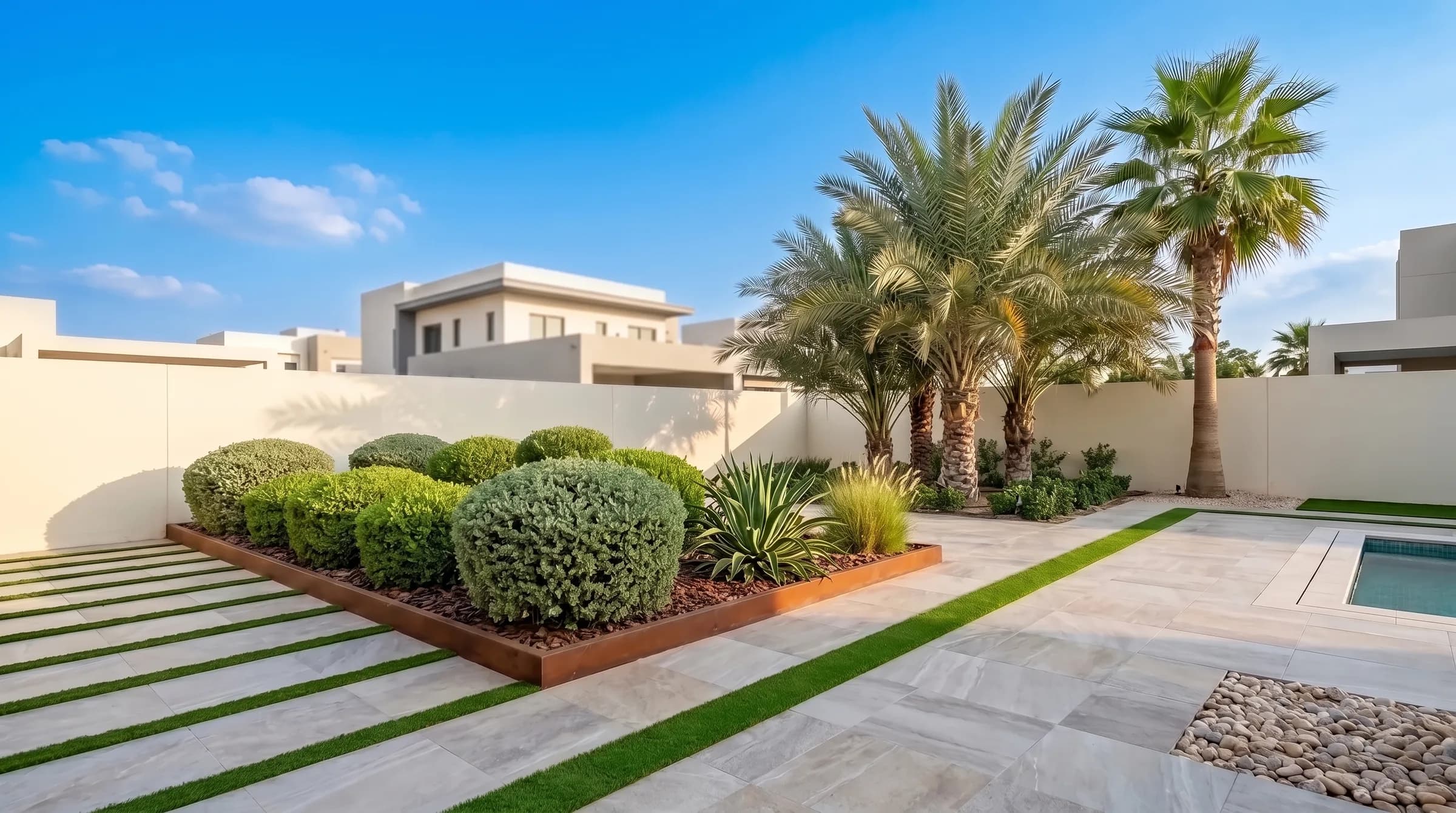
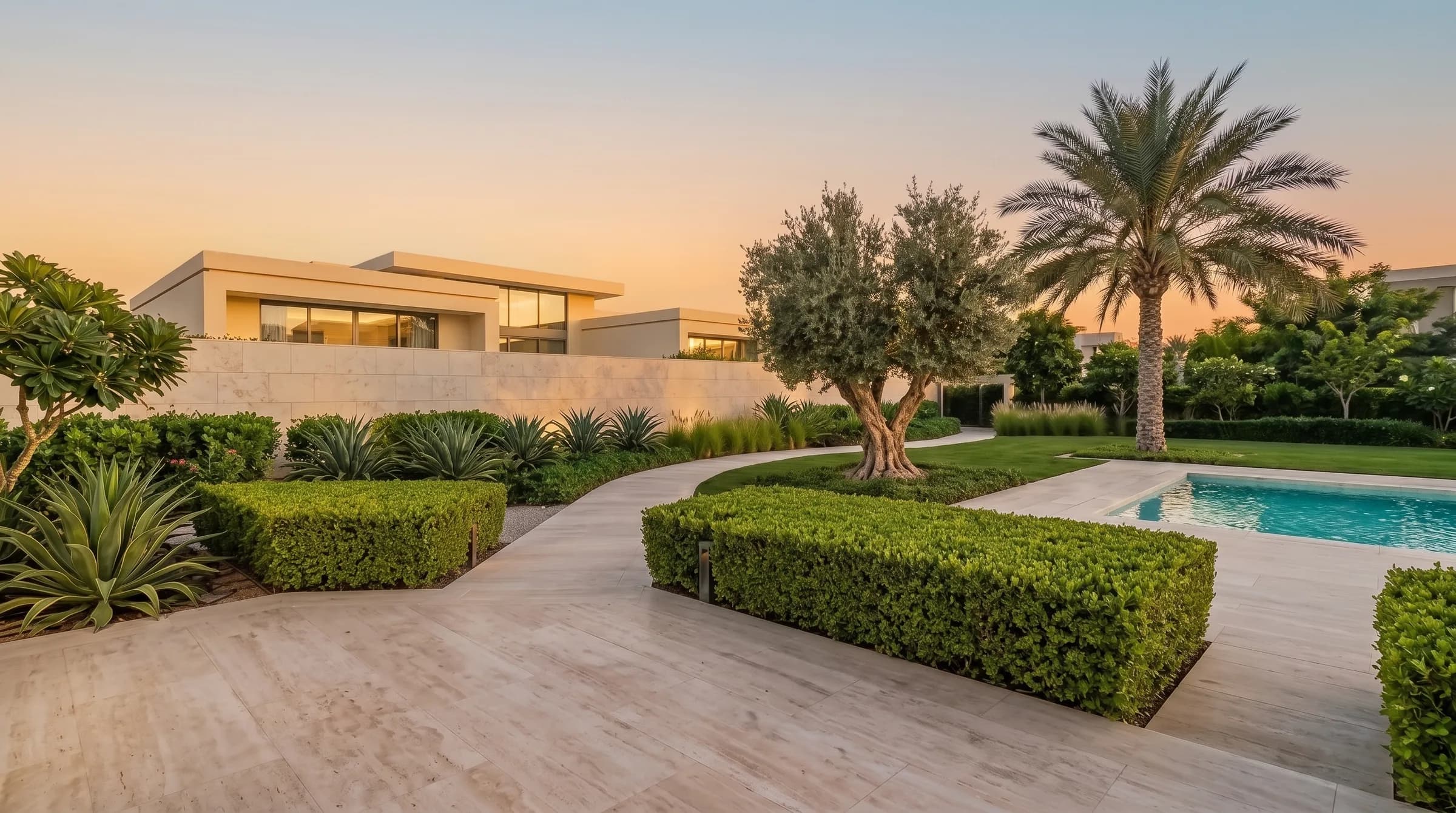
Good lighting, real stone, and hedges cut to a line.
Walk through the garden
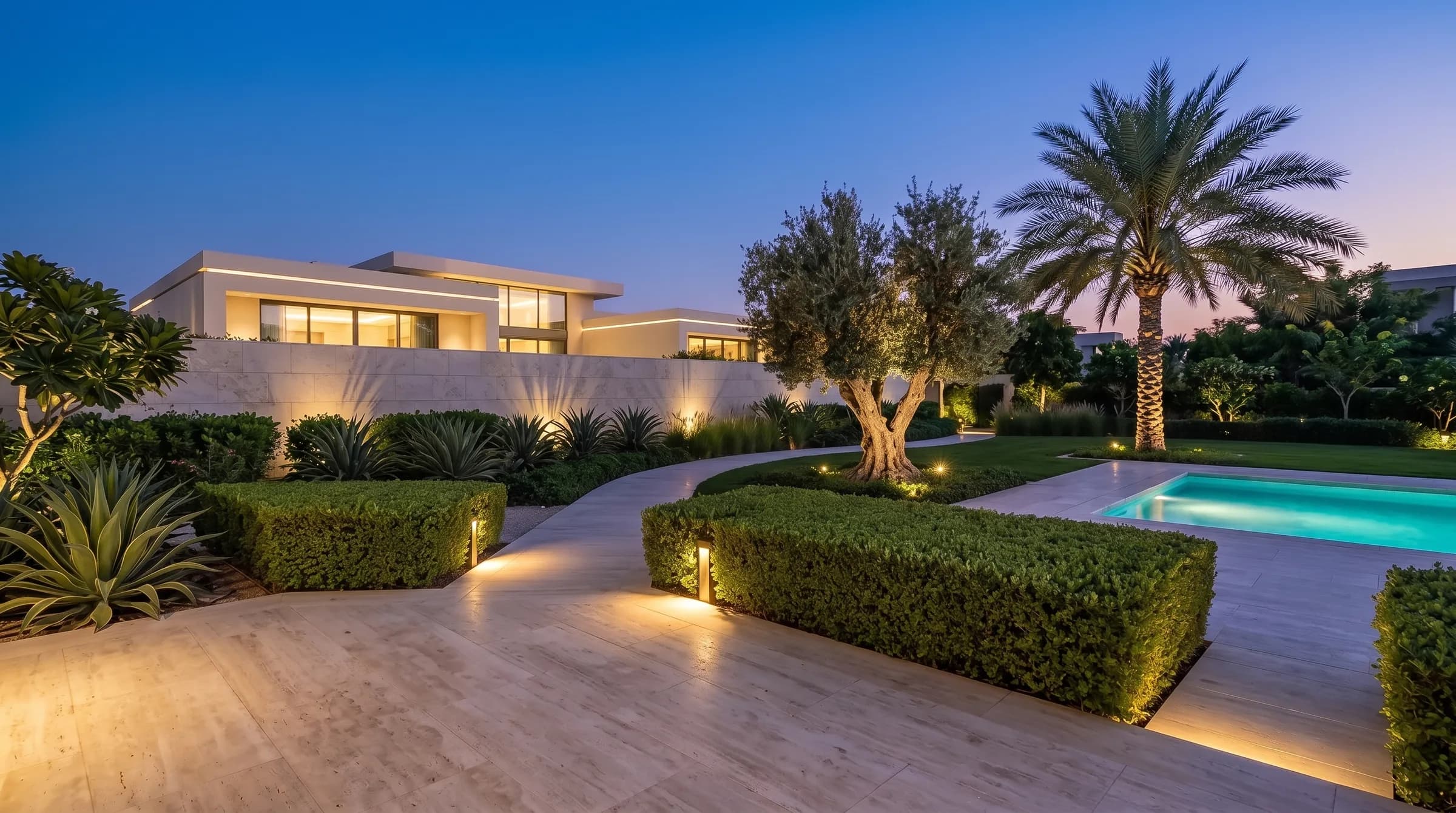
Stone and light, layered after dark.
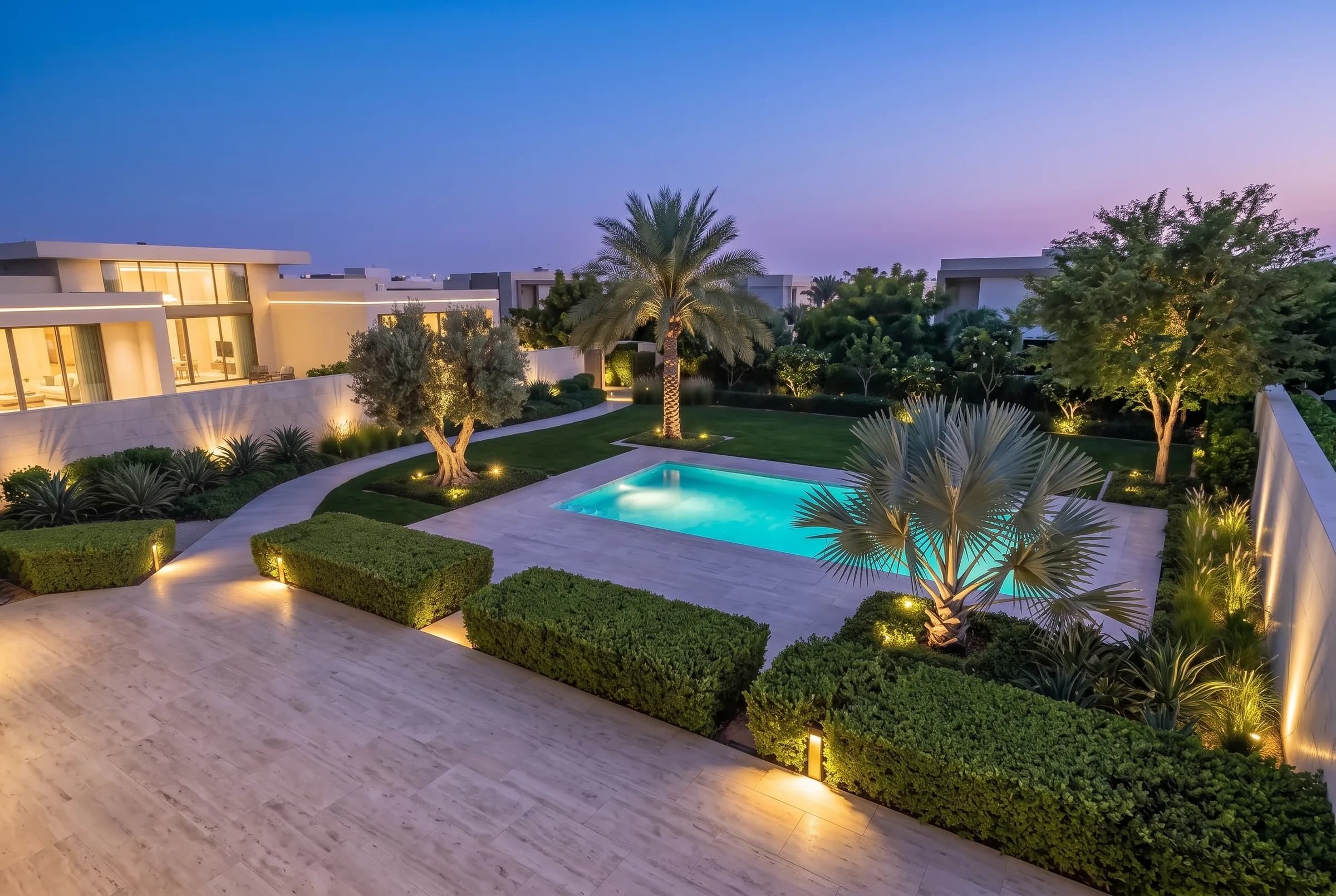
Lit stone, pool and clipped hedges carry the garden after dark.
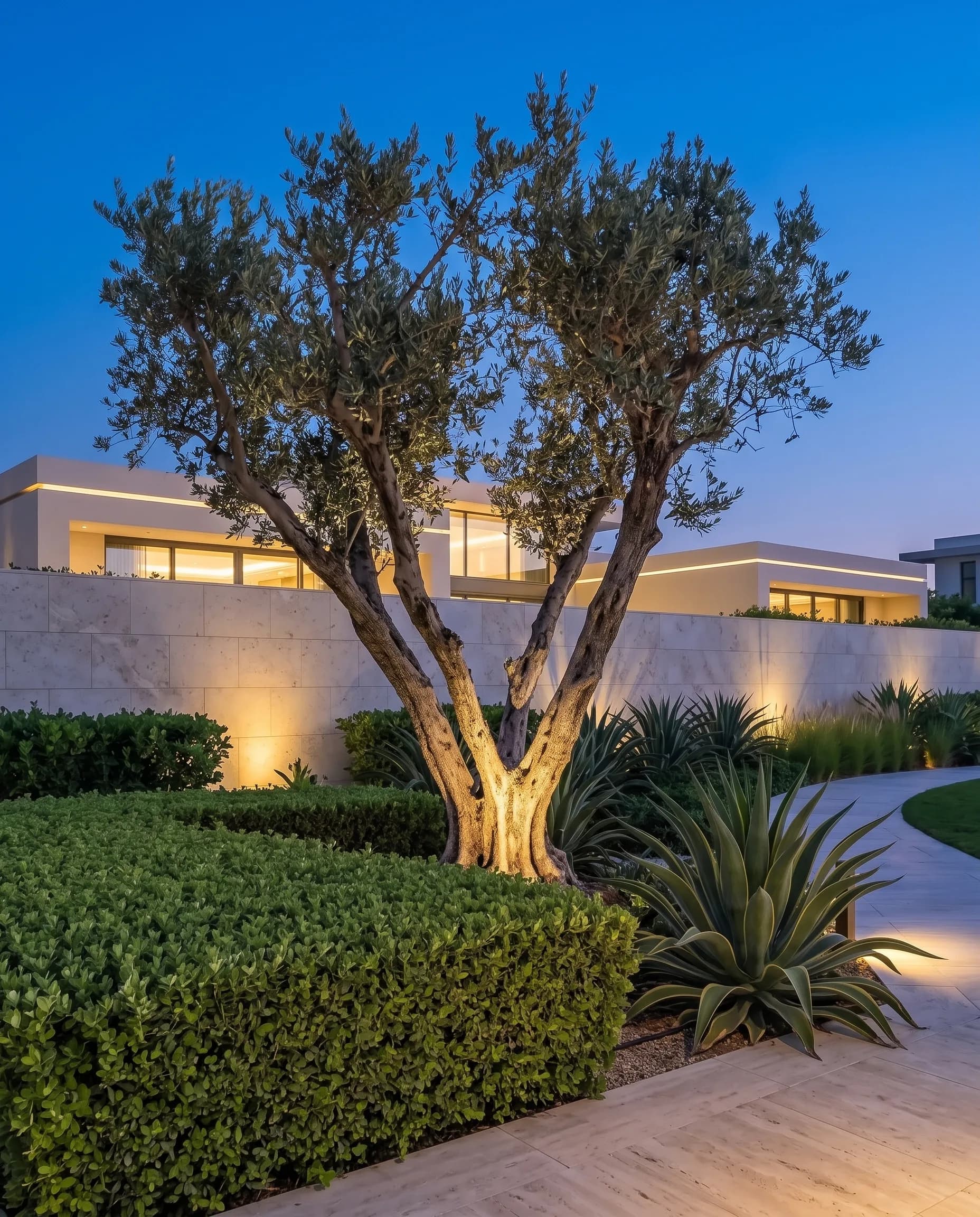
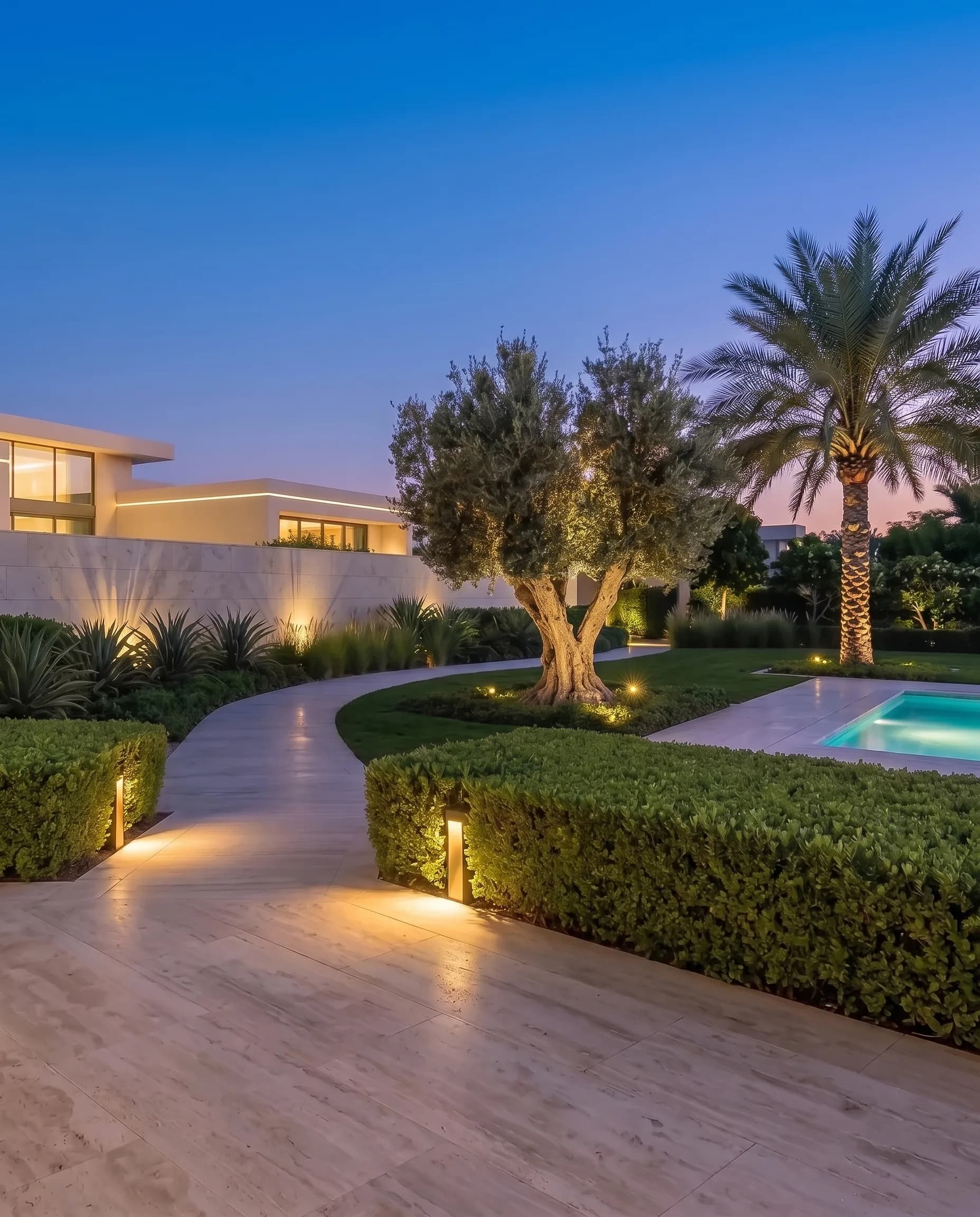
A sculptural olive, uplit against a hard-edged hedge.
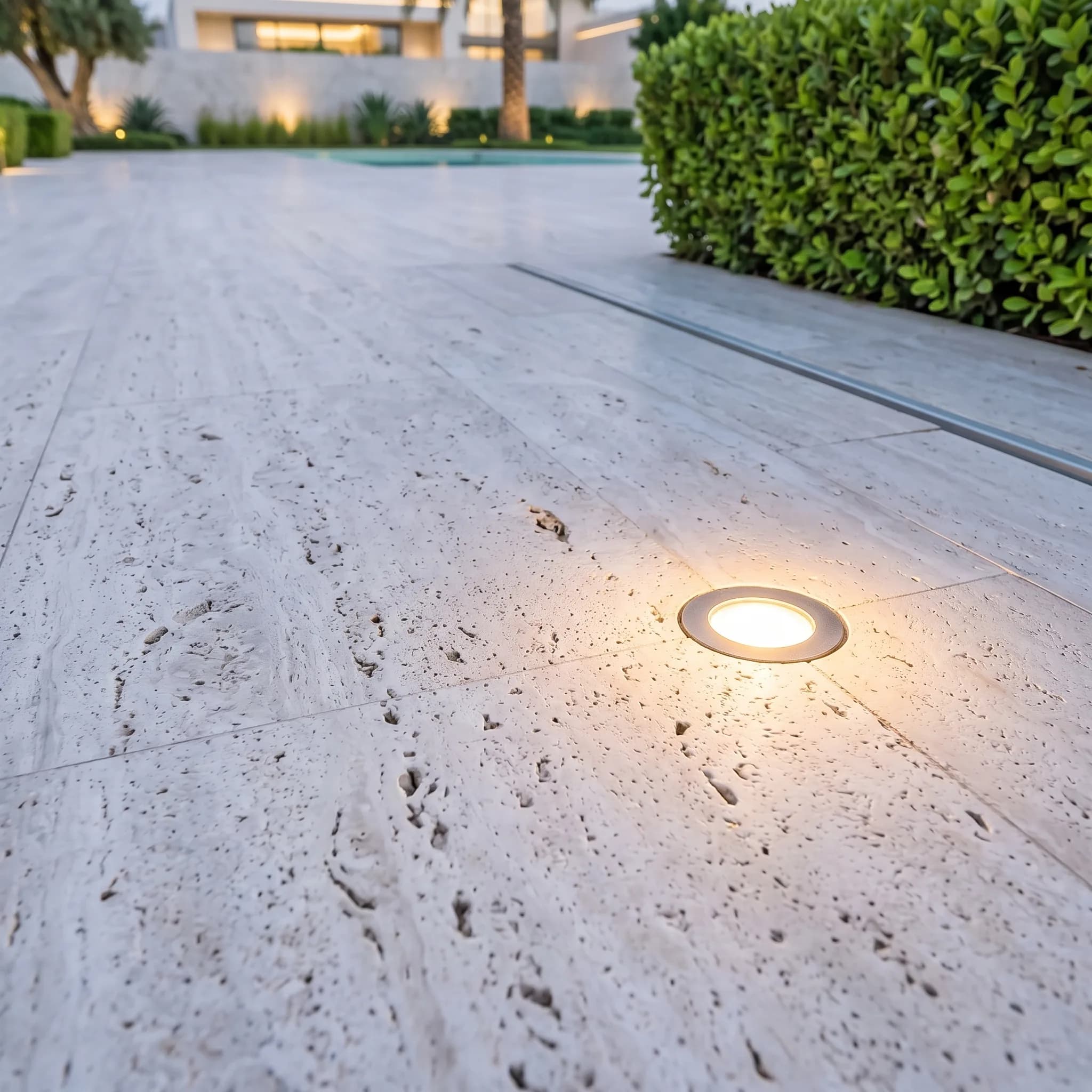
Travertine paving catches the warm light at the hedge line.
After sunset, it glows.
Materials & palette
What it's built from
Large-format travertine paving · Pale limestone walling and bed edging · Warm 2700–3000K layered low-voltage lighting · Precision-clipped hedge blocks and lines
Key plants
What grows into the luxury look

Olive
A Mediterranean tree built for heat, drought and poor soil, now a sought-after specimen for Dubai villa gardens — though most UAE-grown trees are prized for their silvery form rather than a reliable harvest.
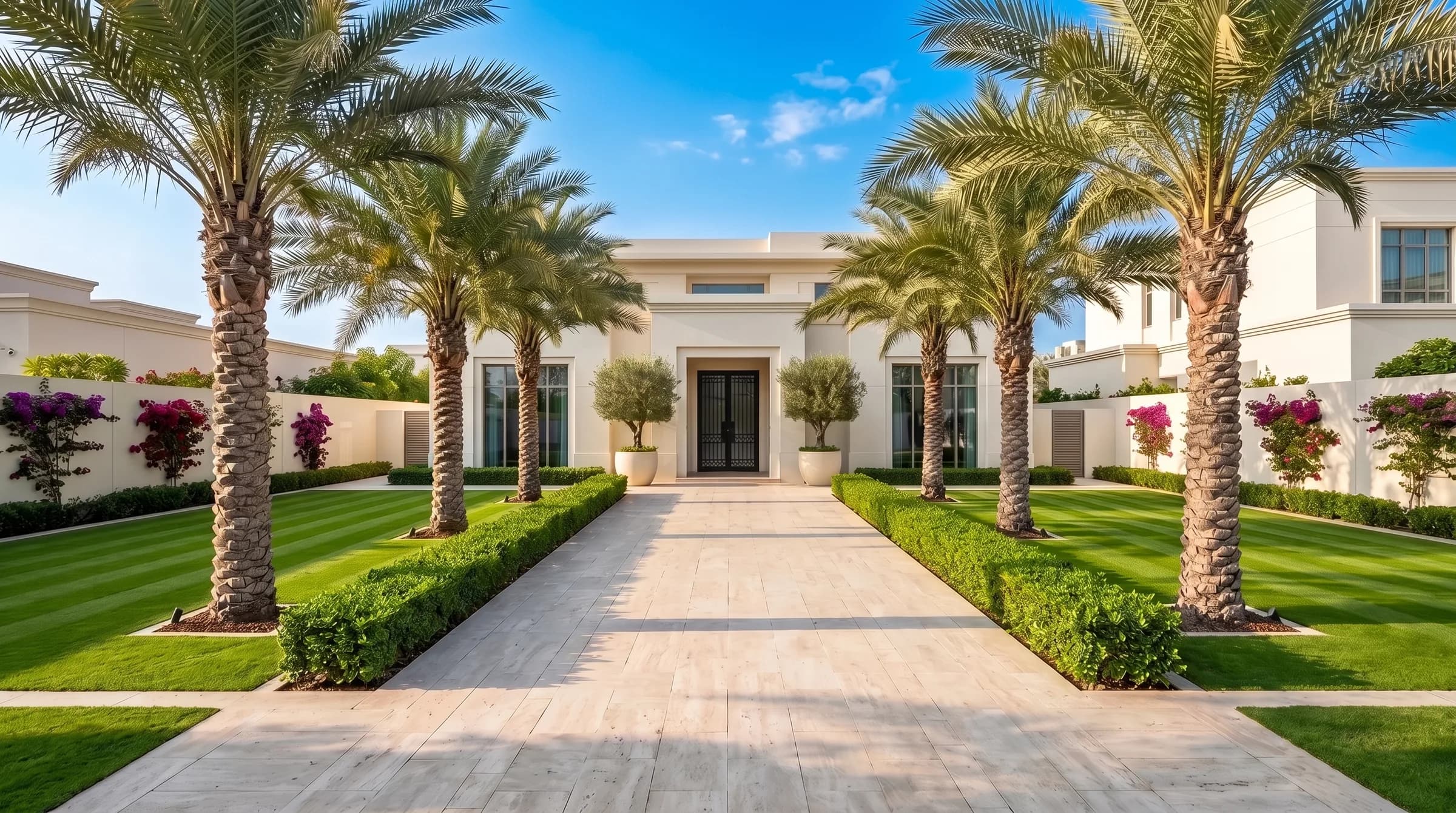
Date Palm
The palm the Gulf was built around: it tolerates 45°C and salty water, gives real fruit and real shade, but a mature specimen needs hand pollination, a seasonal prune and regular checks for red palm weevil.

Washingtonia Palm
A fast, very tall fan palm used across Dubai as an avenue and skyline tree: full sun, wind- and salt-tolerant, but it eventually outgrows small gardens and needs its dead-frond skirt managed.

Bismarck Palm
A massive, silver-blue fan palm from Madagascar that makes a single-specimen statement in a large Dubai garden — highly drought tolerant once established, but it needs real space and is unforgiving to transplant badly.

Texas Sage
A silver-leaved shrub from the Texas/Mexico desert that flushes with purple flowers a few days after rain or humidity — extremely drought tolerant, but needs sharp drainage.

Sea Jasmine
A tough, salt-spray-tolerant hedge and screening shrub with small jasmine-like white flowers — thrives right on the coast where few other shrubs will.

Agave
A sculptural, spine-tipped rosette that needs almost no water or care once planted — the architectural anchor of a desert-modern garden, not a plant for a path edge.

Ghaf
The UAE's national tree: a deep-rooted native that stays green through summer, tolerates salty soil and needs very little water once established.
The guide
Everything to know before you build luxury
Why choose it
The case for luxury
Mood
Lit, Polished, Crisp, Sculptural, Fresh
This style isn't a resort look — it's what good lighting, good stone and good hedge discipline add up to on their own. Lighting is planned in layers rather than switched on as an afterthought: a broad wash for facades and lawns, low path and step lights for safe movement, and accent up-lighting that grazes the trunk of a specimen tree or washes a garden wall after dark, all in a consistent warm 2700–3000K that reads as residential rather than commercial.
Stone carries the daytime look — large-format travertine paving that stays cool underfoot, and pale limestone for walls and bed edges — paired with hedges and topiary blocks clipped to a hard, consistent line rather than left soft. A single sculptural, multi-stem Olive earns its place as a hero feature near the entrance or terrace, uplit at night; feature palms like Date Palm, Washingtonia Palm and Bismarck Palm add height and evening silhouette. Underplanting stays restrained — Agave for structure, Frangipani and Bougainvillea for occasional colour — so the lit stonework and specimens keep the attention, with Ghaf as a lower-water anchor tree away from the feature planting.
Luxury here isn't a theme, there's no resort backdrop, no lobby-style layout, nothing borrowed from a hotel. It's what happens when lighting, stone and hedge discipline are each done properly rather than added as an afterthought, and the emotional case is almost entirely about what happens after dark: most Dubai gardens go flat and featureless at night, lit by whatever floodlight came with the build. This one is designed to be at its best then, not merely visible.
The practical case is that each of the three elements earns its keep on its own. Travertine paving genuinely stays cooler underfoot than darker stone or porcelain in direct sun, which matters for most of the year here, not just as a texture choice. A single sculptural Olive, uplit and given real space near the entrance, does more for the garden's presence than a dozen smaller specimens scattered through a border. And hedges cut to a hard, precise line read as expensive because precision is the expensive part, the plant underneath can be Texas Sage or Sea Jasmine, both genuinely easy to grow in Dubai, it's the clipping discipline that costs.
None of it needs a pool to work, which is the point the brief for this style insists on. A pool can be one feature among several, a still, lit sheet of water catching the evening sky, but the garden's identity comes from the lighting design, the stone and the hedge lines holding their edge, not from water at all.
- A genuinely different day-to-night presence thanks to layered, warm lighting
- Natural stone and precisely clipped hedges read as considered and expensive without being loud
- Scales from a full estate plot down to a single stone-and-light entrance courtyard
- Villas wanting a refined evening presence without a resort theme
- Owners ready to invest in a proper layered lighting design, not just extra floodlights
- Plots with clean sightlines suited to hard hedge lines and large-format stone
What it feels like
A day in the garden
In daylight, with the fixtures off, this garden runs on stone and precision. Travertine paving catches the early sun warm and pale, Texas Sage and Sea Jasmine hedges hold a hard, clean edge that doesn't soften even in strong light, and a multi-stem Olive throws dappled shade across the terrace rather than one dense pool of it. Touch the stone at midday and it's warm, not scorching, one of the real, practical reasons travertine is used here over darker paving.
The real character shows at blue hour. A single ground-recessed uplight at the base of the olive's trunk grazes the bark upward into the canopy, the boundary wall gets a low-angle wash that turns plain render into something textured, and path and step lights mark the route in pools rather than a continuous strip. The colour temperature stays a consistent warm 2700 to 3000K throughout, nothing shifts to blue or white, which is what keeps it reading as residential rather than commercial.
Underfoot, large-format travertine stays cool enough to cross barefoot well into the evening. The air carries a faint trace of whatever restrained flowering accent is nearby, Frangipani rather than a heavy border of scent, and any water present reads as a still, lit sheet rather than moving or splashing. It's a controlled, quiet evening presence, built for standing on the terrace with a drink rather than entertaining a crowd.
How the look is built
The choices behind the look
Three-layer lighting design
A broad wash lights facades, driveways and lawns; low path and step lights mark routes; accent up-lighting grazes the trunk of a specimen tree or washes a wall, specified together as one plan, not added fixture by fixture.
The overlap between the three layers, not any single one, is what reads as designed rather than simply lit.
Consistent 2700 to 3000K colour temperature
Every fixture on the plot, path, wash, accent, is specified to the same warm colour temperature, never mixed with cool white or coloured light.
Consistency keeps the evening garden reading as a considered extension of the house rather than a commercial or hotel-style rig.
Uplit sculptural specimen
A single multi-stem Olive is given real space near the entrance or terrace and lit from one ground-recessed fixture at its base, rather than surrounded by competing planting.
It becomes the garden's one unmistakable hero feature, the detail a visitor actually remembers instead of a blur of general greenery.
Large-format travertine paving
Paving is laid in large slabs with minimal visible joints rather than smaller unit pavers, in pale cream or tan tones.
It reads as considered and expensive specifically because of the joint discipline, and it stays genuinely cooler underfoot through the hottest months than darker stone or porcelain.
Hard-edged hedge lines
Texas Sage or Sea Jasmine are clipped to a precise, consistent block or line roughly every four to six weeks through the growing season, rather than left to soften naturally.
The precision, not the species, signals expensive, a soft, informal hedge line undoes the whole effect regardless of how healthy the plant is.
Feature palms in matched pairs
Date Palm, Washingtonia Palm or Bismarck Palm are planted in rows or matched pairs flanking an entrance or driveway, each with its own base uplight.
Matched spacing and repeated lighting turn what could be a random cluster of palms into a deliberate architectural gesture.
Restrained underplanting
Agave supplies structure and Frangipani or Bougainvillea give occasional colour, kept deliberately sparse rather than filling every gap with mixed planting.
Restraint keeps the eye on the lit stonework and the specimen trees, which is where this style wants attention to land.
A quiet water feature
Where water appears, it's a still reflecting channel or a lit pool edge rather than a splashing fountain, one feature among several, not the organising idea.
It adds a reflective surface for the lighting design to play across without pulling focus away from the stone and the specimens.
Living with it
What it actually takes to keep
Higher than it might look from a photograph, because precision is expensive to maintain, not just to build. Hedges need trimming roughly every four to six weeks through the growing season to hold a hard line, miss a cycle and the proper-haircut effect softens within days, and a multi-layer lighting system needs periodic fixture, bulb and timer checks to keep every layer working together. The stone and the specimen trees are themselves genuinely low-maintenance; it's the lines and the lighting that ask for a consistent schedule.
Weekly
- Check that every lighting layer, wash, path, accent, is actually switched on and working together, not just the brightest fixture
- Wipe down or rinse dust off travertine paving so the pale stone keeps its clean read
- Check the olive and feature palms' base uplights haven't shifted or been buried by irrigation run-off
Monthly
- Inspect hedge lines for any softening of the hard edge and schedule a clip before it's visibly overdue
- Test the lighting controller or timer and adjust seasonal on and off times as daylight hours shift
- Check Agave for rot at the base, it's the one plant here more likely to suffer from over- than under-watering
Seasonal
- Clip Texas Sage or Sea Jasmine hedges every four to six weeks through the growing season, tapering off in cooler months
- Prune the specimen Olive in late winter to open the canopy to light and air
- Remove only fully dead fronds from feature palms, ideally before summer, never cut green fronds or top the crown
- Have an electrician check low-voltage lighting connections and fittings once a year, ahead of the main evening-use season
Moderate, there's no lawn built into this style, so irrigation is really about the specimen trees, feature palms and restrained underplanting rather than a continuous green surface. Olive and Agave both want infrequent, deep watering rather than little and often, which also happens to be the lower-maintenance option, shallow, frequent watering encourages shallow roots and, for agave specifically, raises the risk of rot.
Watch-outs
- Mixing fixtures from different brands without checking they're all true 2700–3000K produces a visibly patchy warm-to-cool mismatch once installed — specify the exact colour temperature in writing, not just "warm white"
- Agave rot is nearly always an over-watering problem, not an under-watering one, especially if it shares a zone with thirstier planting
- Red palm weevil is a genuine regional pest of feature palms, regular scouting and prompt treatment of a wilting crown matters more on a garden built around specimen palms
- A softened hedge line is the fastest way this style stops looking luxury and starts looking merely tidy, don't let the clipping cycle slip
Trade-offs
- Clipped hedges need frequent, precise trimming to hold their lines — this is not a low-maintenance look
- A proper lighting design is a real upfront specification cost, not just adding fittings later
- Specimen olives, feature palms and natural stone cost more to source than smaller nursery stock or precast paving
Who it's for
Is this plot, and this owner, the right fit
Good fit
- Villas wanting a genuinely different evening presence, not just extra floodlights switched on after dark
- Owners ready to specify a proper layered lighting design upfront, as part of the build, not bolted on afterwards
- Plots with clean, simple sightlines that suit hard hedge lines and large-format stone rather than busy planting
- Anyone who wants the garden's presence to come from materials and light rather than a resort theme or a pool
Not for
- Owners on a tight build budget, specimen olives, feature palms and natural stone all cost more than smaller nursery stock or precast paving
- Anyone who wants to set the lighting once and forget it, the layered system needs periodic checking to keep working as one scheme
- Plots wanting dense, layered planting and shade rather than restrained, structural greenery
- Owners unwilling to commit to a four-to-six-week hedge clipping cycle through the growing season
Effort
4 of 5
Water
Moderate
Build cost
AED 300–550/m²
Signature features
- Uplit specimen trees and feature palms
- Wall-grazing accent light along stone walls
- Precisely clipped hedge lines and topiary blocks
- A still or lit water feature as one element, not the centrepiece
What people assume
Common assumptions, checked against reality
It's the resort-hotel look.
The brief for this style is explicit: no lobby-style layout, no hospitality theme. It's lighting, stone and hedge precision, which can exist with or without a pool.
A pool is what makes a garden luxury.
A pool can be one feature among several here, but the identity of this style comes from the three-layer lighting design and stone discipline, not from water.
Expensive lighting means more fixtures.
It means three coordinated layers, wash, path, accent, all at one consistent warm colour temperature. A garden with twenty mismatched floodlights looks commercial, not considered.
The hedges must be some rare, hard-to-grow species.
Texas sage and sea jasmine are both genuinely easy to grow in Dubai's heat, the expense is in the clipping discipline, not the plant.
Natural stone is just a look; porcelain would do the same job.
Travertine has a real functional reason for its use here: it stays measurably cooler underfoot than darker stone or porcelain through Dubai's hottest months, not only a visual preference.
Dubai notes
Climate, salinity and approvals
Lighting design has to account for Dubai's long, bright evenings and short winter dusk both, a scheme built only around a December blue hour will feel under-lit relative to a July one when daylight runs later. Specify the controller with seasonal timer adjustment in mind, not a single fixed on-time.
Stone choice is a genuine heat-management decision here, not just a palette one, pale, large-format travertine stays meaningfully cooler underfoot in direct sun than darker stone or standard porcelain, which matters on a terrace used through the afternoon as much as in the evening.
Feature palms are a real target for red palm weevil, a serious pest across the Gulf region that the UAE has invested heavily in monitoring and controlling. Regular scouting, looking for wilting fronds or a drooping crown, matters more here than in a style with fewer, less prominent palm specimens.
As with any change to boundary walls, lighting that faces a neighbouring plot, or new hardscape, check your community's landscaping and lighting guidelines, Emaar, Nakheel or the relevant owners' association, before the design is finalised.
Make it yours
Three ways to adapt it
On a townhouse plot
Scale the three-layer lighting plan down to a single terrace and entrance rather than a full perimeter, keep one uplit specimen, an olive or a single feature palm, as the hero, and let hard hedge lines do the rest of the structural work in a smaller footprint.
Without a pool
A still, lit reflecting channel or a shallow water bowl gives the lighting design something reflective to play across, at a fraction of a pool's build cost and upkeep, entirely in keeping with this style's own brief, which never treats a pool as the centrepiece.
A lower-water version
Lean further into Ghaf as the anchor tree and Agave for structure, and trim the underplanting back further still. The lighting and stone, which carry most of this style's identity, use no water at all, so the planting side can run genuinely low without touching what makes the garden read as luxury.
FAQ
Common questions
Does a "Luxury" garden need a swimming pool?
How often do the hedges actually need clipping to keep that look?
What does a proper garden lighting design actually involve?
Want this in your garden?
Keep it this fresh with Garden Care from AED 500/month.
Keep exploring