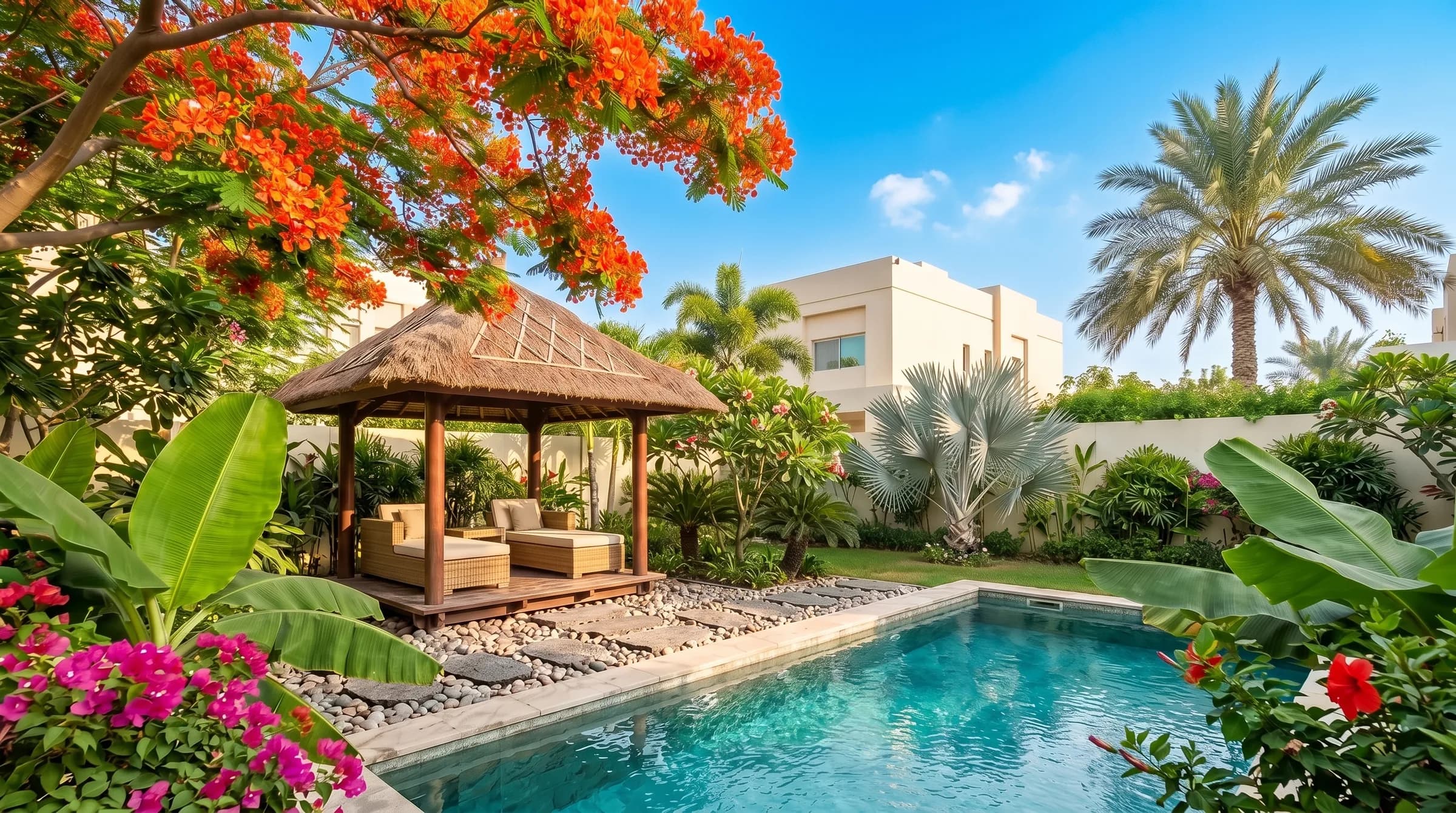
Desert modern
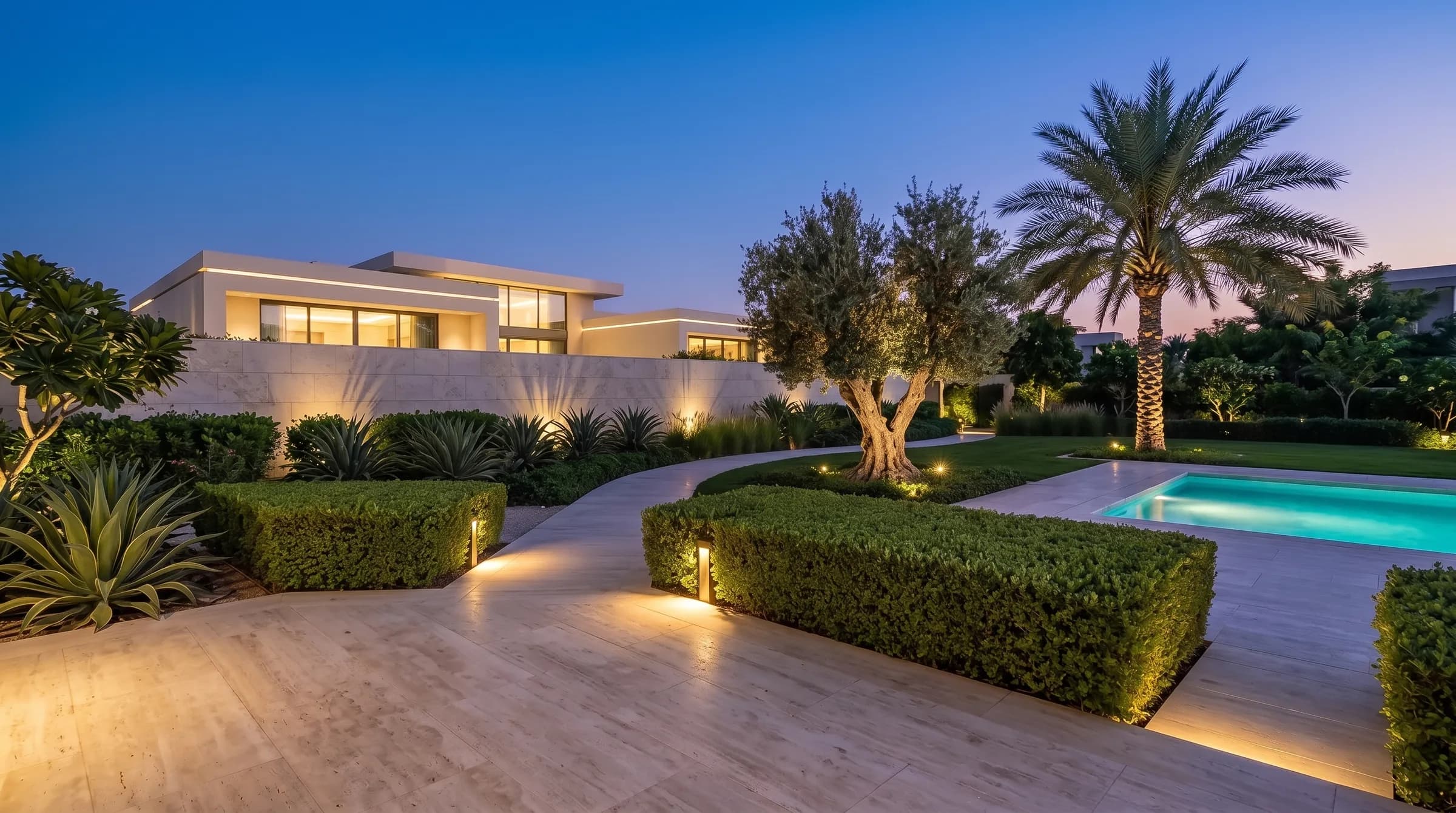
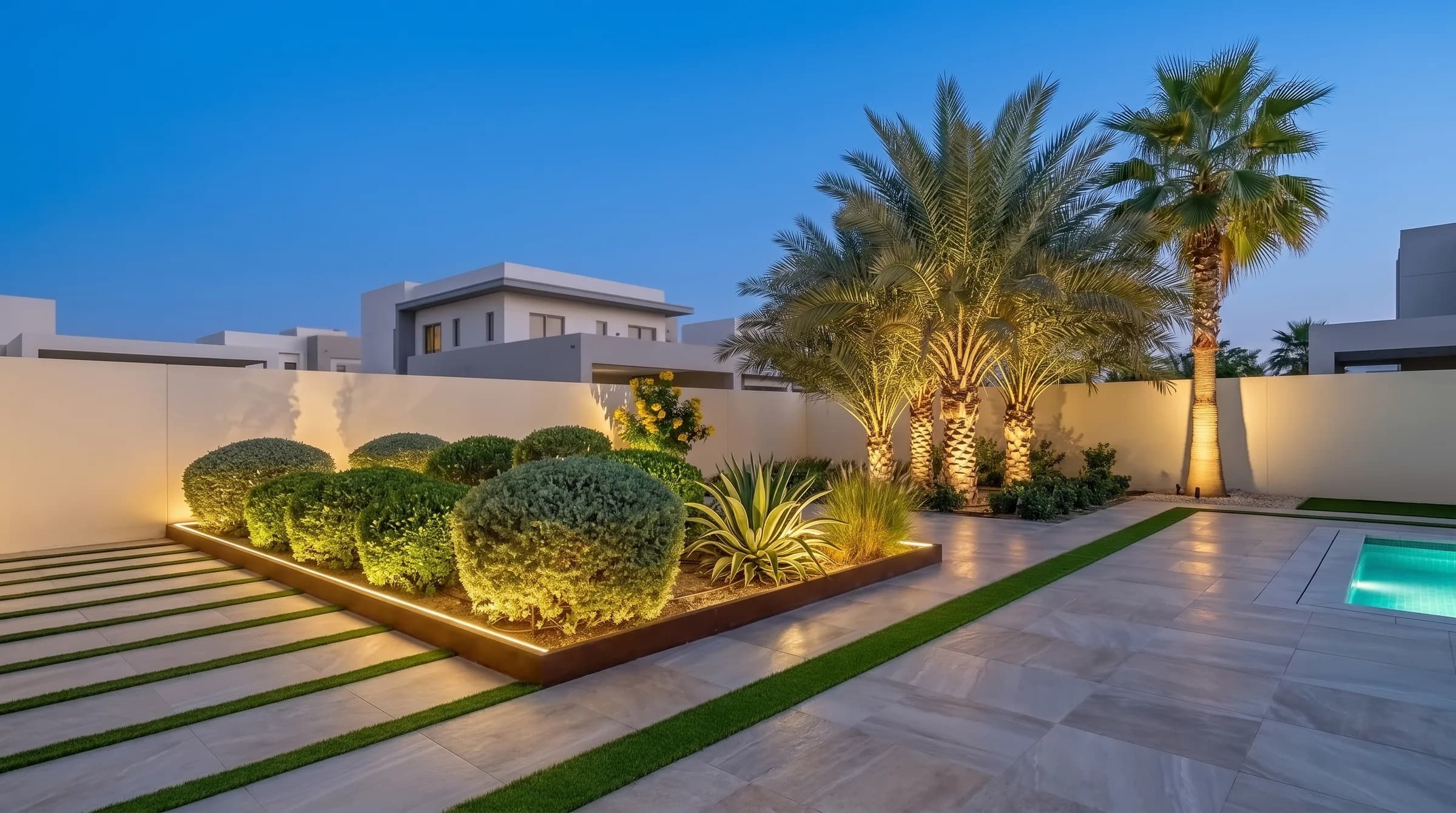
Tiled surfaces, bright turf strips and uplit palms — the low-water look done properly.
Walk through the garden
Clean lines, built for the heat.
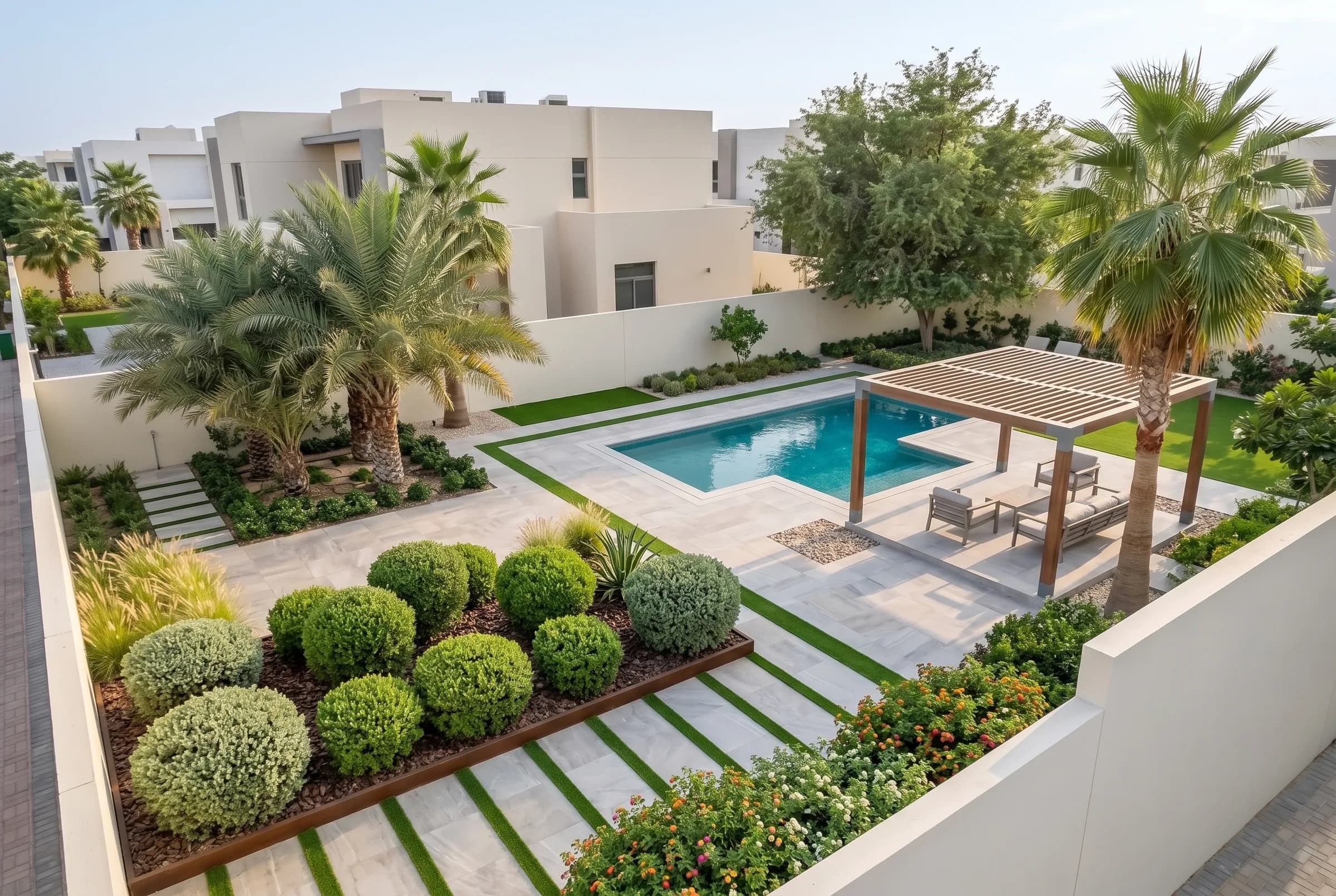
Tile-and-turf strips thread the whole plot together.
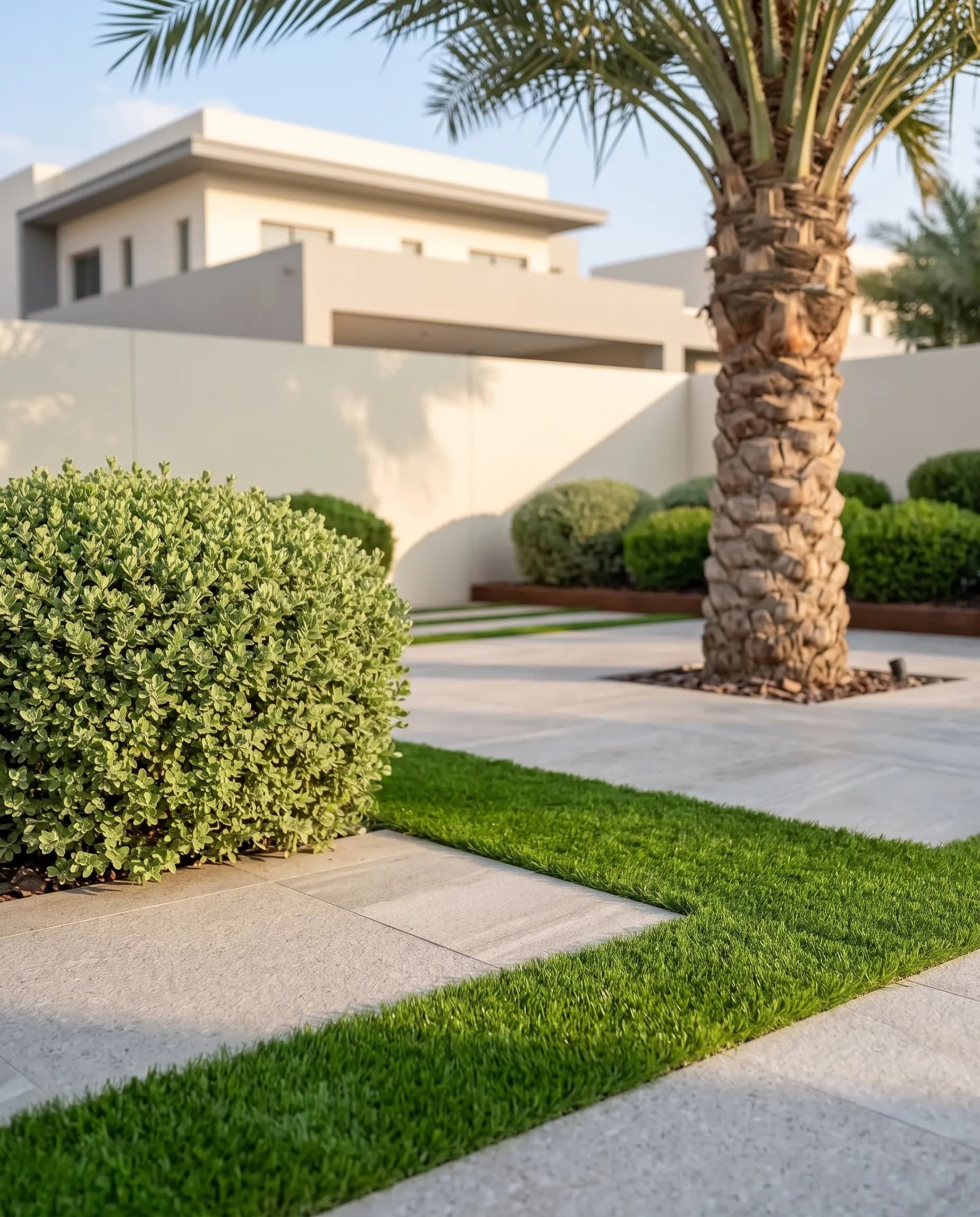
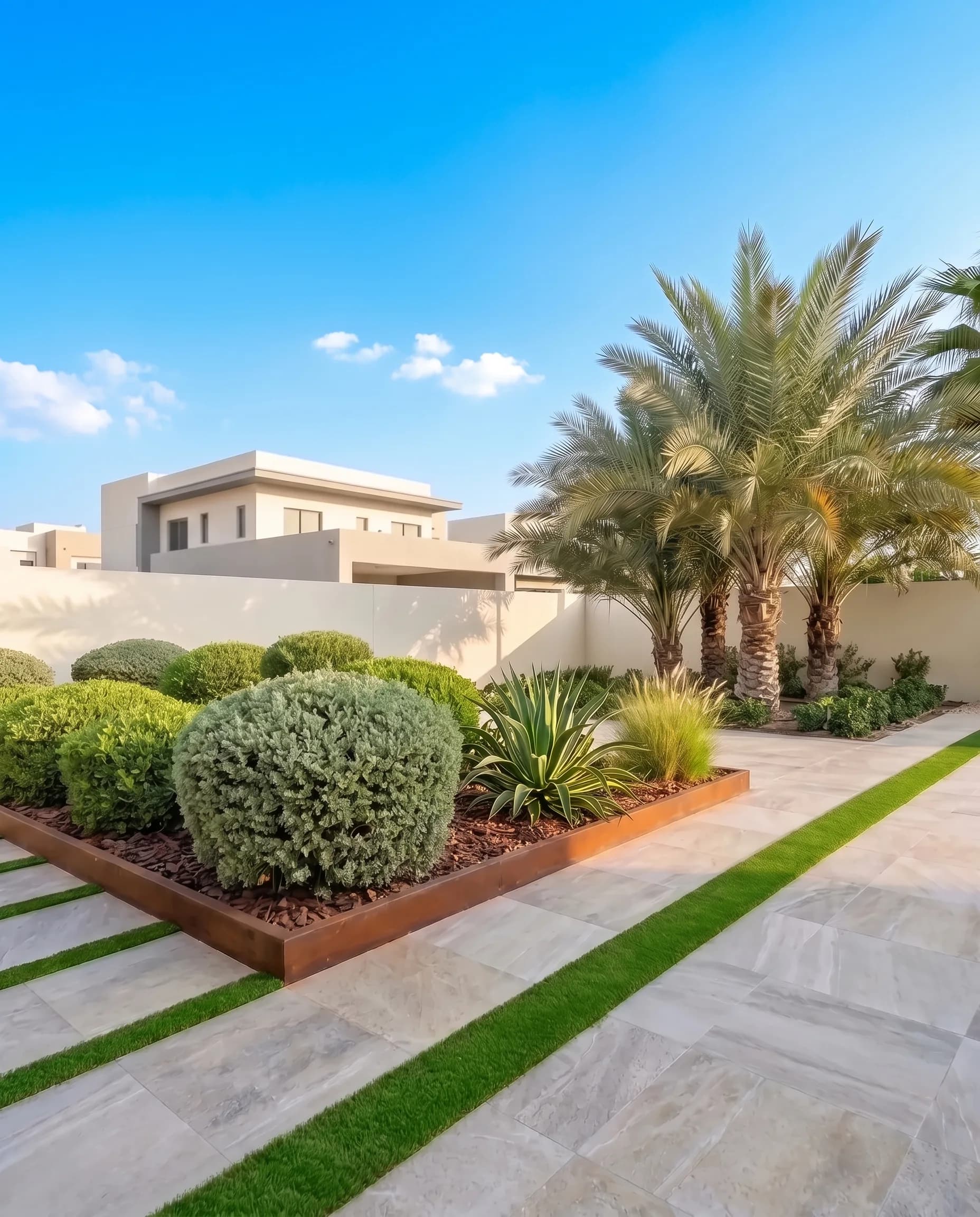
Tile meets turf strip at a clipped shrub and palm base.
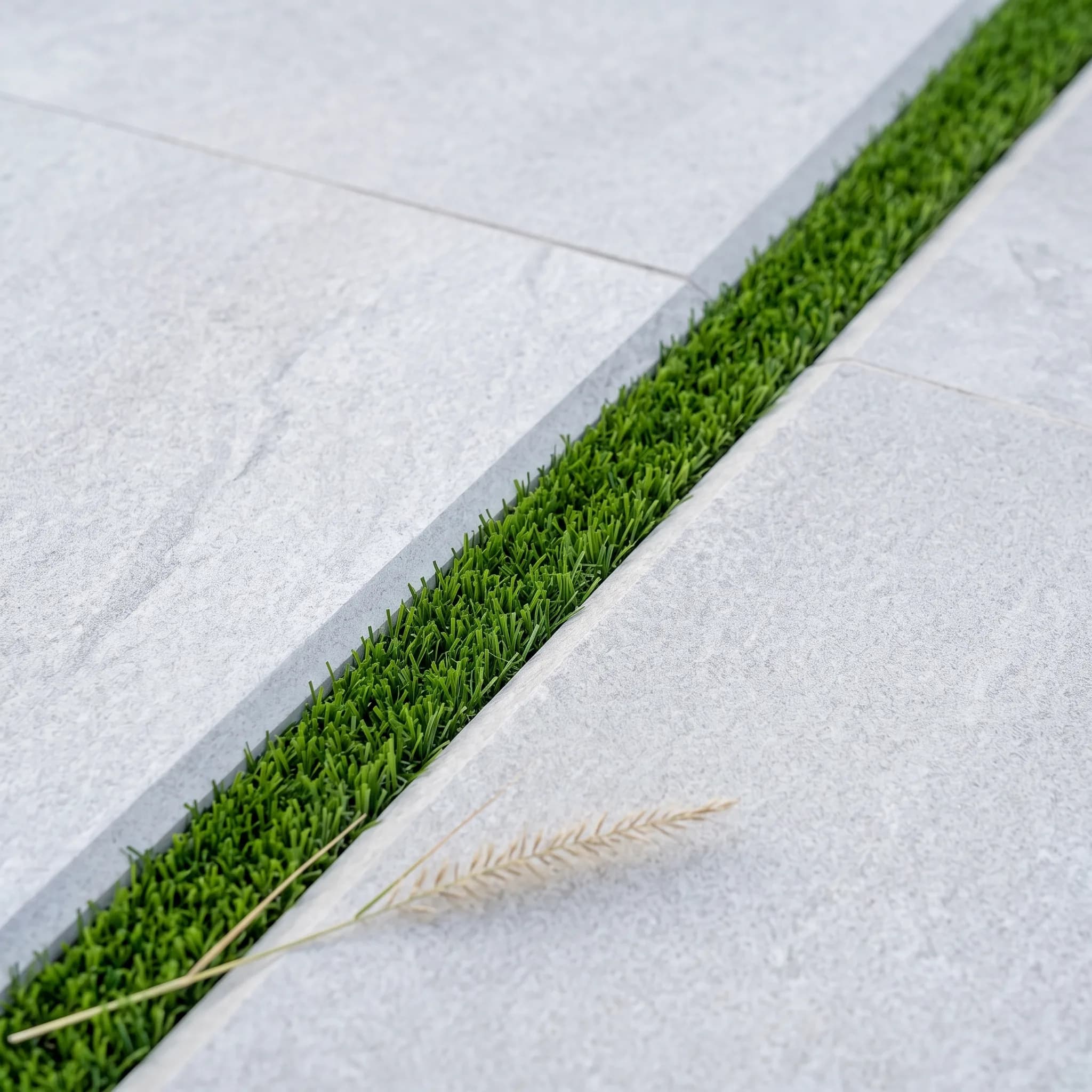
Where porcelain tile meets artificial grass — the style's signature detail.
After sunset, it glows.
Materials & palette
What it's built from
Large-format porcelain tile paving · Vivid-green artificial-grass strips and stepping pads between tiles · Raised rendered or painted concrete planters · Corten-steel edging · Small gravel mulch rings — accent only, never a ground-covering field
Key plants
What grows into the desert modern look
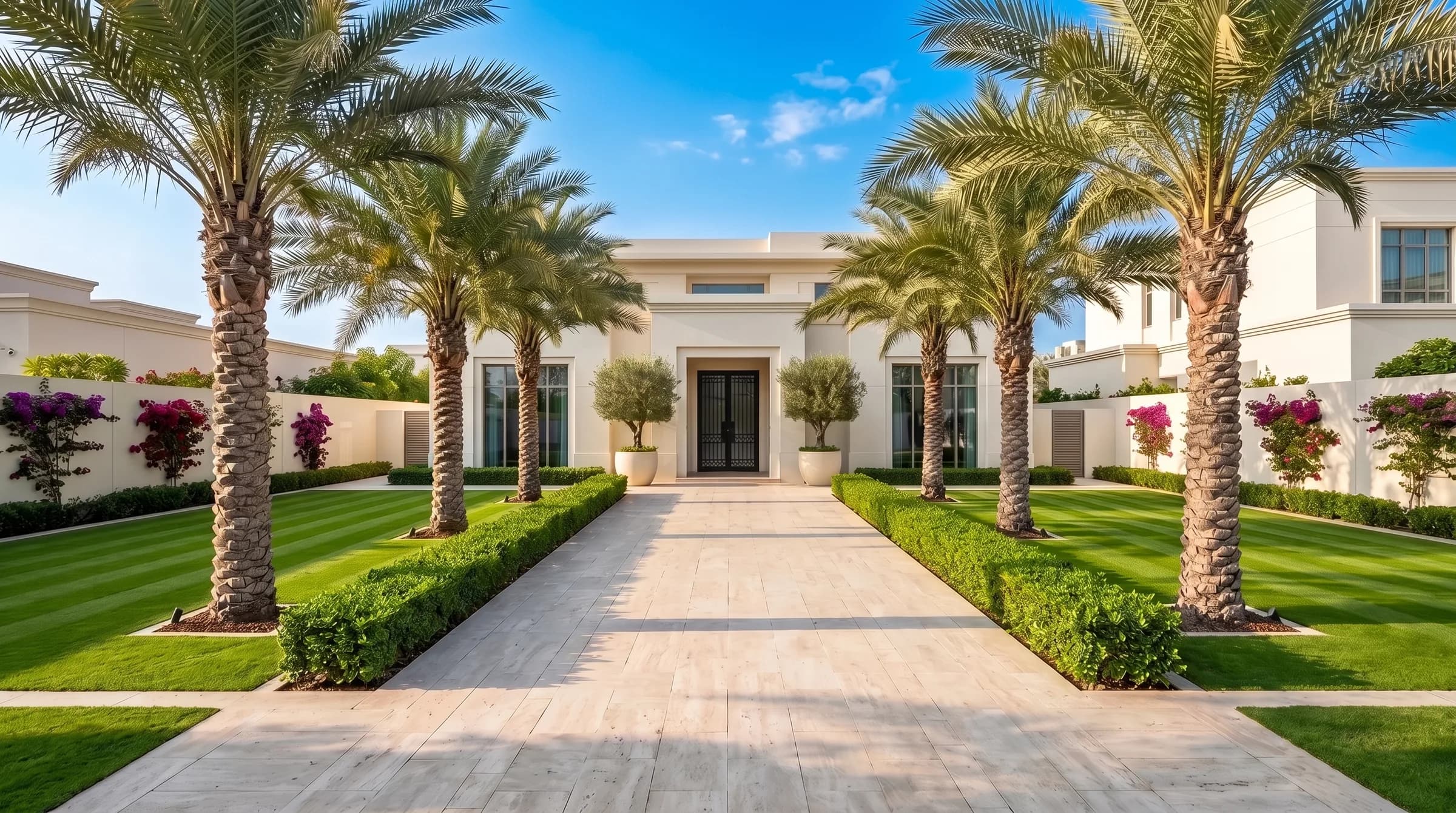
Date Palm
The palm the Gulf was built around: it tolerates 45°C and salty water, gives real fruit and real shade, but a mature specimen needs hand pollination, a seasonal prune and regular checks for red palm weevil.

Washingtonia Palm
A fast, very tall fan palm used across Dubai as an avenue and skyline tree: full sun, wind- and salt-tolerant, but it eventually outgrows small gardens and needs its dead-frond skirt managed.

Ghaf
The UAE's national tree: a deep-rooted native that stays green through summer, tolerates salty soil and needs very little water once established.

Texas Sage
A silver-leaved shrub from the Texas/Mexico desert that flushes with purple flowers a few days after rain or humidity — extremely drought tolerant, but needs sharp drainage.

Hopbush
A native UAE shrub found wild in wadis from Fujairah to Abu Dhabi — highly salt tolerant and useful for screening or stabilising saline, disturbed ground.

Arak
A native UAE shrub so salt-tolerant it can be irrigated with water almost as salty as the sea, traditionally harvested for miswak chewing sticks.

Agave
A sculptural, spine-tipped rosette that needs almost no water or care once planted — the architectural anchor of a desert-modern garden, not a plant for a path edge.
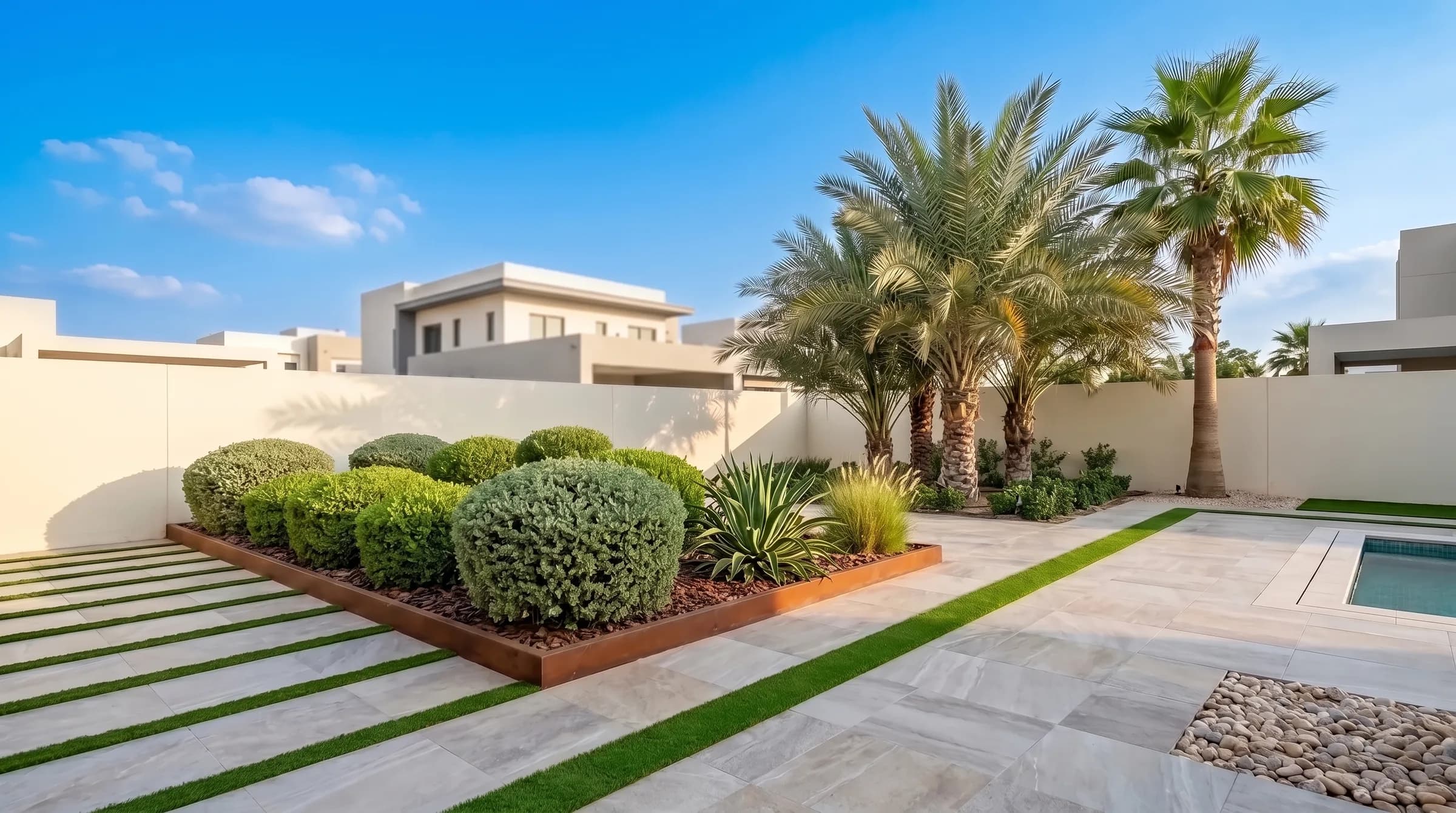
Desert grass
A native, clump-forming desert grass that survives on rainfall alone in the wild — not a lawn grass, but a tough, low-water accent for desert-modern planting.
The guide
Everything to know before you build desert modern
Why choose it
The case for desert modern
Mood
Fresh, Clean-lined, Sun-loving, Low-water, Evening-lit
Desert modern here means tile first, not gravel first: large-format porcelain does the ground-plane work a lawn would elsewhere, narrow strips or stepping pads of artificial grass thread through it for green underfoot, and straight architectural lines — corten-steel edging, raised rendered planters — replace the meandering beds of a softer style. It's a deliberate correction away from the sand-and-decomposed-granite cliché: gravel still has a place here, but only as a small mulch ring around a specimen plant, never as the ground itself.
The planting leans on the same low-water native and adapted species used elsewhere on this site, arranged for structure rather than coverage: Date Palm and Washingtonia Palm as the vertical anchors, Ghaf as a larger shade tree where the plot allows one, and Texas Sage, Hopbush and Arak kept in tight, clipped mounds along the planter edges. Agave adds a structural succulent accent and Desert grass gives soft texture in the spots a full turf strip would be too much.
Lighting does real work in this style: warm low-voltage uplights at the base of each palm trunk, plus linear LED strips along steps, planter lips or pergola beams, carry the garden into the evening. Because there's no natural lawn to irrigate, this is the most water-efficient style here; see our summer watering guide and artificial vs natural grass comparison for the trade-offs behind that choice.
This style exists to correct an assumption: that a low-water Dubai garden has to mean gravel, decomposed granite and a handful of struggling succulents. It doesn't. Large-format porcelain does the ground-plane work a lawn would do elsewhere, narrow strips or stepping pads of artificial grass thread real green underfoot, and Date Palm and Washingtonia Palm carry the vertical presence. The result reads as a proper, considered garden, not a plot that gave up on planting to save water.
The practical case is the strongest of any style here. There's no natural lawn to irrigate, and every key plant, Ghaf, Texas Sage, Hopbush, Arak, Agave, Desert grass, is genuinely low-water, several of them native or long-adapted to this exact climate rather than merely tolerant of it. That combination makes this the lowest-effort, lowest-water style on this site by a real margin, without the garden looking like a compromise.
It also happens to suit a modern villa facade better than a softer, planted style does. Straight corten-steel edging and raised rendered planters echo clean architectural lines rather than fighting them, and the evening lighting, uplit palm trunks, linear LED along steps and planter lips, gives the garden a strong after-dark presence for a modest fraction of a full lighting-led build.
- Very low water demand — no natural lawn, and the native/adapted shrubs need minimal irrigation
- Reads as a proper tiled, green garden rather than a bare or gravel-heavy desert plot
- Artificial-grass strips need no mowing and stay a consistent green year-round
- Evening lighting on palms and steps gives it a strong after-dark presence for modest cost
- Owners who want a low-water garden without a gravel/bare-desert look
- Villas with a clean modern facade that porcelain tile and straight lines can echo
- Plots wanting a strong evening presence — uplit palms, LED lines — without a full luxury-resort build
What it feels like
A day in the garden
In daylight this garden reads clean before it reads green, porcelain tile catches the light pale and even, and the turf strips running through it are a deliberately vivid, healthy colour rather than a muted desert palette. Texas Sage and Hopbush hold tight, rounded, clipped forms along the planter edges, and Date Palm trunks throw long, graphic shadows across the tile through the afternoon.
Touch matters more here than in most styles, because the ground plane is doing more of the visual work. Light-coloured porcelain in shade stays genuinely comfortable underfoot; the same tile in direct summer sun gets hot enough that bare feet notice, and unshaded artificial turf can run hotter still, which is exactly why the turf appears as narrow strips and stepping pads threaded through tile, not as one continuous open panel baking in full sun all day.
Evening is where this style does something few low-water gardens manage: it looks considered rather than merely functional. Warm low-voltage uplights ring each palm trunk and wash the fronds from below, linear LED strips along a step edge or pergola beam catch the eye without glare, and the porcelain underfoot holds a faint residual warmth rather than the day's full heat. A turquoise pool corner, where the plot has one, becomes the single brightest colour note in the whole scene.
How the look is built
The choices behind the look
Porcelain-first ground plane
Large-format porcelain tile, usually 60 by 60cm or bigger, does the ground-plane work a lawn or gravel field would do elsewhere, often continued straight out from the indoor floor tile.
It reads as a seamless extension of the house rather than a separate garden zone, and it's the detail that most clearly separates this look from a gravel-and-cactus desert garden.
Turf as strips, not a panel
Narrow strips or stepping pads of artificial grass run as joints between tile bands or pavers, roughly 5 to 15cm wide, rather than filling one continuous lawn-shaped area.
Green appears as a graphic, architectural line rather than a field, which is what keeps the low-water planting choice from reading as an absence.
Palms as vertical anchors
Date Palm and Washingtonia Palm rise singly or in small clusters out of a turf strip or planter, both genuinely local, heat-adapted species.
Height and silhouette carry the garden's presence, which matters most in a style that deliberately keeps the ground plane flat and low.
Clipped shrub mounds
Texas Sage, Hopbush and Arak are kept in tight, rounded or lightly clipped mounds along the planter edges rather than left informal.
The discipline in the shrub shapes softens the hard architectural lines without tipping the whole look into something jungly or unstructured.
Corten-steel and raised planters
Raised, rendered or painted concrete planters and corten-steel edging keep soil off the tiled ground plane entirely, rather than cutting open beds into it.
Every line stays straight and architectural, matching a modern villa facade instead of competing with it.
Palm-trunk uplighting
Warm 2700 to 3000K low-voltage uplights sit at the base of each palm trunk, plus linear LED strips recessed into steps, planter lips or pergola beams.
Evening presence comes from a handful of well-placed fixtures rather than a full layered scheme, most of why this style costs meaningfully less after dark than the luxury style.
Gravel as accent only
Gravel or decomposed granite appears only as a narrow mulch ring around a single specimen plant, never as the ground itself.
It keeps the texture variety a gravel bed can offer without reintroducing the bare, dusty read this style is deliberately correcting away from.
Drip irrigation on low-water zones
Beds run on drip at low volumes suited to native and adapted species, Ghaf and Arak in particular tolerate long gaps between deep waterings once established.
Irrigation stays genuinely minimal rather than just nominally reduced, the real source of this style's low running cost, not the tile.
Living with it
What it actually takes to keep
The lowest-effort style on this site, honestly, and by a real margin. There's no lawn to mow or trouble-shoot, the shrub layer takes infrequent clipping rather than constant shaping, and the palms mostly look after themselves between an annual frond tidy. What upkeep there is goes into the hard surfaces, brushing and rinsing the artificial turf, checking tile joints, rather than the planting, which flips the usual maintenance balance most Dubai gardens run on.
Weekly
- Check turf strips for debris or leaf litter caught in the pile, especially under palms shedding fruit or old fronds
- Glance over drip lines on Agave and Desert grass for blockages, even though both tolerate a missed watering better than most
Monthly
- Brush and rinse artificial turf strips to keep the pile upright and remove dust
- Check tile joints and turf edges for weeds or algae, especially after a humid spell
- Tidy Texas Sage and Hopbush mounds back to shape if growth has softened the line
Seasonal
- Remove only fully dead, brown fronds from Date Palm and Washingtonia Palm, never cut green fronds or top the crown
- Light formative pruning of Ghaf in winter to lift the canopy and remove crossing branches
- Cut Desert grass back to around 150 to 200mm in late winter to refresh growth for spring
- Check low-voltage uplighting fittings and connections once a year before the main evening-use season
The lowest of any style here, there's no natural lawn, the artificial turf needs none, and every key plant is rated low or very-low water once established. Ghaf and Arak in particular want a deep soak every one to two weeks rather than frequent shallow watering, which also keeps their roots deep rather than surface-bound and better able to ride out a missed cycle.
Watch-outs
- Budget-grade artificial turf in full sun can get too hot for bare feet in Dubai's summer, keep it to shaded or lightly-used strips, or specify a cooling infill
- Matted, seamed or curling turf edges are the fastest way this style starts looking cheap rather than considered, good installation matters as much as the product
- Dark porcelain tile runs hotter underfoot than light tones in direct sun, specify pale grey, beige or white for anywhere feet will land
- Corten-steel edging is meant to weather to its rust patina, but without a drip-edge detail that rust can stain pale porcelain or turf next to it — insist on the detail at design stage, not after the stain shows
Trade-offs
- Artificial turf still needs periodic brushing/rinsing and eventual replacement (roughly 8-15 years)
- Large-format porcelain costs more per m² than basic paving or plain gravel
- Less shade and softness than a layered planting style until specimen palms and shrubs fill out
- Tile joints and turf edges need occasional weeding or algae checks in humid months to stay crisp
Who it's for
Is this plot, and this owner, the right fit
Good fit
- Owners who want a genuinely low-water garden without a gravel or bare-desert look
- Villas with a clean, modern facade that porcelain tile and straight lines can echo rather than fight
- Anyone who wants a strong evening presence, uplit palms, LED lines, without the build cost of a full lighting-led style
- Plots where minimal ongoing maintenance matters more than a lush, layered planting look
Not for
- Owners who want dense shade, this style stays deliberately open and low, with palms doing the only real height
- Anyone who wants the softness of a full planting scheme rather than a disciplined, architectural one
- Plots facing full, unshaded summer sun across most of the usable area, where turf and tile heat matter most
- Owners who specifically want a natural lawn for children or pets to use
Effort
2 of 5
Water
Low
Build cost
AED 180–380/m²
Signature features
- Tile-and-turf-strip ground pattern instead of a full lawn
- Low-voltage uplights on palm trunks and specimen shrubs
- Linear LED strip lighting along steps, planter lips or pergola beams
- Shade structure or pergola over the seating zone
- Turquoise pool or water accent where the plot allows
What people assume
Common assumptions, checked against reality
It's just gravel and a couple of cacti.
The brief here is deliberately tile-and-turf, not gravel-and-sand, porcelain does the ground-plane work gravel used to, and gravel itself appears only as a small accent ring around a specimen plant.
Low water means a sparse, thin-looking garden.
Palms, clipped shrub mounds and turf strips give real density and structure, the saving comes from what isn't a natural lawn, not from planting less.
Artificial grass is a maintenance-free surface.
It needs periodic brushing, rinsing and eventual replacement, genuinely low effort compared with a natural lawn, but not zero.
This style doesn't need irrigation design at all.
It still runs drip zones for the palms and shrub beds, the saving is in volume and frequency, not in skipping irrigation altogether.
It needs a pool to look finished.
The look is built from palms, the tile-and-turf pattern and lighting, it works on plots with no pool at all, and a pool just adds one more colour accent where there's room for one.
Dubai notes
Climate, salinity and approvals
Surface heat is the real technical constraint behind every material choice in this style. Ambient Dubai summer air commonly reaches the low-to-mid 40s°C, and dark or budget-grade surfaces run hotter still in direct sun, which is exactly why pale porcelain and turf kept to shaded or lightly-trafficked strips, rather than one open sun-baked panel, are the deliberate choices here, not aesthetic ones.
Every key plant in this style is rated low or very-low water for good reason: Ghaf is native to the UAE and genuinely drought-adapted, and Arak, Texas Sage and Hopbush all tolerate real dry spells once established. That's what makes the low running cost credible rather than optimistic.
Where irrigation runs on borehole water rather than DEWA mains, test it for salinity and sediment before installing drip, borehole supply is often higher in both than mains water, and fitting filtration up front avoids scale and salt build-up in emitters later.
As with any change to boundary walls, raised planters or exterior lighting, check your community's landscaping guidelines, Emaar, Nakheel or the relevant owners' association, before the design is finalised, since requirements vary by community.
Make it yours
Three ways to adapt it
On a townhouse plot
Run a single turf-and-tile strip from the gate to the door rather than a full patterned layout, keep one or two Date Palms as the vertical anchor, and let raised planters along the boundary carry the Texas Sage and Hopbush shrub layer in place of ground beds.
Without a pool
The style loses nothing without one, palms, the tile-and-turf pattern and evening lighting already carry the look on their own. Put the budget a pool would have used into larger-format tile or a proper three-point lighting plan on the palms instead.
A denser green version
Widen the turf strips and add a second or third Ghaf as a larger shade tree where the plot allows one, it's still the lowest-water style here even with more green, since every plant on the list stays low-water regardless of how much of it is planted.
FAQ
Common questions
Isn't 'desert modern' just gravel and cacti?
How does artificial grass fit a 'low water' style?
Does this style need a pool to look right?
Want this in your garden?
Keep it this fresh with Garden Care from AED 500/month.
Keep exploring