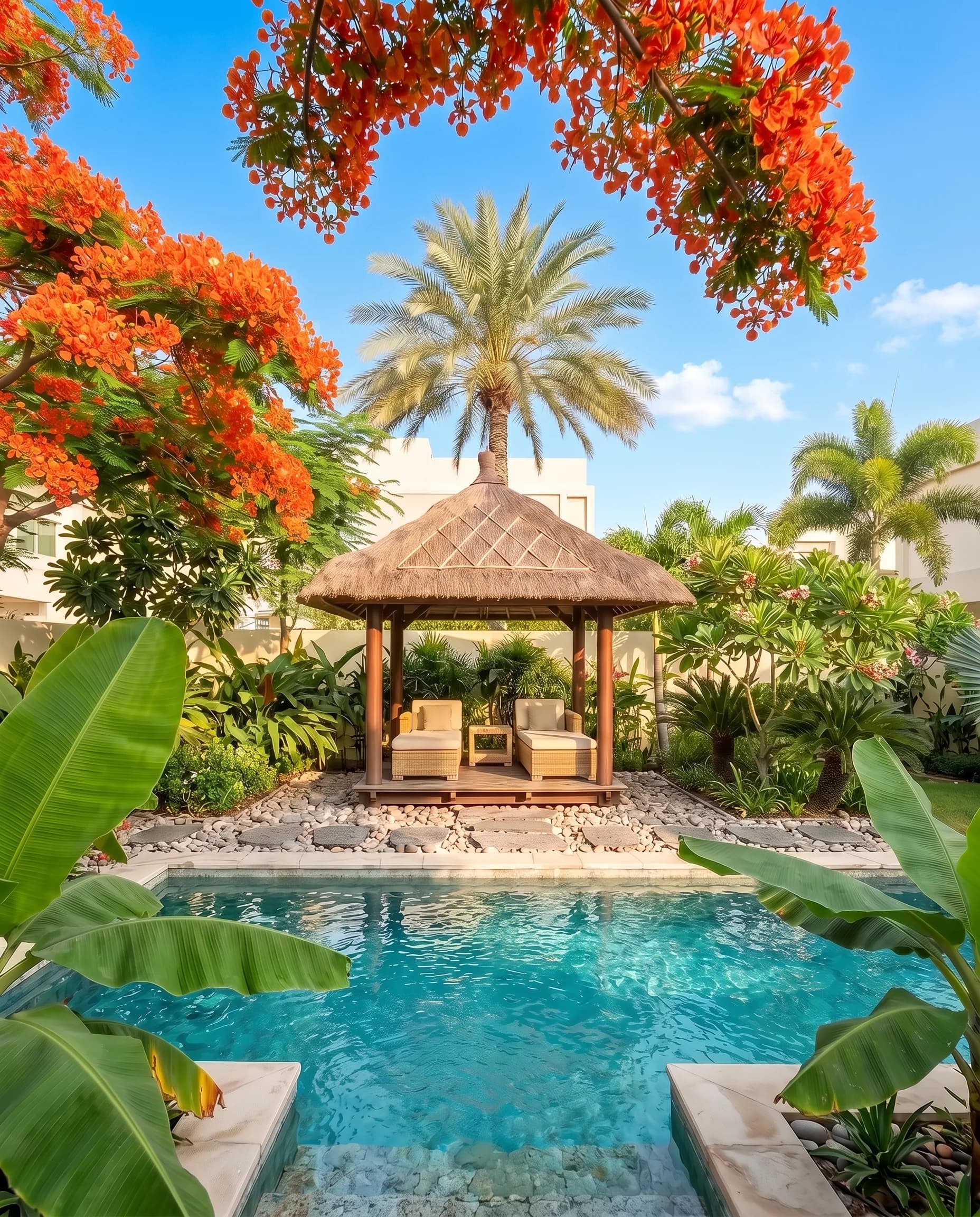
Tropical & jungly
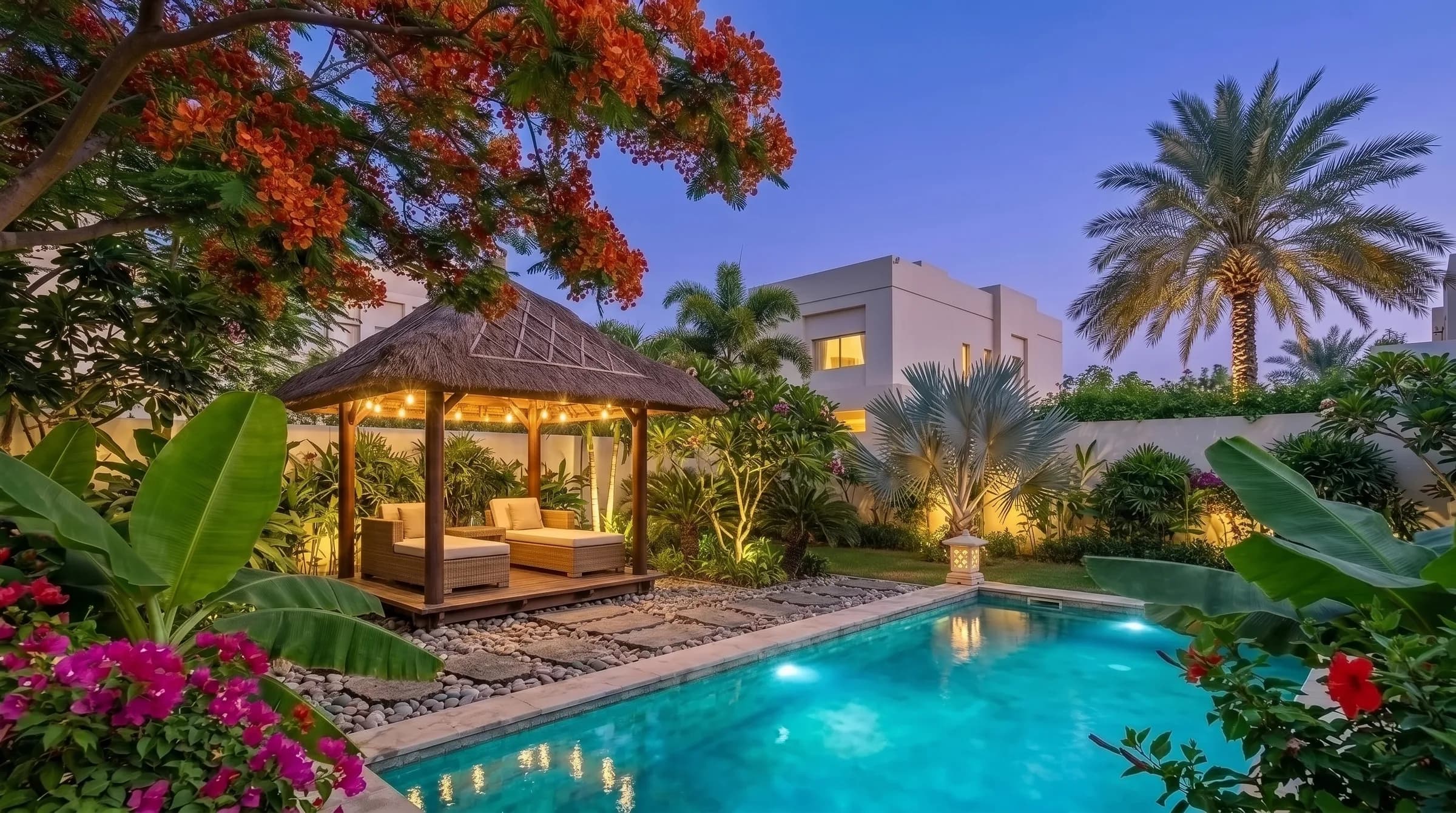
Bali-villa vibe: real banana leaves, warm teak, a plunge pool, kept fresh by real water.
Walk through the garden
A Bali-villa retreat, leaf by leaf.
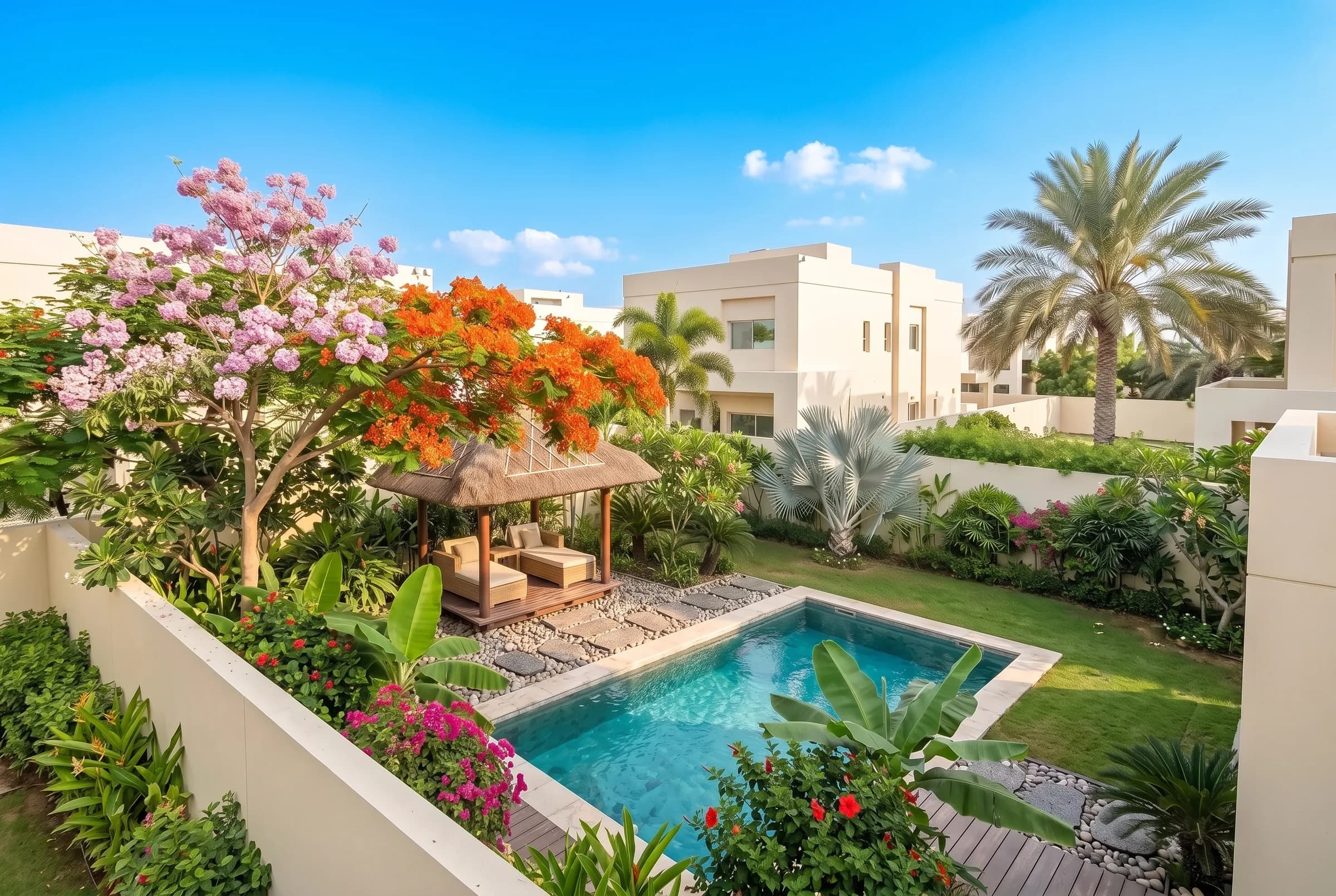
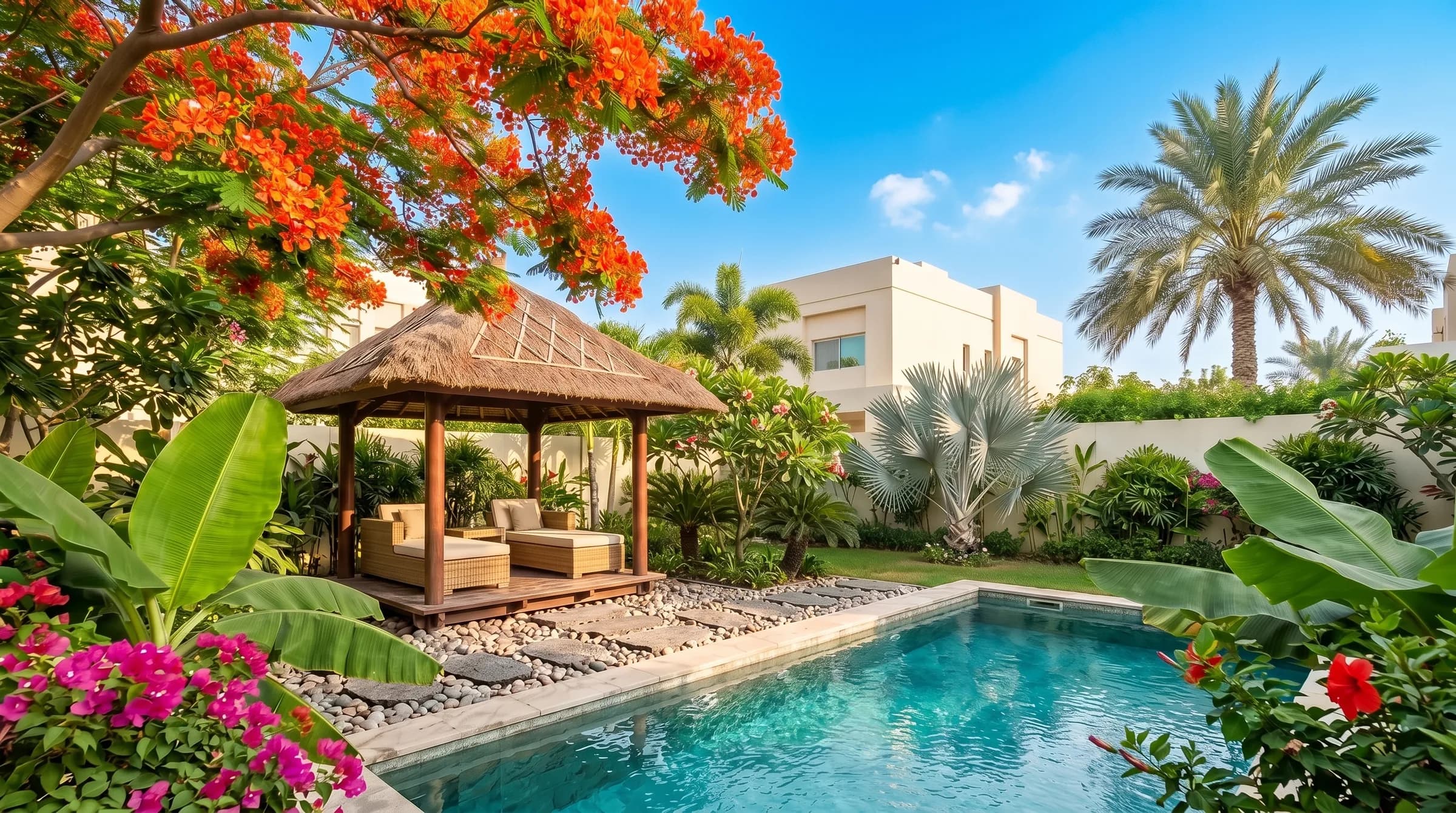
Layered palms and a flowering canopy wrap the whole plot in green.
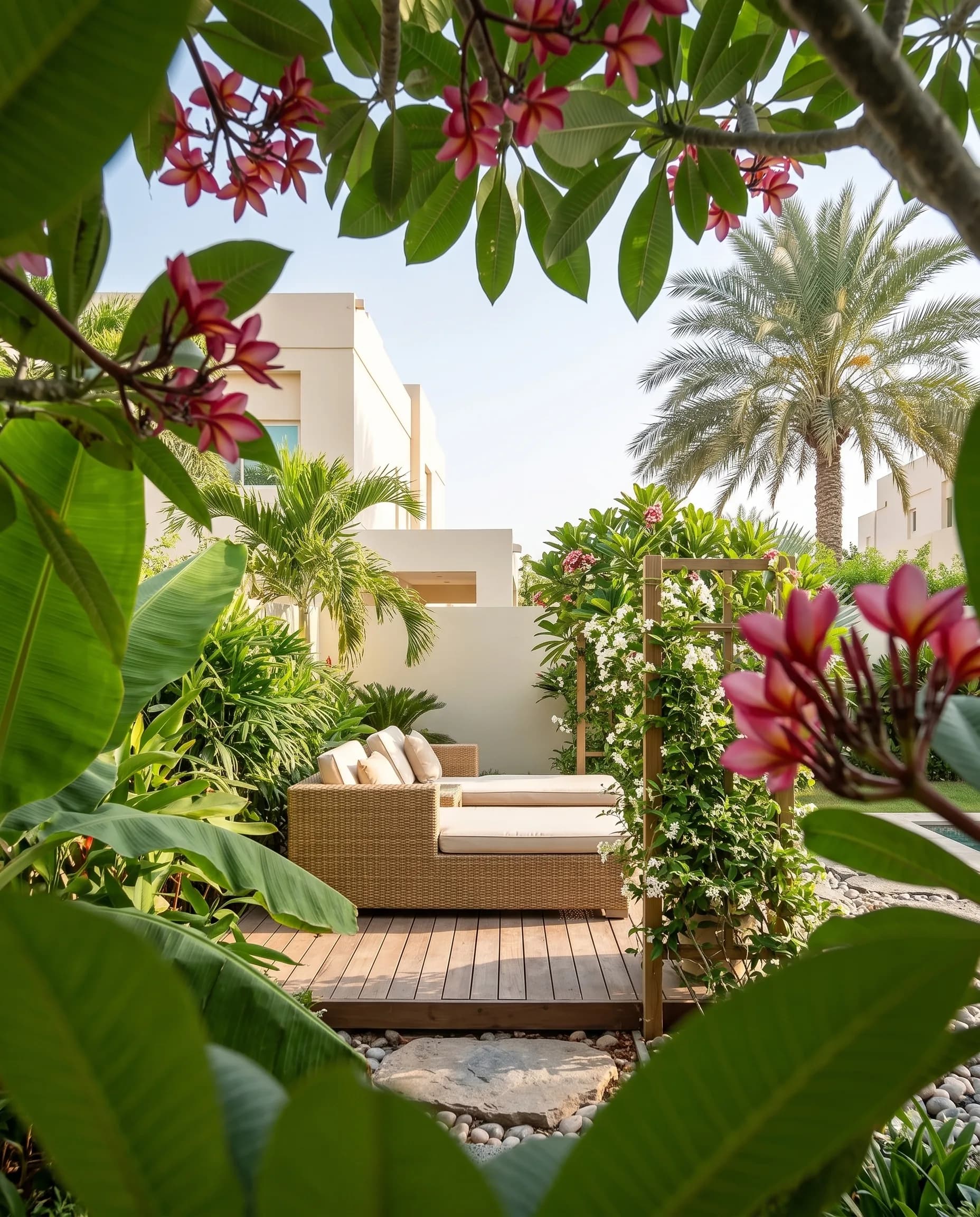
A teak daybed tucked between frangipani and jasmine.
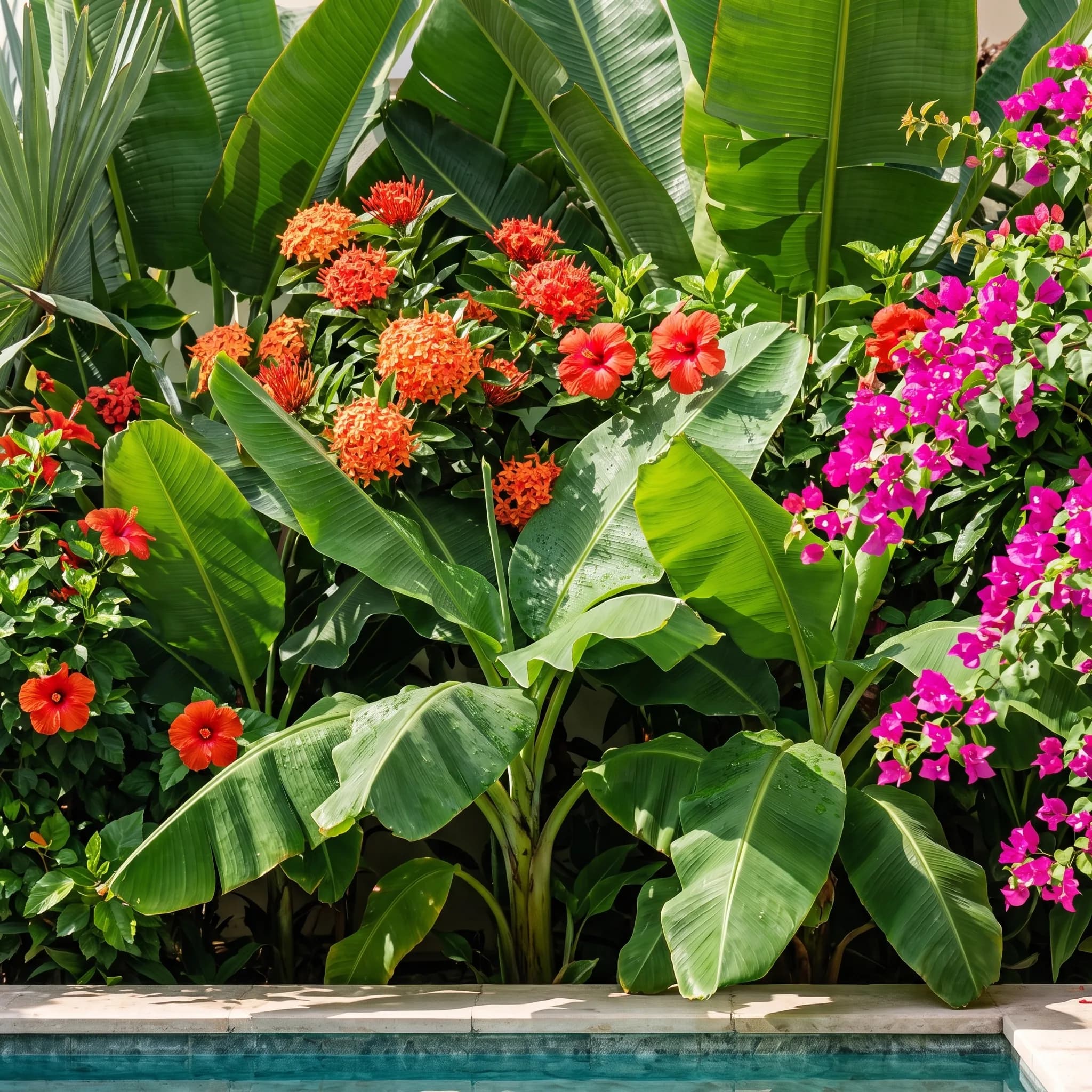
Banana leaves, ixora and bougainvillea in full colour.
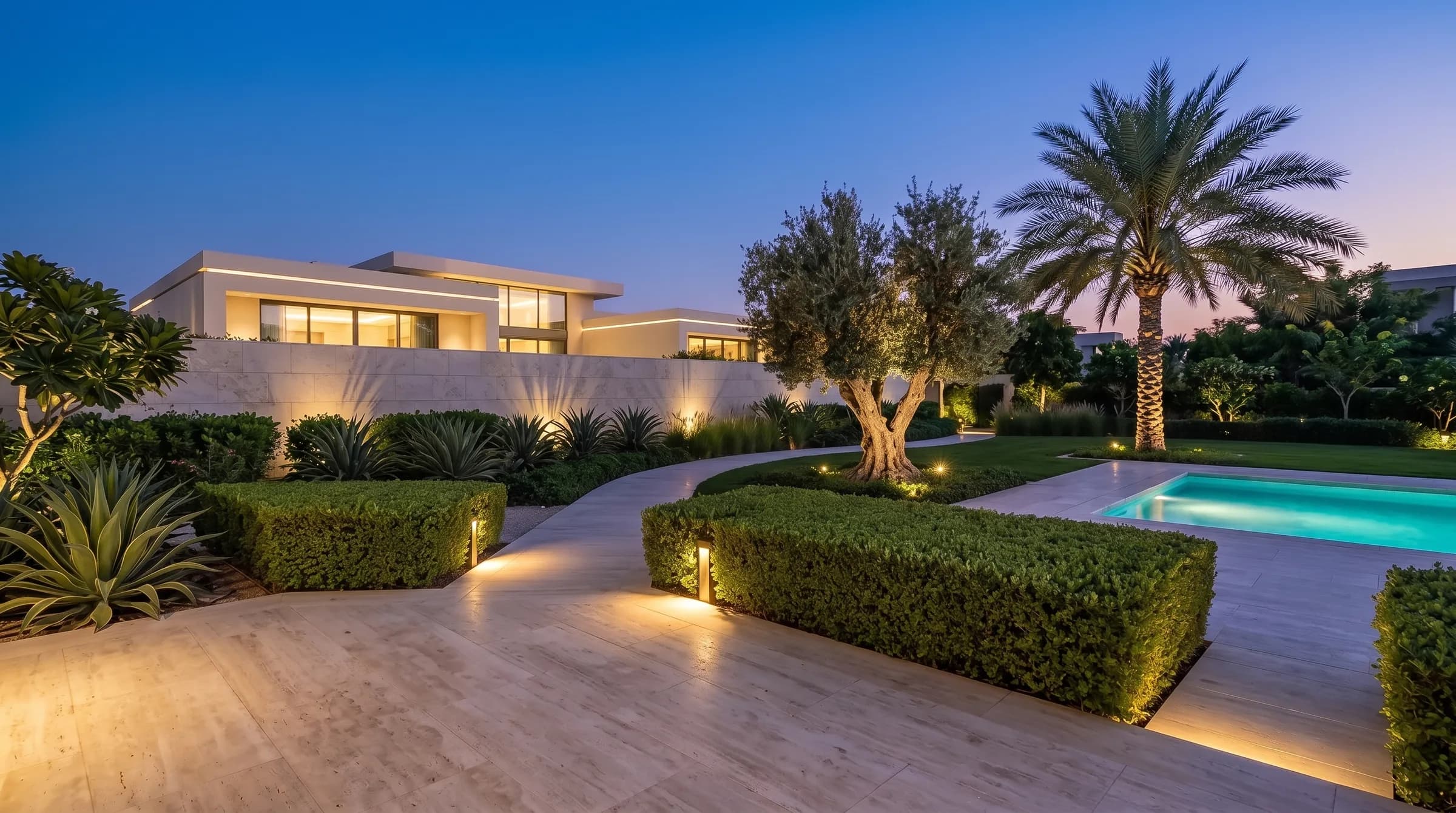
After sunset, it glows.
Materials & palette
What it's built from
Teak or ipe-look timber decking · Natural volcanic-look stone stepping pads · Plunge or reflecting pool with stone coping · Rounded river pebble beds · Timber gazebo or open-sided pavilion (bale) · Stone or bamboo lanterns · Warm 2700-3000K low-voltage uplighting
Key plants
What grows into the tropical & jungly look

Banana
The plant behind the Bali-villa look: fast and dramatic, and genuinely fruits in Dubai gardens — but only in a wind-sheltered spot with daily summer water. The thirstiest, least wind-tolerant plant here.

Bird of paradise
An architectural, banana-leaved plant grown across Dubai for its orange-and-blue flowers; more drought-tolerant than it looks once settled, but dislikes salty soil and flowers best away from harsh afternoon sun.

Traveller's palm
A dramatic, fan-shaped specimen from Madagascar, not a true palm, that gives instant height in full Dubai sun — but its huge leaves shred in open wind and it has no salt tolerance, so it needs a sheltered courtyard.

Elephant ear
A giant-leaved shade plant that brings jungle scale to a sheltered courtyard corner — needs real shade and consistently moist soil, and its sap irritates skin and eyes, so keep it away from small children.

Royal Poinciana
A wide, flat-crowned tree that turns solid red-orange for weeks around May to July, then gives deep summer shade — but it needs real space and a strong branch structure to stay safe in Dubai's wind.

Frangipani
A small, sculptural tree that goes bare through the Dubai winter and covers itself in fragrant, waxy flowers from spring to autumn — one of the easiest flowering trees for a hot, dry garden.

Foxtail Palm
A neat, self-cleaning palm from Queensland with bushy, foxtail-shaped fronds — a popular villa specimen in Dubai for its moderate size and low mess, though it wants more consistent water than a true desert palm.

Bougainvillea
Dubai's most reliable colour: a thorny, sun-loving climber that flowers hardest when watered a little less, not more, and covers walls, pergolas and boundaries on very little care.

Hibiscus
A genuinely tropical shrub that can flower almost every day of the year in Dubai — the trade-off is that it is one of the thirstiest common landscape plants here and needs watching for pests in heat.

Arabian Jasmine
The most fragrant plant in a Gulf garden: a true tropical jasmine that keeps flowering through summer heat rather than shutting down, best planted where its scent reaches a seating area.
The guide
Everything to know before you build tropical & jungly
Why choose it
The case for tropical & jungly
Mood
Lush, Layered, Bali-vibe, Fresh, Shaded
This is the Bali-villa look: a flowering canopy overhead, a mid-storey thick enough that no bare bed ever shows, and true banana-leaved plants doing the work a Balinese resort plot does with real banana groves. Royal Poinciana carries the canopy colour, Frangipani supplies the scent and silhouette every Bali-holiday photo has, and Foxtail Palm adds height and drama without needing the deep soil a full-size shade tree wants. Banana and Bird of paradise give the broad, paddle-leaved foliage the style is named for — both need a genuinely wind-sheltered spot, so keep them in a walled courtyard rather than an open lawn. Hibiscus and Bougainvillea keep colour going year-round, and Arabian Jasmine climbs a trellis or gazebo post for scent near seating.
The shadiest corners are where the two most dramatic, most demanding plants belong: Elephant ear for genuine jungle-scale leaves under a pergola or tree canopy, and a single Traveller's palm as a fan-shaped specimen wherever the spot is properly boxed in from wind. Treat both as accents for the most sheltered part of the plot, not the whole planting scheme — neither is a low-maintenance choice. None of this is native, and almost none of it is drought-tolerant — it is the opposite bet to desert modern. A plunge or reflecting pool rather than a large resort pool keeps the water feature itself proportionate to a villa garden rather than a hotel; a real, well-kept version of this style in Dubai (documented in Emirates Hills, Al Barari and elsewhere) leans on shade structures, dense planting and a decent irrigation system to survive summer, not on any plant here being naturally suited to the climate.
Expect real trade-offs before committing: shade takes two to three years to establish from scratch, hardwood decking gets hot enough underfoot in direct sun that it usually needs a shaded location, and this is consistently the highest water and labour demand of the four styles on this site — banana and elephant ear alone need near-daily summer watering to look like the reference photos.
Most gardens here are a negotiation with the climate: hold the line against the heat, keep water use defensible, get something green out of six months of real growing season. Tropical does something different. Layer three tiers of planting tight enough that no bed ever shows bare soil, and the garden stops behaving like a plot and starts behaving like a room, walled by leaf rather than rendered block, roofed by a flowering canopy rather than open sky. Everywhere else in a Dubai villa reads as outside. This reads as inside, but green.
The practical case is just as real, if less romantic. A dense canopy is genuine outdoor shade, the kind that makes a plunge pool and a timber daybed usable at four in the afternoon rather than only after dark. Royal Poinciana and Frangipani do the overhead work; Foxtail Palm adds height without the root run of a full shade tree. None of it is native and almost none of it is drought-tolerant, so go in with eyes open: it is the highest water and labour demand of the four styles here, and it buys shade, screening and a look nothing else on this list produces.
There's also the matter of privacy and proportion. A plunge or reflecting pool, not a full resort pool, keeps the water in scale with dense planting and a villa-sized plot, and the layered screening at the boundary means this style doesn't need a taller wall to feel private, it borrows privacy from foliage instead of block work. Real versions of this look exist in Dubai today, in Emirates Hills and Al Barari, built on exactly this trade: water and labour for shade, screening and a garden that feels like nowhere else on the street.
- The most distinctive, least-copied look of the four styles on this site
- Genuine outdoor shade and privacy screening from dense, layered planting
- Scales down well to a plunge pool and courtyard rather than needing a large plot
- Shaded or partly shaded plots, or owners willing to fund a shade structure early
- Owners set on the Bali-resort look and prepared for the water bill that comes with it
- Villas with a modest plunge/reflecting pool rather than a full swimming pool as the water feature
What it feels like
A day in the garden
Morning here starts wet. Drip lines finish their run before the heat builds, so the stepping stones are still faintly dark with water when anyone is outside, and the air smells of damp soil and Frangipani, a scent that turns almost sweet in the first hour of light and fades by nine. Low sun comes through the canopy in patches rather than sheets, so the teak decking is warm, not yet hot, and there's enough dappled shade under Royal Poinciana to sit outside with coffee before the day turns.
By midday the canopy is doing its actual job. Under Foxtail Palm and a mature flowering tree, the air reads noticeably cooler than the open paving a few metres away, enough of a difference that a shaded seating pocket stays usable through the hottest hours, provided it was positioned under real canopy rather than open sky. Touch the timber decking in full sun and it's uncomfortably hot; touch it in shade and it's merely warm. Elephant ear and Bird of paradise hold their broad leaves rigid and glossy rather than wilting, proof the irrigation is keeping pace with the heat.
Evening is when the style earns its name. Warm uplights pick out trunks and the underside of the canopy rather than flooding the whole plot, a stone or bamboo lantern glows beside the plunge pool, and string lighting over a gazebo turns a dining spot into a room that has walls even though it doesn't. Arabian Jasmine carries its scent further and more sweetly after dark than at any point in daylight, and the pool itself goes from a bright turquoise rectangle at five to a quiet, lit sheet of water by eight, reflecting the lanterns rather than the sky.
How the look is built
The choices behind the look
Three-tier planting
Canopy (Royal Poinciana, Frangipani), mid-storey (Foxtail Palm, Hibiscus, Bougainvillea) and groundcover are planted to overlap, so gaps close within two to three years rather than being left as mulch between specimens.
No bare bed ever shows, which is what makes the planting read as jungle rather than as a collection of individual shrubs.
Banana-leaved accents
Bird of paradise and Elephant ear go in the most sheltered, shadiest corners, a courtyard wall or under an existing tree, rather than scattered through the open bed, since both need real wind shelter to keep their leaves from shredding.
Those broad paddle leaves are the one detail most people picture when they say Bali villa, so a few well-placed specimens do more for the look than a whole bed of them would.
Plunge or reflecting pool
A small, stone-edged plunge or reflecting pool replaces a full resort pool, usually finished in dark or stone-lined tile rather than bright blue.
The water reads as still and considered rather than as the main event, keeping the garden in scale with the planting around it instead of competing with it.
Warm low lighting
Uplights at 2700 to 3000K aim into the canopy and up tree trunks rather than at the ground, backed up by a stone or bamboo lantern and string lighting over the seating pocket.
Light comes from inside the planting rather than from above it, so the garden glows rather than being lit, the difference between a floodlit car park and a room with lamps.
Teak or stone hardscape
Teak or ipe-look decking and natural volcanic-stone stepping pads replace a continuous path, set into gravel or groundcover rather than poured as a slab.
Timber reads warm and residential rather than commercial, though it needs a shaded run, in full sun it gets too hot to cross barefoot at midday, which is exactly why the canopy above it isn't optional.
Drip irrigation, run hard
Beds run on drip, watered more heavily and more often than anywhere else on this site, Banana and Elephant ear both want the soil kept consistently moist through summer.
Consistent moisture keeps the broad leaves rigid and glossy instead of folding and browning at the edges, the biggest visual gap between a well-run tropical garden and a struggling one.
Stepping-stone path
A stepping-stone route through the planting replaces a straight paved axis, set at a deliberately irregular rhythm rather than evenly spaced.
Walking the garden becomes a small journey rather than a straight line from gate to door, which is most of what makes a modest plot feel larger than it is.
Boundary softened on every side
Planting runs the full perimeter rather than stopping at one feature bed, so the rendered wall shows in glimpses rather than as a continuous line.
Privacy comes from foliage depth rather than wall height, and the garden loses the bounded-rectangle feel a lawn-and-border layout keeps.
Living with it
What it actually takes to keep
This is the most demanding style on this site, honestly. Three planting tiers need pruning, feeding and pest-watching through the growing season to stay dense rather than gappy, the broad-leaved accents want real attention in peak summer, and the irrigation system runs more zones and more run-time than anywhere else here. None of that is a reason to avoid it, it's a reason to budget a proper maintenance visit into the plan from day one rather than assume the garden looks after itself once planted, because at this density neglect shows within weeks, not months.
Weekly
- Check drip emitters on Banana and Elephant ear haven't blocked, both wilt fast once a line fails
- Deadhead spent Hibiscus and Bougainvillea blooms to keep the colour coming
- Skim and brush the plunge pool, a leaf-dropping canopy fouls water faster than an open pool does
- Walk the boundary for gaps in the mid-storey where light is reaching bare soil
Monthly
- Feed flowering shrubs through the growing season to support near-continuous colour
- Check Foxtail Palm fronds for leaf-spot fungus, especially if overhead watering has crept in
- Tie climbing Arabian Jasmine back onto its support before it swamps neighbouring plants
- Hose dust off broad foliage after a windy spell so the leaves keep their gloss
Seasonal
- Prune Royal Poinciana in late March to April, before spring growth, to keep a strong branch structure
- Prune Bougainvillea hard straight after its main bloom in mid-spring, never in late summer or autumn, which cuts into next year's flowering
- Cut Frangipani back to shape in late winter, before new leaves appear
- Remove each Banana stem after it fruits, it won't flower again and left in place it just crowds the clump
- Refresh mulch and reassess the irrigation schedule in October, the start of the main autumn growth window
Drip on every bed, run longer and more often than any other style here, banana and elephant ear alone can want near-daily deep watering in peak summer, tapering to two or three times a week in winter. Hydrozone the thirstiest accents, banana, elephant ear, hibiscus, on their own line rather than sharing a zone with the more moderate frangipani and bougainvillea, so one plant's needs don't over- or under-water the other.
Watch-outs
- Wind shreds banana and bird-of-paradise leaves fast, plant them only in a genuinely walled, sheltered corner, never an open lawn edge
- Banana, elephant ear and traveller's palm all carry the lowest salt tolerance on this site, so test irrigation water salinity before committing to them, especially on borehole or TSE supply
- Overhead watering invites leaf-spot fungus on palms, keep irrigation at the base
- A leaf-dropping canopy fouls a plunge pool fast, budget for more frequent skimming
Trade-offs
- Highest water demand of any style here — expect the largest DEWA irrigation bill
- Most labour-intensive to maintain: year-round pruning, feeding and pest-watching to keep the layers dense
- Full sun without shelter is hard on the most tropical-looking accent plants; shade has to be designed in, not assumed
Who it's for
Is this plot, and this owner, the right fit
Good fit
- Owners set on the Bali-resort look who are prepared to pay for the water and labour it takes to hold
- Shaded or partly shaded plots, or anyone willing to fund a shade structure early rather than wait for the canopy to grow in
- Villas built around a plunge or reflecting pool rather than a full resort pool
- Anyone who wants a garden that reads as private rooms rather than one open lawn
Not for
- Open, fully exposed plots with no wall, pergola or existing tree to shelter the most tropical-looking accents from wind
- Owners who want the lowest possible water bill or a genuinely low-maintenance routine
- Anyone planning to leave the garden to an occasional visit rather than regular attention
- Plots where a full-size resort pool, not a plunge pool, is the non-negotiable centrepiece
Effort
5 of 5
Water
High
Build cost
AED 230–520/m²
Signature features
- Three-tier layered planting with no bare bed showing
- Plunge or reflecting pool as a calm focal point, not a large resort pool
- Shaded gazebo/bale seating pocket
- Stepping-stone path instead of a straight axis
- Boundary wall fully softened by planting on all sides
What people assume
Common assumptions, checked against reality
It's basically a rainforest garden.
It's closer to a curated Bali-resort reading built from the handful of tropical-looking species that genuinely survive Dubai's heat and salinity, frangipani, foxtail palm, hibiscus, bougainvillea, arranged in dense layers, not an actual rainforest plant list.
Once it's planted, it looks after itself.
This is the most labour-intensive style here, year-round pruning, feeding and pest-watching are what keep three planting tiers dense instead of gappy.
A jungle look needs full shade everywhere.
Most of the canopy and colour plants, royal poinciana, frangipani, bougainvillea, want full sun; it's specifically the banana-leaved accents that need shelter, not the whole garden.
It must use less water than a lawn because there's no grass.
It's the opposite. There's no lawn here, but the layered planting and broad-leaved accents make this the highest water demand of the four styles on this site.
Banana and bird-of-paradise are exotic novelties that won't really thrive here.
Both are genuinely grown in Dubai villa gardens today, including banana specimens fruiting heavily enough to need staking, they just need the wind shelter and consistent water their profile calls for.
Dubai notes
Climate, salinity and approvals
Summer is the real test of this style. Dubai's June to September heat regularly reaches the low-to-mid 40s°C with coastal humidity past 80%, hardest on exactly the plants this look depends on, since broad, soft leaves lose water fast in heat and humidity together. Shade and consistent drip irrigation aren't optional extras here, they're what separates a tropical garden that holds its look through August from one scorched by July.
Wind is the second constraint, and it's a design decision, not a watering one. Banana, bird-of-paradise and similar broad-leaved accents all shred in open wind, so they only belong in a genuinely walled or courtyard-enclosed spot, checked before planting, not after.
Where irrigation runs on treated sewage effluent rather than DEWA mains, budget for a dedicated filter on the drip lines, TSE generally needs its own filtration to protect emitters from sediment, and it's worth confirming the requirement with the community or utility before the system is designed.
As with any style that adds a pergola, gazebo or changes to boundary planting, check your community's landscaping guidelines, Emaar, Nakheel or the relevant owners' association, before building. Requirements vary by community and are worth confirming early rather than after the structure goes up.
Make it yours
Three ways to adapt it
On a townhouse plot
Drop the plunge pool for a single reflecting basin or a stone water bowl, keep the three-tier planting but on one boundary wall rather than all four, and let a single royal poinciana or frangipani do the canopy job a grove would do on a larger plot. The gazebo shrinks to one shaded daybed corner.
Without a pool
The water feature can be a tiled rill or a shallow, stone-edged basin rather than anything swimmable, it still gives the reflective, cooling presence the style wants without the build cost or upkeep of a pool. Keep it planted right to the edge so it reads as part of the garden, not a separate feature.
A lower-water version
Swap banana and elephant ear, the two thirstiest, most demanding accents, for bird-of-paradise alone, which holds a similar architectural leaf shape on markedly less water. It won't be quite as lush, but it keeps the silhouette without the near-daily summer watering the true banana-leaved plants need.
FAQ
Common questions
Is a genuine Bali-villa look achievable in Dubai, or is this mostly aspirational?
Do I need banana or traveller's-palm-type plants specifically, or can our plant list deliver the look without them?
Why a plunge pool instead of a full pool?
Want this in your garden?
Keep it this fresh with Garden Care from AED 500/month.
Keep exploring