
Aloe vera
Aloe vera
Sun/part shadeSalt: 2 of 5
Adapted
Agave americana
أغاف
A sculptural, spine-tipped rosette that needs almost no water or care once planted — the architectural anchor of a desert-modern garden, not a plant for a path edge.
See it planted
Season
How Agave behaves through Dubai's seasons, month by month.
Best planting window
New leaf growth
Remove dried lower leaves
Peak summer heat
Best planting window: Mar, Sep–Nov
Plant offsets or nursery specimens in the cooler months so roots establish before summer heat.
New leaf growth: Mar–May
Fresh centre leaves emerge as the rosette slowly expands through spring.
Remove dried lower leaves: Jan–Feb
Cut back dried or damaged outer leaves with gloves and long sleeves — the sap irritates skin.
Peak summer heat: Jun–Aug
Well within its comfort zone; established plants need little intervention even in extreme heat.
Agave barely changes face through the year, which is the point. Fresh centre leaves push through in spring (March–May), the rosette inching wider rather than producing anything as fleeting as a foliage flush. Through peak summer (June–August) it holds its blue-grey colour and rigid form without visible strain while softer plants around it wilt. Midwinter (January–February) is simply tidy-up time: cut away any dried, browning outer leaves at the base, gloved, to keep the silhouette clean. Expect no seasonal drama at all until, once in its lifetime after ten to thirty years, a flowering spike rises metres above the rosette.
Meet the plant
Meet the agave, the plant that solved Dubai's biggest gardening problem before anyone had to ask it to. Where most ornamentals need cosseting through summer, an established agave simply sits there being magnificent — a tight, symmetrical fountain of blue-grey blades radiating from a single point, each one finishing in a spine sharp enough to draw blood if you forget it is there.
Its character is blunt: agave does not soften a garden, it sharpens one. Place a single specimen in a gravel bed against a rendered wall and the whole composition reads as considered rather than planted — the kind of restraint that is harder to pull off than a border crammed with colour. People love it for exactly that discipline: one plant doing the work of a whole bed, asking almost nothing in return.
What it brings to the mood is stillness. It does not rustle, drop petals or need deadheading; it just holds its shape through the hottest months, a fixed point the rest of the garden can move around. And there is drama held in reserve — the decades-long wait for a single flowering spike that, when it finally comes, means the story is ending as spectacularly as it lived.
Agave americana is grown for its shape, not its flowers: a huge, symmetrical rosette of thick, blue-grey leaves, each tipped with a sharp spine and often edged with smaller hooked teeth. In a desert-modern Dubai garden it works as a single dramatic focal point — in gravel, against a wall, in a large pot — doing more with less water than almost anything else in the plant library.
Once established it is close to maintenance-free: no feeding needed, and watering only two or three times a month in summer is typical once the roots are down, less in winter. That toughness comes with two real hazards worth planning around. The spines are stiff enough to injure, so keep it well away from paths, play areas and low windows. The sap itself contains calcium oxalate crystals and irritant compounds that can cause a burning, blistering contact dermatitis on skin — wear gloves and long sleeves for any pruning or handling of a damaged leaf.
It is also monocarpic: after ten to thirty years, a mature rosette sends up a tall flowering spike, blooms once, and then the original rosette dies — hence the common name "century plant", though it rarely takes a century. By the time that happens it has usually produced offsets ("pups") around its base, so the planting carries on even as the parent dies back. Pair it with Crown of thorns or Aloe vera for a layered, no-irrigation succulent bed.
Design
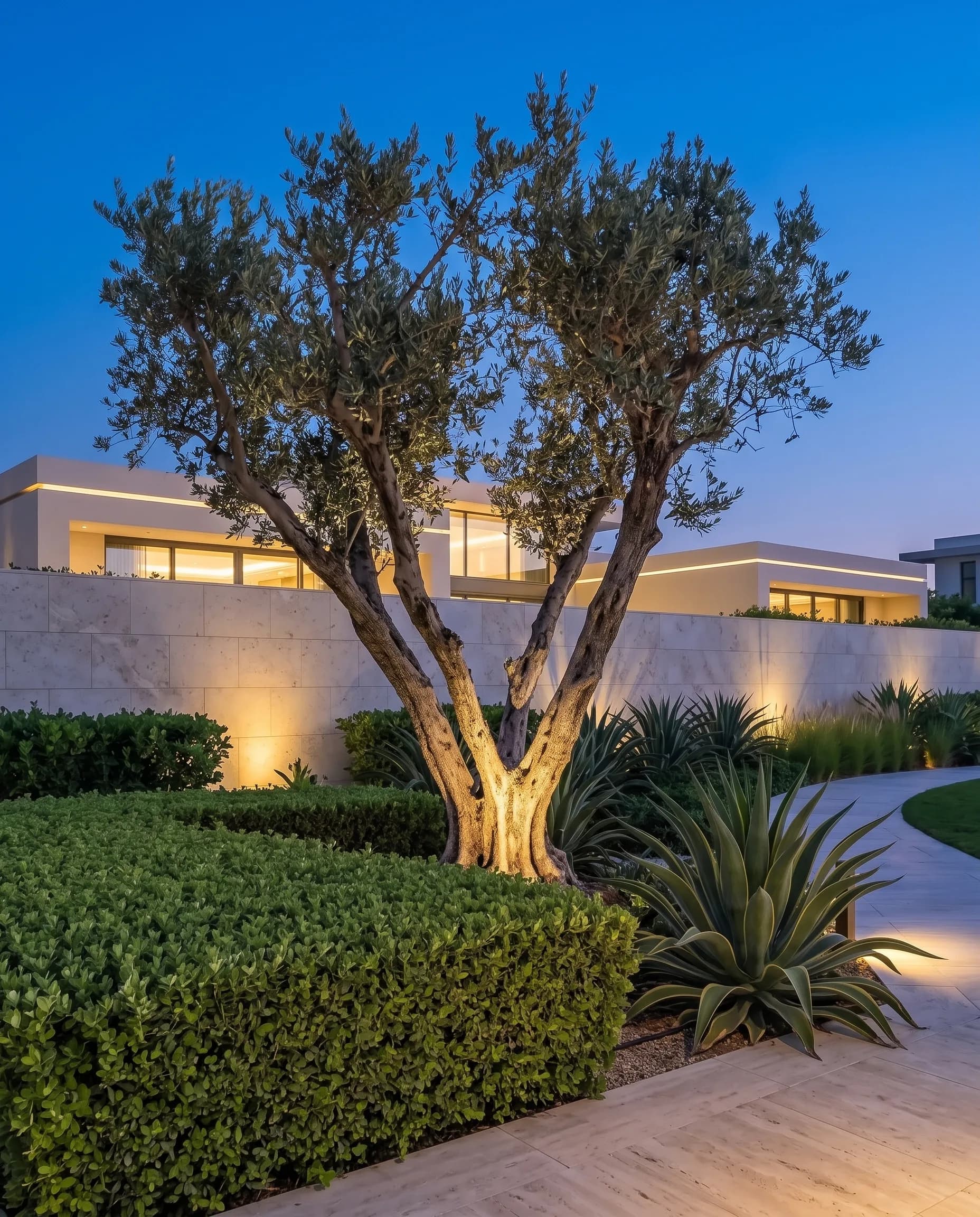
Give it uninterrupted sun and a spot it can hold for decades — agave resents being moved, and its spines make later repositioning a hazard in itself. It is at its best isolated: a single rosette in gravel against a rendered wall, or a matched pair flanking an entrance, rather than massed with other planting. Keep it at least a metre back from paths, pool decks and anywhere children play, and give its eventual 1.5–3 m spread real room before committing it to a tight bed. The result is a garden that reads as composed and architectural rather than lush.

Crown of thorns
Similar low-water succulent logic in a contrasting form — rigid blue-grey blades against crown of thorns' looser, flowering stems.
Aloe vera
Shares free-draining soil and near-zero irrigation, so the two group easily in one dry bed without conflicting care.

Desert Rose
Contrasts agave's rigid geometry with the desert rose's rounded caudex and bright flowers for texture variety in a succulent planting.
Care guide
Summer: Two to three deep waterings a month is typical for an established plant; more is more likely to cause rot than help it.
Winter: Rainfall is often enough; irrigate only in an extended dry spell.
Establishment: Water every 4–5 days for the first month or two while roots establish.
Avoid these
Extra notes
Toxicity: The sap contains calcium oxalate crystals and other irritant compounds that cause contact dermatitis — redness, burning and sometimes blistering — on contact with skin or eyes. Wear gloves and eye protection when pruning or removing damaged leaves, and keep cut material away from children and pets.
FAQ
Not sure how it suits your garden?
Ask about Agave on WhatsAppKeep exploring
Aloe vera
Aloe vera
Crown of thorns
Euphorbia milii
Desert Rose
Adenium obesum
Sources
Last reviewed 2026-09-30 by Ghaf Gardens horticulture desk.
Pool + garden care
From AED 500/month
Price depends on your garden's size, pool and complexity. Prices in AED, excluding 5% VAT.