Date Palm
Phoenix dactylifera
Full sunSalt: 4 of 5
Native
Washingtonia robusta
نخيل واشنطونيا
A fast, very tall fan palm used across Dubai as an avenue and skyline tree: full sun, wind- and salt-tolerant, but it eventually outgrows small gardens and needs its dead-frond skirt managed.
See it planted
Season
How Washingtonia Palm behaves through Dubai's seasons, month by month.
Best planting/transplant window
Cream-coloured flower clusters
Small black fruit follows flowering
Remove dead fronds and spent flower/fruit stalks before summer
Peak heat
Red palm weevil monitoring
Best planting/transplant window: Mar–Apr, Oct–Nov
Spring or autumn, avoiding the coolest and the most extreme heat weeks, gives roots time to re-establish.
Cream-coloured flower clusters: May–Jul
Small black fruit follows flowering: Jul–Sep
Fruit drop can be messy on paving and pools below the crown.
Remove dead fronds and spent flower/fruit stalks before summer: Mar–Apr
Only fully brown material; never cut green fronds or top the crown.
Peak heat: Jun–Aug
Water more frequently in high summer; young and recently transplanted palms are most at risk.
Red palm weevil monitoring: Jan–Dec
Check trunk and crown for tunnels, ooze, frass or a fermented smell year-round.
Washingtonia palm grows steadily through the warm months, with cream-coloured flower clusters appearing from around May to July followed by small black fruit through August and September that can be messy on paving or pools beneath the crown. Spring, before summer heat sets in, is the best window to remove dead fronds and spent flower or fruit stalks. Through peak summer, June to August, watering needs rise and recently transplanted or young palms are most at risk of stress. Red palm weevil monitoring — checking the trunk and crown for tunnels, ooze, frass or a fermented smell — is a year-round task rather than a seasonal one, since the pest is active whenever conditions allow.
Meet the plant
Meet the Washingtonia palm, the tree that gives Dubai's drives and boulevards their rhythm. Nothing else grown here gains height quite this fast on such a slender trunk, and a mature avenue of them reads as pure verticality — repeated columns against the sky, crowned with a burst of fan-shaped fronds that catch even a light breeze and set it moving.
Its personality is defined by that contradiction between speed and scale: a young plant looks almost modest, and within a decade or two it can tower well above a two-storey villa roofline, a growth rate few other palms match. The thick skirt of dead fronds that builds up beneath the crown, left in place, adds a wilder, more textured silhouette and shelters birds; stripped away, the trunk reads as clean and architectural instead — a genuine style choice rather than a right or wrong answer.
It brings height, movement and a sense of scale to a Dubai garden or streetscape that few other plants can match, provided there is truly room for it to keep growing for decades to come.
Washingtonia robusta, the Mexican fan palm, is not native to the Gulf but has naturalised into Dubai's streetscape the way a handful of other fast, tough palms have — it is native to northern Mexico, and grows in a similarly hot, bright climate with just enough underground moisture to keep it going. It is prized here for exactly what makes it a poor fit for a small courtyard: a slender trunk that shoots up fast and a crown that eventually towers well above rooftops, giving instant height and rhythm along drives and boundaries.
Its dead fronds fold down against the trunk rather than dropping cleanly, building a thick, skirted mane that many landscapes leave in place for texture (and as habitat for birds) and others strip for a cleaner, more manicured look. Either is fine horticulturally; only the skirt's fire risk and the sharp, tooth-edged petioles argue for removing it near paths and seating.
Despite its desert reputation, Washingtonia robusta is native to sites with permanent surface or underground water, so it is not as drought-hardy as it looks — establish it with regular watering and expect it to slow, not thrive, on minimal irrigation. It works well paired with Date Palm and Foxtail Palm for a mixed-height palm avenue.
Like every palm grown in the UAE, it is a potential host for red palm weevil, the region's most serious palm pest, which has driven mandatory monitoring, reporting and licensed-pesticide protocols across the country since it was first recorded in the UAE in the 1980s. That isn't a reason to avoid the species — date palms, the country's most valuable tree crop, face the same risk — but it does mean routine inspection is part of responsible ownership, not an optional extra.
Design
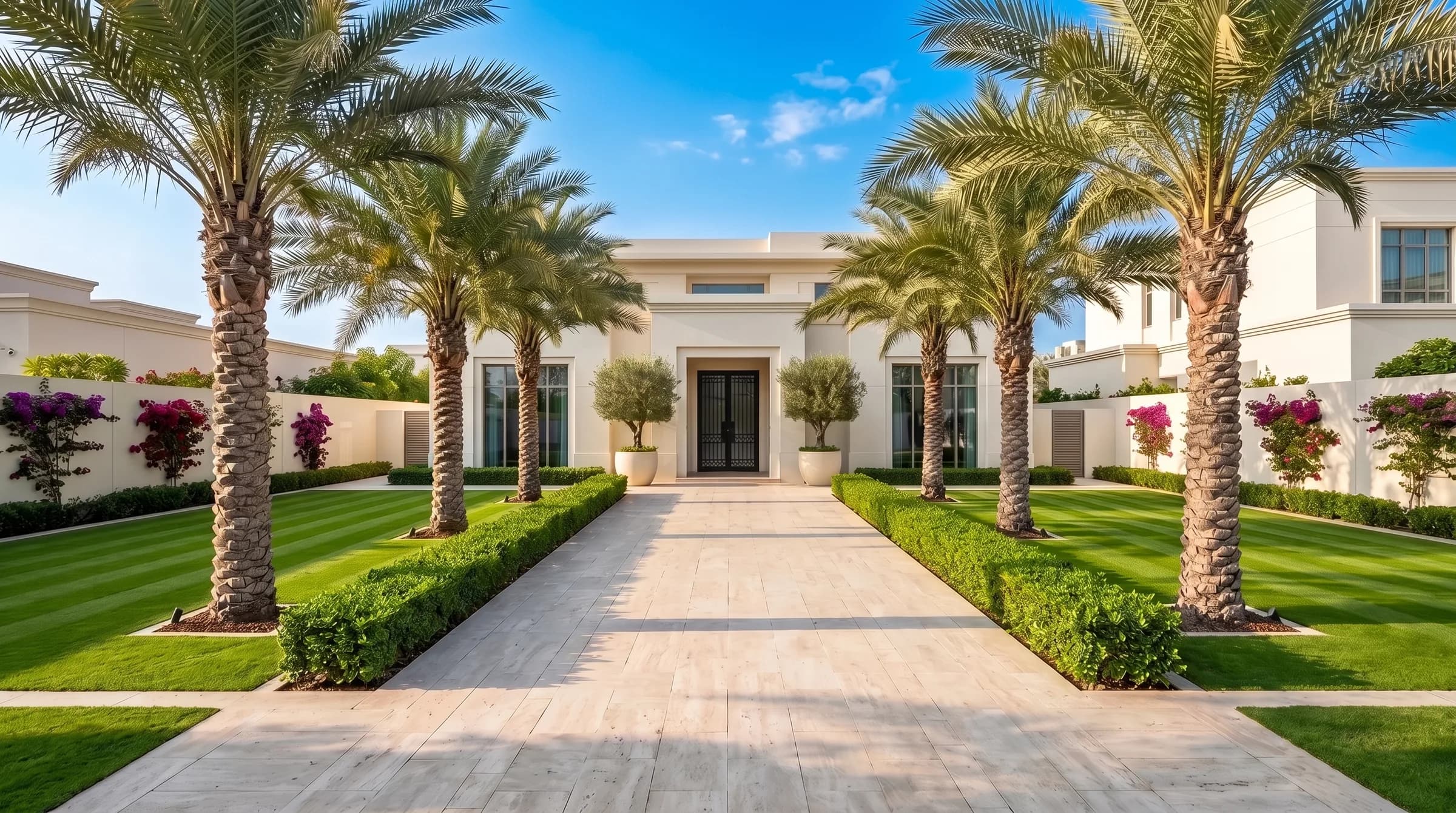
Plant it where its eventual height, not its current size, makes sense — along a drive, a boundary line, or in a repeated avenue where verticality and rhythm matter more than shade. Avoid siting it close to overhead cables, rooflines or anywhere its mature 10–20 m height would eventually conflict with structures. Keep the base clear of paths and seating given the sharp, tooth-edged petioles, and decide early whether the dead-frond skirt will be left for texture or stripped for a cleaner line, since that affects how close it can comfortably sit to walkways. Its narrow footprint makes it a practical choice for tight side gardens where a broad-canopied tree would not fit.
Date Palm
Date palm's shorter, thicker trunk and productive fronds contrast well with Washingtonia's tall, slender profile in a mixed-height palm avenue.

Foxtail Palm
Foxtail palm's fuller, more symmetrical crown adds variety of form alongside Washingtonia's narrower silhouette without competing on height.

Bismarck Palm
Bismarck palm's broad, silvery-blue crown provides strong visual contrast to Washingtonia's tall, narrow form when planted as a specimen counterpoint.
Care guide
Summer: Deep soak 2–3 times a week for an established palm in peak heat.
Winter: Roughly weekly deep watering is usually enough.
Establishment: Deep, regular watering for the first year or two — this species is native to sites with reliable underground water and establishes poorly on minimal irrigation.
Avoid these
Extra notes
Toxicity: Not known to be toxic.
FAQ
Not sure how it suits your garden?
Ask about Washingtonia Palm on WhatsAppKeep exploring
Date Palm
Phoenix dactylifera
Foxtail Palm
Wodyetia bifurcata
Bismarck Palm
Bismarckia nobilis
Sources
Last reviewed 2026-09-30 by Ghaf Gardens horticulture desk.
Pool + garden care
From AED 500/month
Price depends on your garden's size, pool and complexity. Prices in AED, excluding 5% VAT.