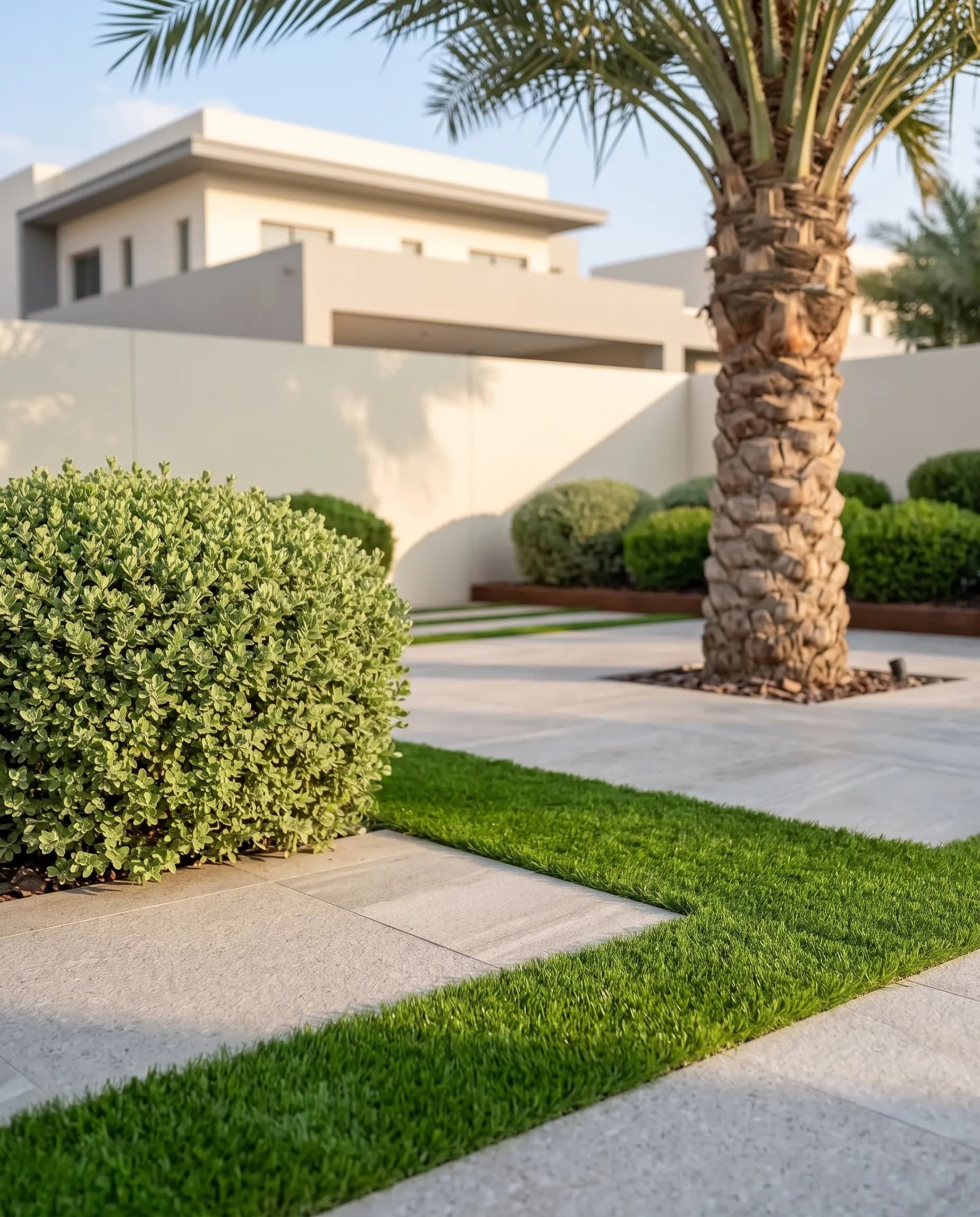

Ghaf
Prosopis cineraria
Full sunSalt: 4 of 5
Native
Pennisetum divisum
ثمام
A native, clump-forming desert grass that survives on rainfall alone in the wild — not a lawn grass, but a tough, low-water accent for desert-modern planting.
See it planted
Season
How Desert grass behaves through Dubai's seasons, month by month.
Best planting window
Bristly flower spikes
Fresh leaf growth after winter rain
Cut back for tidiness
Best planting window: Sep–Dec
Plant in the cooler months so the root system establishes before summer heat.
Bristly flower spikes: Feb–Apr
Cream to purple-tinged flower spikes appear on established clumps in spring.
Fresh leaf growth after winter rain: Mar–Apr
Cut back for tidiness: Feb
An annual hard cut-back to around 150–200 mm keeps the clump neat and encourages fresh growth; not essential, but tidier for a garden setting than leaving it wild.
Desert grass follows the desert's own rhythm rather than a garden calendar. Plant in the cool season (September–December) so roots settle before summer heat. Winter rain, when it falls, triggers fresh leaf growth through March–April, and established clumps send up soft, bristly cream-to-purple flower spikes from February through April — the plant's one real seasonal display. An optional hard cut-back to around 150–200 mm in February tidies the clump and refreshes it for spring, though leaving it uncut looks equally at home in a naturalistic planting. Through summer it simply holds on with minimal or no supplemental water, exactly as it does in the wild.
Meet the plant
Meet desert grass, a plant that never needed a garden to prove itself. Long before anyone planted it deliberately, ecologists surveying Al Ain's Wadi Tarabat found it to be the single most important species in that stretch of desert — not the showiest, just the one doing the most work holding the ecosystem together, anchoring loose sand against the wind with nothing but whatever rain happened to fall.
Its character in a garden is loose and unruly compared with the trimmed hedges and mown lawns around it — a woody-based clump of fine blue-green blades that arch and sway rather than sit still, topped in spring with soft, bristly flower spikes that catch low light beautifully. Where most of Dubai's planting aims for tidiness, desert grass offers something closer to honesty: this is roughly what the ground here actually wants to grow.
What it brings to the mood of a garden is movement and a sense of place. It sways in a breeze that barely stirs a clipped hedge, and drifted through gravel or beneath a light canopy it reads as a deliberate nod to the desert the whole city is built on, rather than an import pretending otherwise.
Desert grass grows wild across the UAE's sandy plains, rocky slopes and wadi beds, from Abu Dhabi to Dubai, Sharjah and Fujairah. Reviews of UAE native vegetation record it as one of the most important species in some of the country's protected desert ecosystems — in Al Ain's Wadi Tarabat, for example, it was found to have the highest importance value of any plant surveyed — because it anchors loose sand and survives on whatever rain falls, with no supplemental irrigation at all.
It grows as a woody-based, arching clump of fine, blue-green leaves up to about 1.2 m tall, topped with soft, bristly cream-to-purple flower spikes in spring. Unlike the turf grasses on this list, it is not mown into a lawn — it is planted as a specimen or drift in gravel, rock gardens and naturalistic desert-modern schemes, where its loose form and pale colour read as a deliberately wild counterpoint to clipped hedges and lawn.
Because it is a genuinely wild desert plant rather than a bred turf cultivar, hard numbers on salinity and irrigation tolerance are limited — but its natural habitat on saline desert soils and dry wadi beds says plenty on its own. Pair it with Ghaf or Hopbush for a low-water native planting scheme, or as underplanting where a light canopy still lets enough sun through.
Design
Use it where a garden wants to read as genuinely desert rather than imported — drifted through gravel, massed on a slope that needs stabilising, or as loose underplanting beneath a high, light canopy like a date palm where enough sun still reaches the ground. It needs full sun and free-draining, even poor soil to perform at its best; a rich, irrigated bed works against its natural habit. Give clumps room (0.4–0.8 m apart) to reach their full arching form rather than crowding them for instant fullness.
Ghaf
Both are UAE natives adapted to the same rainfall-only conditions, giving a planting scheme genuine ecological and visual coherence.

Hopbush
A similarly tough native shrub that shares desert grass's low-water, poor-soil preferences for a layered native planting.

Samr
Pairs naturally in a native desert-modern scheme, with desert grass's soft, low texture offsetting samr's more structured form.
Care guide
Summer: Established plants need very little supplemental water; an occasional deep soak is usually enough on top of whatever rain falls.
Winter: Rainfall alone is often sufficient; irrigate only in a prolonged dry spell.
Establishment: Water every few days for the first couple of months until the root system is established.
Avoid these
Extra notes
FAQ
Not sure how it suits your garden?
Ask about Desert grass on WhatsAppKeep exploring
Ghaf
Prosopis cineraria
Samr
Vachellia tortilis
Hopbush
Dodonaea viscosa

Bermuda grass
Cynodon dactylon
Sources
Last reviewed 2026-09-30 by Ghaf Gardens horticulture desk.
Pool + garden care
From AED 500/month
Price depends on your garden's size, pool and complexity. Prices in AED, excluding 5% VAT.