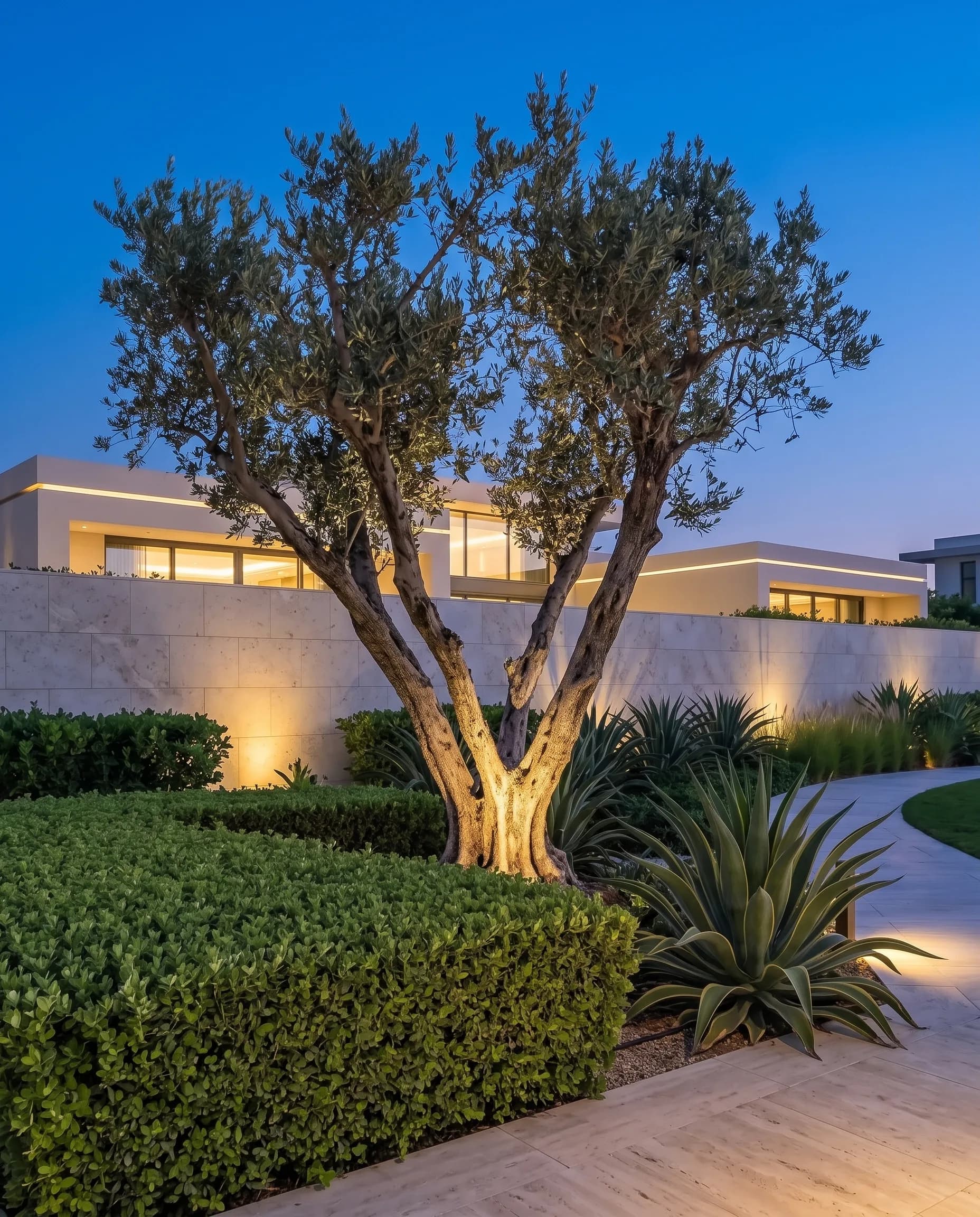
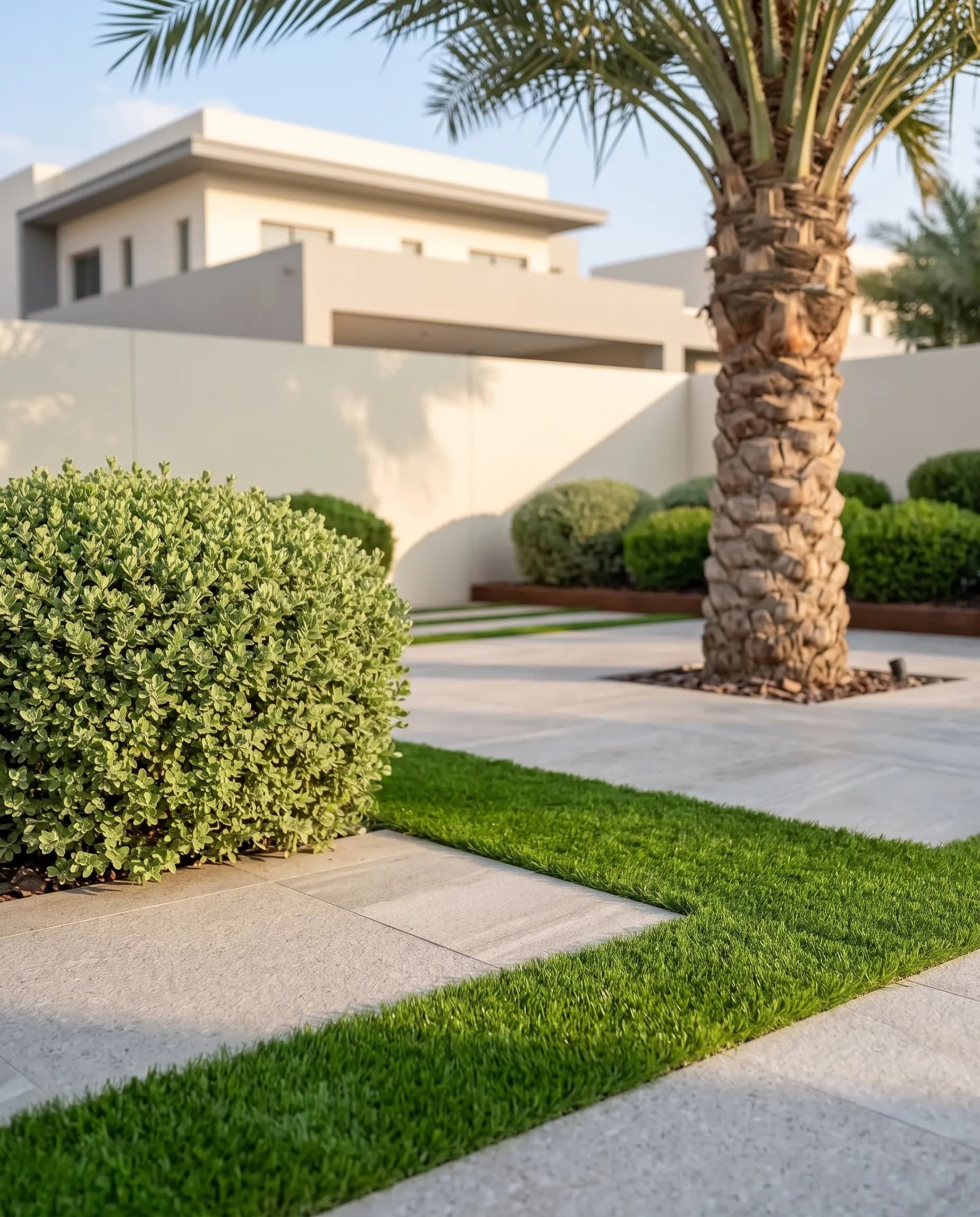

Sidr
Ziziphus spina-christi
Full sunSalt: 4 of 5
Native
Prosopis cineraria
غاف
The UAE's national tree: a deep-rooted native that stays green through summer, tolerates salty soil and needs very little water once established.
See it planted
Season
How Ghaf behaves through Dubai's seasons, month by month.
Best planting window
Light formative pruning
Fresh leaf flush
Small cream-yellow flower spikes
Long, slender pods
Best planting window: Oct–Mar
Plant in the cool season so roots settle before the heat.
Light formative pruning: Dec–Feb
Remove crossing or low branches only; never top the tree.
Fresh leaf flush: Feb–Apr
Small cream-yellow flower spikes: Mar–May
Long, slender pods: May–Jul
Ghaf changes gently through the year rather than putting on a show. It holds fine, grey-green foliage through every month, including the hardest weeks of summer, when it is often the only tree in sight still fully leafed. Late winter brings a flush of fresh leaflets, followed in spring by small cream-yellow flower spikes that draw bees, then slender seed pods through early summer. There is no dramatic bare season and no autumn colour — its constancy, not its change, is the point, which is exactly what makes it stand out against Dubai's baked summer landscape.
Meet the plant
Meet the ghaf, the tree that decided the desert was liveable long before anyone built a city on it. Its taproot chases water metres below the surface, so while everything around it dries to straw by July, a ghaf keeps a light canopy of fine, grey-green leaflets and simply carries on. That is not a metaphor for a garden brochure — it is the tree's literal, measured behaviour, and it is why people and livestock have sheltered under it for generations.
Plant one and you are planting restraint as much as a tree. It does not rush: two or three quiet years pass while its roots do the real work underground, long before there is much to see above it. The canopy it eventually gives is open rather than dense, which is itself a virtue — grasses and low native shrubs grow contentedly underneath it, something that rarely survives beneath a denser exotic shade tree.
In a Dubai garden a mature ghaf reads as quiet authority rather than spectacle: fine feathery foliage, a loosely umbrella-shaped crown, small cream-yellow flower spikes that draw bees each spring, and a silhouette that looks entirely at home against sand, gravel and stone rather than lawn.
Ghaf is the tree the desert grows on its own. Its taproot follows water far below the surface — records for the species cite penetration of 20 metres and more in favourable ground, with some accounts over 30 metres — which is why wild ghaf stay green through July and August when almost everything around them is dormant. It was declared the national tree of the UAE in 2008, and in Dubai the oldest specimens are numbered and protected by Dubai Municipality.
In a villa garden it gives a light, airy canopy rather than dense shade. That is a strength: grasses, native grasses and low shrubs can grow underneath, and the tree never competes with a lawn for surface water the way thirsty exotic trees do. The Environment Agency – Abu Dhabi and ICBA both class it as genuinely salt tolerant, useful where irrigation water or groundwater carries some salinity, and it pairs naturally with Sidr, Samr and date palms in a desert-modern scheme.
The trade-off is patience. Ghaf spends its first two or three years building roots, so top growth is slow, and pushing it with heavy watering or feeding during that period encourages soft growth the roots cannot yet support. Plant it in the cool season, water it deeply and infrequently while it establishes, then step back — frequent shallow watering later in its life keeps roots near the surface and works against the very drought tolerance the species is known for.
Beyond horticulture, ghaf carries real weight in the UAE: it has long marked meeting places and grazing grounds, appears throughout Emirati poetry and folklore, and its presence in a modern garden reads as much as a cultural statement as a landscaping choice. Plaqued, protected specimens cannot be pruned hard, cut or moved without permission from Dubai Municipality's Public Parks and Horticulture Department.
Design
Ghaf wants open ground where its taproot can run and its light canopy is not competing with denser shade: a sunny lawn edge, a desert-modern courtyard, or scattered through a native planting rather than tucked against a wall. Give it distance from pools and paving while young, since disturbance nearby in its first couple of years can set establishment back, and keep foot traffic and play areas clear of its small thorny branches. Underplanted with grasses or low shrubs, it becomes the quiet anchor of a naturalistic scheme rather than its focal point.
Sidr
Sidr shares ghaf's deep-rooted toughness and open native form, so the two read as a matched pair in a desert-modern planting.
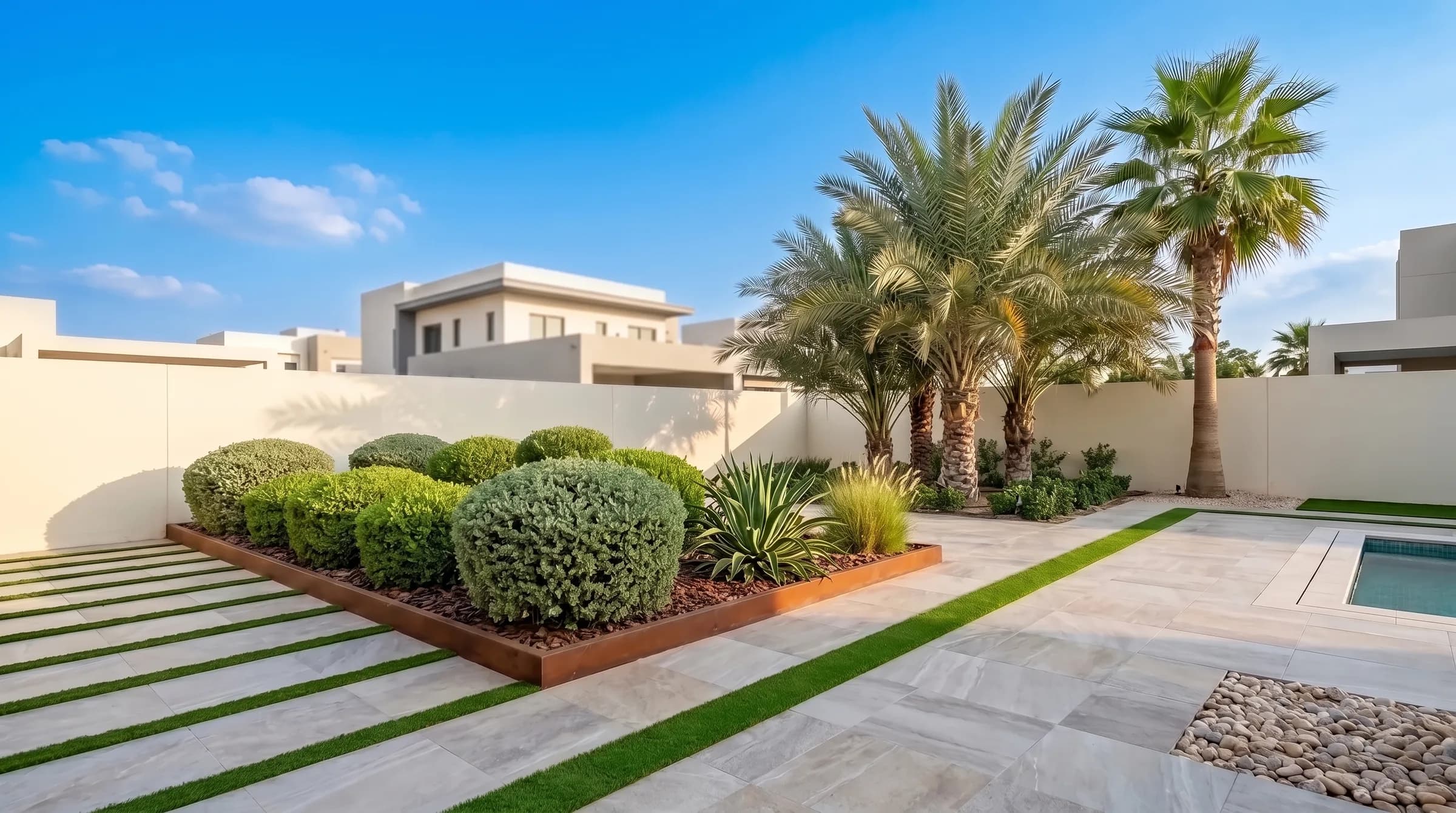
Desert grass
Ghaf's light, filtered canopy is one of the few tree canopies native grasses will grow happily beneath.
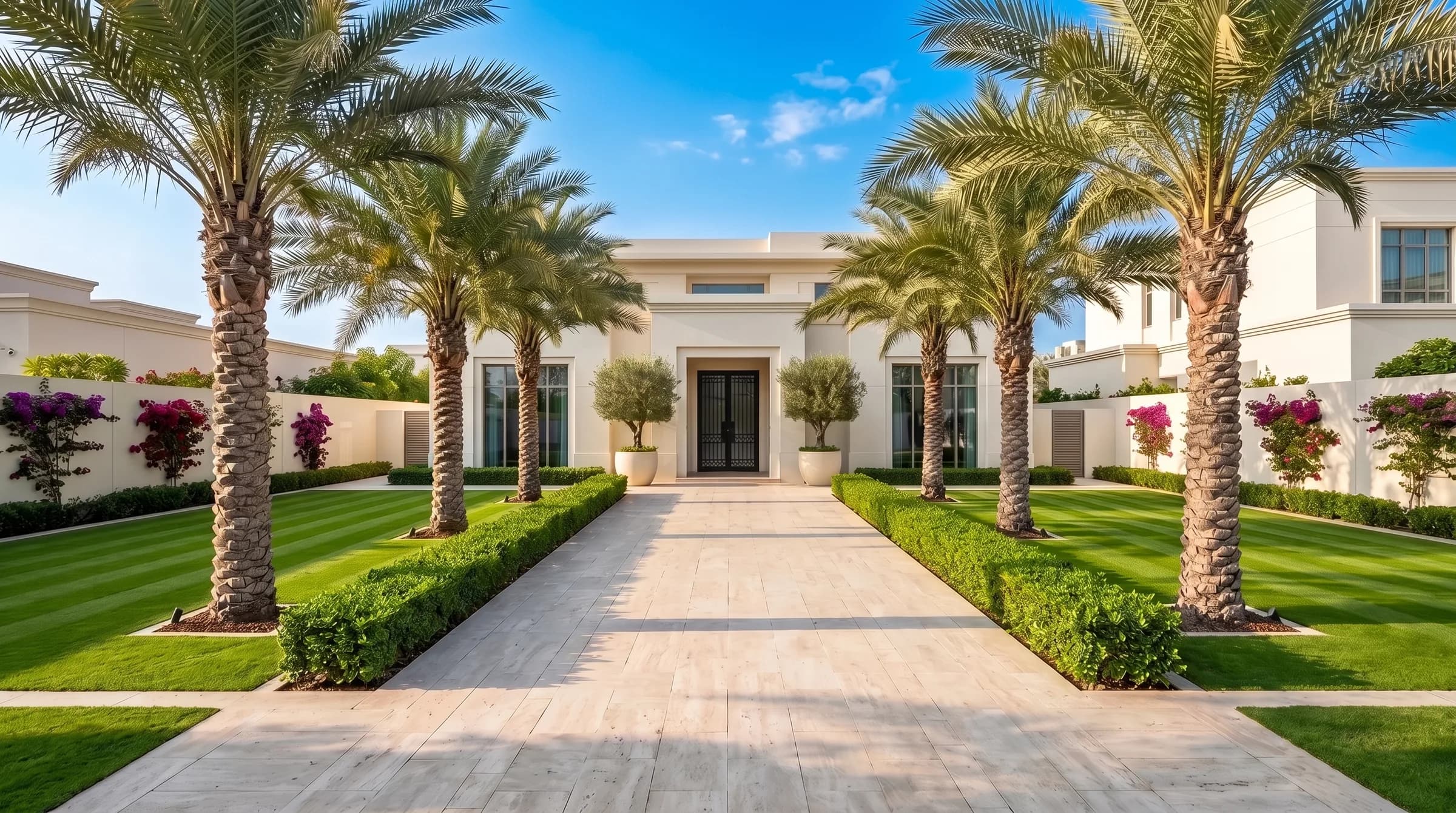
Date Palm
The contrast between ghaf's broad, airy crown and the date palm's vertical trunk and fronded head gives a desert scheme depth without either plant crowding the other.
Care guide
Summer: Established trees: a deep soak every 1–2 weeks is plenty on a drip line. Avoid frequent shallow watering, which keeps roots near the surface.
Winter: Established trees usually need no irrigation from December to February beyond occasional rain.
Establishment: Deep-water once or twice a week for the first year, then taper off over the second year.
Avoid these
Extra notes
Toxicity: Not known to be toxic. The young pods are traditionally eaten in the region.
FAQ
Not sure how it suits your garden?
Ask about Ghaf on WhatsAppKeep exploring
Sidr
Ziziphus spina-christi

Samr
Vachellia tortilis
Date Palm
Phoenix dactylifera

Arak
Salvadora persica
Desert grass
Pennisetum divisum
Sources
Last reviewed 2026-09-30 by Ghaf Gardens horticulture desk.
Pool + garden care
From AED 500/month
Price depends on your garden's size, pool and complexity. Prices in AED, excluding 5% VAT.