
Desert Rose
Adenium obesum
Full sunSalt: 2 of 5
Native
Plumeria rubra
فرانجيباني
A small, sculptural tree that goes bare through the Dubai winter and covers itself in fragrant, waxy flowers from spring to autumn — one of the easiest flowering trees for a hot, dry garden.
See it planted
Season
How Frangipani behaves through Dubai's seasons, month by month.
Leafless winter dormancy
Fresh leaves flush out
Fragrant flowers, heaviest in high summer
Shape and size pruning
Best planting window
Leafless winter dormancy: Dec–Feb
Normal seasonal behaviour that reduces the tree's water needs, not a sign of stress.
Fresh leaves flush out: Mar–Apr
Fragrant flowers, heaviest in high summer: Apr–Sep
UF/IFAS and UAE nurseries both describe a spring-to-autumn bloom, commonly peaking around July–August.
Shape and size pruning: Feb–Mar
Prune just before spring growth starts; wear gloves for the irritant sap.
Best planting window: Oct–Feb
Frangipani's year has a clear rhythm. It stands bare and quiet from around December to February, conserving water while its sculptural branch structure takes centre stage. Fresh leaves flush out in March and April, soon followed by the first flower clusters, and from roughly April through September the tree carries waxy, fragrant blooms almost continuously, heaviest in the humid heart of summer. By late autumn flowering tapers and leaves begin to yellow and drop again, returning the tree to its winter silhouette — entirely normal dormancy, not decline.
Meet the plant
Meet the frangipani, a tree whose personality lives as much in its shape as in its flowers. Its thick, rubbery branches fork again and again into a gnarled, candelabra form that looks deliberate even left entirely alone, and that silhouette does real work in a garden through the bare winter months, when nothing about the tree suggests it is holding structure rather than sulking.
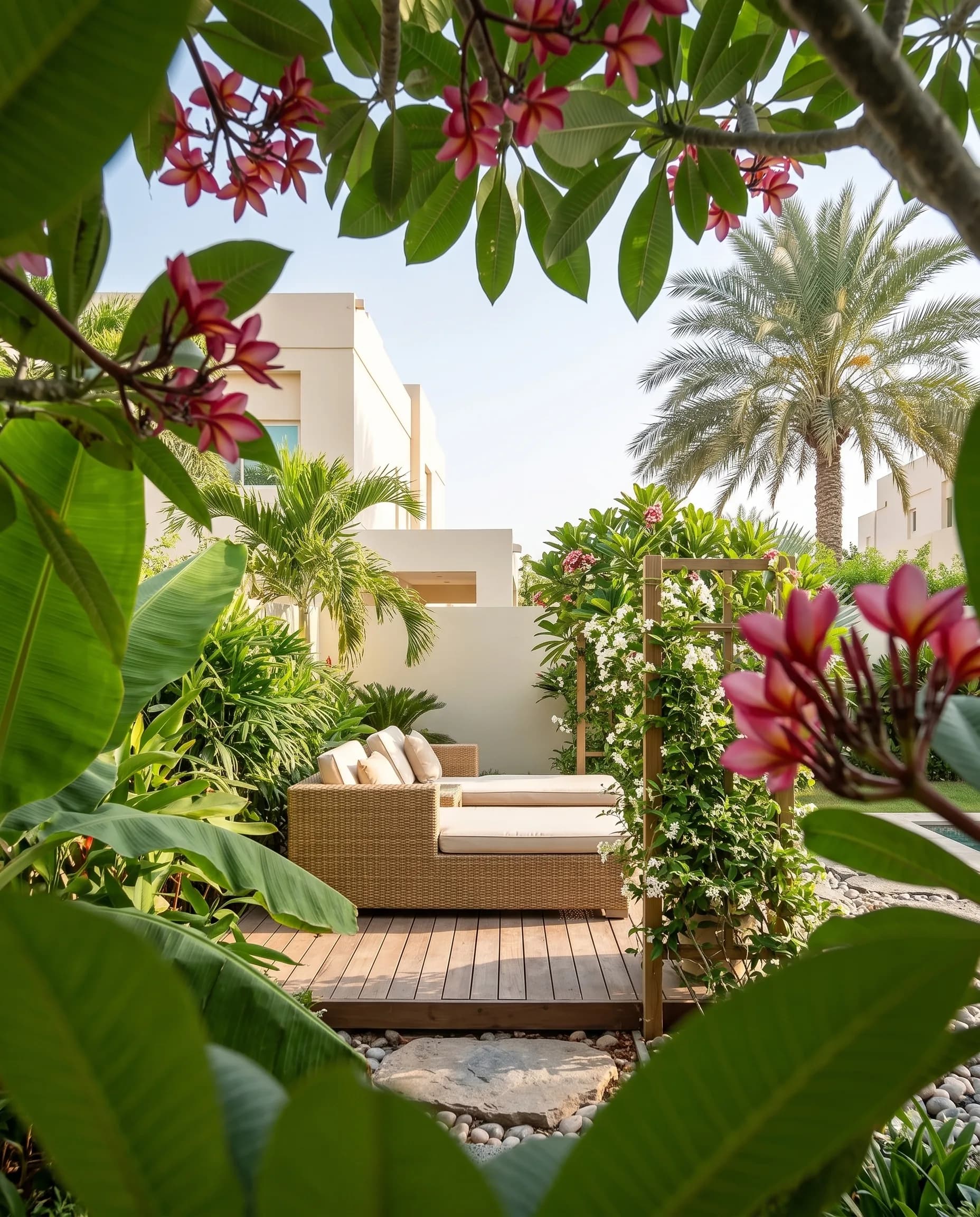
Then it flowers, and for more than half the year a single well-grown specimen can perfume an entire courtyard or pool terrace, the scent intensifying and carrying furthest after dark. Five-petalled, waxy blooms in white, yellow, pink or deep red-orange cluster at the branch tips in flushes that keep coming from spring into autumn, each flower lasting days rather than the single day of a hibiscus bloom.
It asks for very little in return: full sun, sharp drainage, and the patience to let it stand leafless and quiet for a few months each winter. What it gives back is one of Dubai's most reliably fragrant and sculptural low-water trees — as much at home as a single pot specimen on a terrace as it is anchoring a courtyard bed.
Frangipani (Plumeria rubra) is native to Mexico and Central America but has become one of the most widely planted tropical flowering trees in the world, prized across the Gulf for its fragrant, waxy flowers and gnarled, sculptural branching. In the UAE it is a fixture of pool decks, courtyards and entrances, valued as much for its winter silhouette as for its warm-season bloom.
Its thick, succulent-like branches store water, so it copes well with Dubai's heat, sandy alkaline soil and drought once established. It needs full sun for a good flower display and sharp drainage above all else, since the fleshy roots and branches rot readily if kept wet — a lawn's daily irrigation or a low, damp corner is the fastest way to lose one.
It sheds its leaves and stands bare through the cool winter months, a genuine dormancy that conserves water rather than a sign of stress, before flushing new leaves and flower buds as spring warmth returns. The milky sap that oozes from any cut is an irritant to skin and eyes in sensitive people and can cause vomiting if bark or sap is eaten in quantity, so gloves are worth wearing for pruning or taking cuttings.
Cuttings root easily from a length of hardwood left to callus for a week or two before planting, which is how most Dubai gardens propagate more trees cheaply, and why so many local specimens share a handful of popular flower colours. As a specimen it suits Desert Rose and Bougainvillea as poolside or courtyard companions in a tropical or luxury planting, where its scent and sculptural form carry more of the display than leaf cover ever does.
Design
Frangipani rewards being placed somewhere its two seasons both matter: close enough to a terrace, pool deck or bedroom window that summer fragrance carries, but also somewhere its bare winter silhouette against a plain wall or open sky reads as sculpture rather than an eyesore. It wants full sun and sharp drainage, so a raised bed or mounded soil suits it better than a low, damp corner. Keep it clear of daily lawn irrigation, which keeps the root zone wetter than this fleshy-rooted tree tolerates, and allow a mature specimen three to six metres to spread without crowding.
Desert Rose
Desert rose shares frangipani's succulent-branched, drought-tolerant character, extending flowering colour at a lower, container-friendly scale.

Bougainvillea
Bougainvillea's papery bracts give continuous colour through frangipani's leafless winter months, when the tree itself offers only bare branch structure.

Pink Trumpet Tree
Both trees flower in flushes through the warm months, giving a courtyard a changing succession of tropical bloom rather than one fixed display.
Care guide
Summer: A deep soak every 7–10 days is plenty for an established tree; more frequent watering through the hottest months supports heavier flowering, but the tree tolerates far less.
Winter: Stop or cut right back while the tree is leafless and dormant — wet soil combined with cool roots is the most common way to lose a frangipani to rot.
Establishment: Water weekly until new growth shows the tree has rooted in.
Avoid these
Extra notes
Toxicity: The milky sap is an irritant to skin and eyes and can cause vomiting if eaten; keep pruning cuts away from children and pets.
FAQ
Not sure how it suits your garden?
Ask about Frangipani on WhatsAppKeep exploring
Desert Rose
Adenium obesum
Bougainvillea
Bougainvillea glabra

Hibiscus
Hibiscus rosa-sinensis

Royal Poinciana
Delonix regia
Pink Trumpet Tree
Tabebuia rosea
Sources
Last reviewed 2026-09-30 by Ghaf Gardens horticulture desk.
Pool + garden care
From AED 500/month
Price depends on your garden's size, pool and complexity. Prices in AED, excluding 5% VAT.