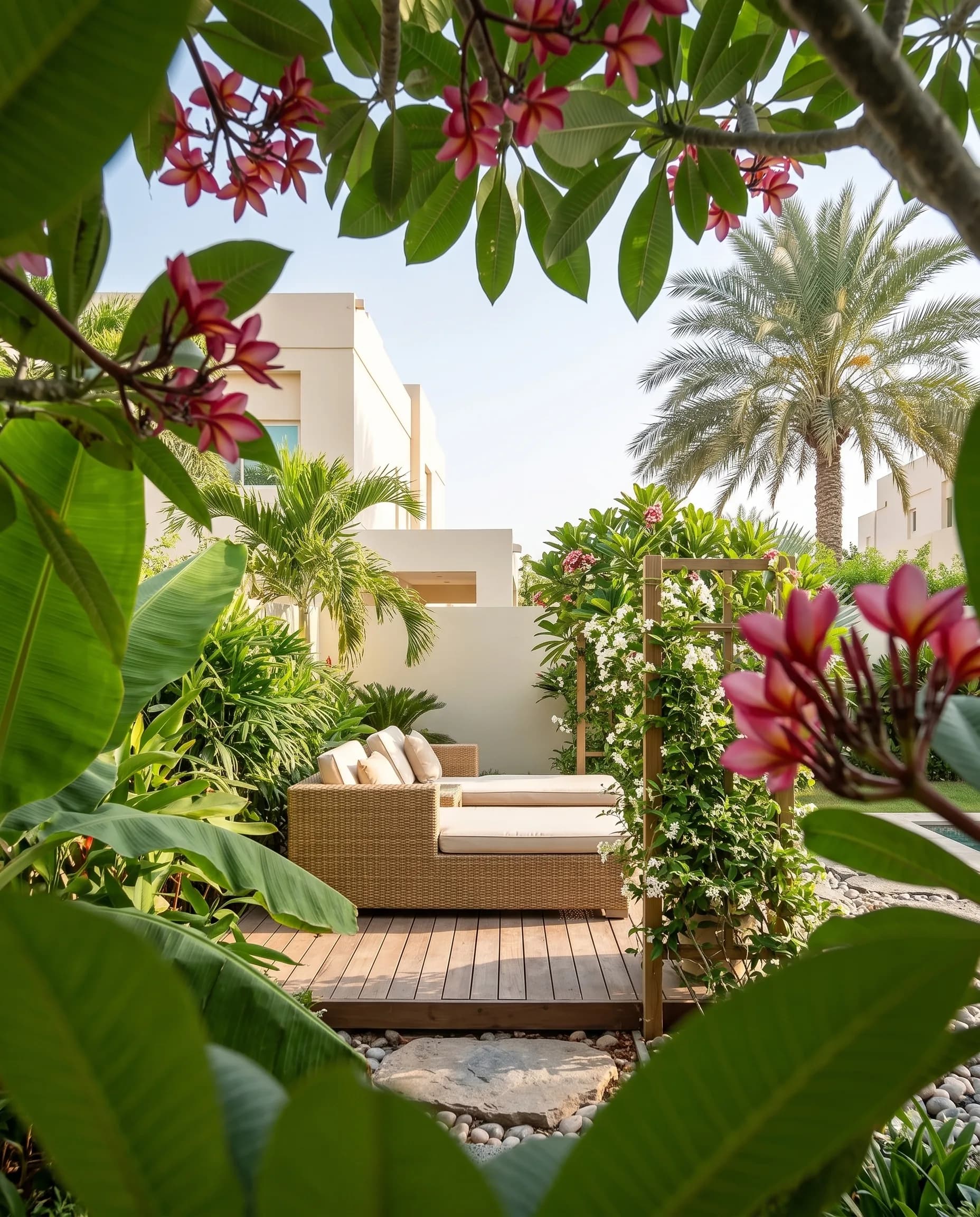

Banana
Musa acuminata
Full sunSalt: 1 of 5
Alocasia macrorrhizos
A giant-leaved shade plant that brings jungle scale to a sheltered courtyard corner — needs real shade and consistently moist soil, and its sap irritates skin and eyes, so keep it away from small children.
See it planted
Season
How Elephant ear behaves through Dubai's seasons, month by month.
Best planting window
New leaf flush in warm, sheltered shade
Growth slows in the coolest weeks of winter
Watch for spider mites in dry summer heat
Main feeding window during active growth
Best planting window: Mar–Apr, Sep–Oct
Avoid planting in the coldest winter snap or the hardest summer heat.
New leaf flush in warm, sheltered shade: Mar–May, Sep–Oct
Growth slows in the coolest weeks of winter: Dec–Jan
Watch for spider mites in dry summer heat: Jun–Aug
Main feeding window during active growth: Apr–May, Sep–Oct
Elephant ear grows fastest in the warm shoulder seasons, with new leaf flushes through March–May and again in September–October once summer's worst heat has broken. Feed monthly through those same active-growth windows to support the size the leaves are grown for. Through the driest, hottest stretch of summer (June–August) watch for spider mites, which build up fastest when the air is dry even though the plant itself wants consistently moist soil. Growth slows through the coolest weeks of winter (December–January), a normal rest rather than a problem, before picking back up as spring warmth returns.
Meet the plant
Meet elephant ear, the plant that makes a shaded corner feel like it belongs somewhere far wetter than Dubai. Its leaves are the whole point — heart-shaped, matte, sometimes reaching the better part of a metre across on a well-fed clump — and they arrive fast, turning a bare, shady patch behind a wall into something genuinely jungle-scaled within a single warm season.
Its character is lush and a little demanding, closer to the tropics it actually comes from than to the drought-adapted plants that make up most of this library. It wants shade, steady water and rich soil, and it tells you immediately when any of those slip — the big leaves droop within hours of a missed watering, a far more honest signal than the slow decline of a stressed succulent.
That same plant, elsewhere in the world, is eaten: in parts of the Pacific and Southeast Asia the corm and stem are staple food once thoroughly cooked, which breaks down the needle-like crystals that make the raw plant painful to touch. In a Dubai garden it plays a purely ornamental role, valued for the sheer drama of its foliage rather than anything on the plate, but that dual identity — jungle food crop and shade-garden showpiece — is part of what makes it more interesting than the average big-leaved plant.
Elephant ear is a rainforest understory plant from Southeast Asia and the Pacific, and it behaves like one here: it wants filtered or dappled shade, not open Dubai sun, and consistently moist soil rather than the deep-and-infrequent watering that suits most of our drought-tolerant plant library. In the right spot — under a tree canopy, a pergola, or the shaded side of a wall — its huge, heart-shaped leaves give a courtyard genuine jungle scale fast.
It's a fast, easy spreader once it has shade and water, multiplying by offsets so a single clump fills in without buying more plants. But it has low drought tolerance: the big leaves wilt quickly if a watering is missed in summer, and full, unshaded sun scorches and bleaches them rather than encouraging growth.
The one safety note worth taking seriously: the sap contains needle-like calcium oxalate crystals that irritate skin and are genuinely painful in the eyes, and all parts of the plant are toxic if chewed or eaten. Wear gloves when pruning or dividing it, and think twice before planting it somewhere small children or pets roam unsupervised.
Design
This plant only works in real shade — under a tree canopy, beneath a pergola, or on the shaded side of a tall wall — never in open Dubai sun, which scorches and bleaches the leaves rather than encouraging growth. It wants shelter from wind as well as sun, and a spot where consistent watering is practical, since it shows stress within hours of drying out. Keep it out of gardens where small children play unsupervised, given the sap's toxicity, and give it real room: a well-fed clump can reach 1.5–2.5 m across.
Banana
Both want shade-to-part-shade, rich soil and steady moisture, so they share a watering zone easily in the same sheltered jungle-style corner.

Bird of paradise
A similar bold-leaved tropical look with lower water demand, letting elephant ear anchor the shadiest, wettest part of the same bed.

Traveller's palm
Travellers-palm's tall, fan-shaped silhouette gives vertical structure above elephant ear's broad, low-growing leaves in a layered tropical planting.
Care guide
Summer: Keep the soil consistently moist — water deeply most days in full summer heat, more often for a potted plant.
Winter: Reduce to two or three times a week; let the surface dry slightly between waterings.
Establishment: Water every one to two days for the first month while new roots establish in the shade bed.
Avoid these
Extra notes
Toxicity: All parts contain calcium oxalate crystals that irritate skin, eyes and mouth on contact, and cause vomiting and mouth pain if eaten. Keep it away from pets and small children, and wear gloves when pruning or dividing it.
FAQ
Not sure how it suits your garden?
Ask about Elephant ear on WhatsAppKeep exploring
Banana
Musa acuminata
Bird of paradise
Strelitzia reginae
Traveller's palm
Ravenala madagascariensis

Heliconia
Heliconia psittacorum

Fiddle-leaf fig
Ficus lyrata
Sources
Last reviewed 2026-09-30 by Ghaf Gardens horticulture desk.
Pool + garden care
From AED 500/month
Price depends on your garden's size, pool and complexity. Prices in AED, excluding 5% VAT.