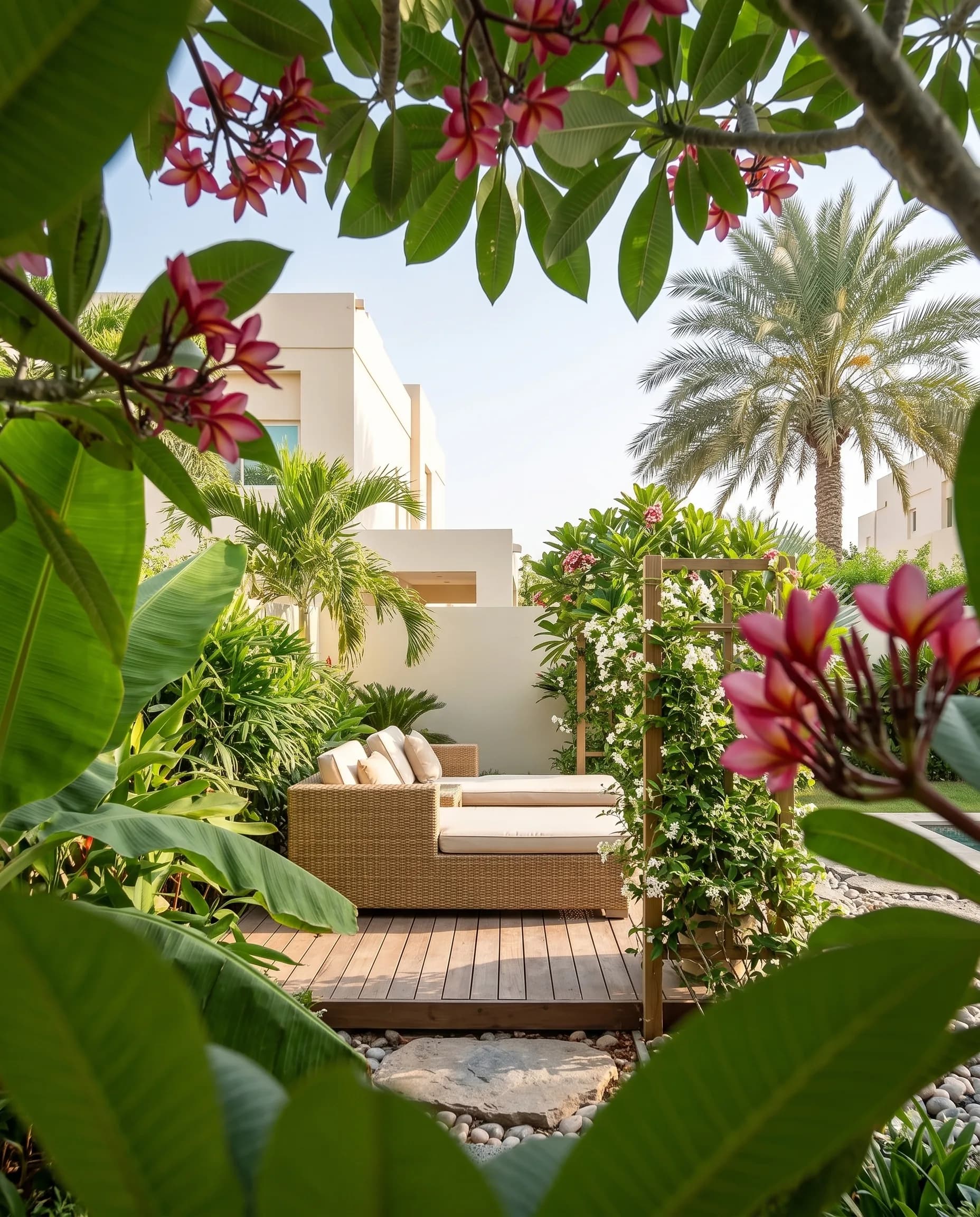

Bougainvillea
Bougainvillea glabra
Full sunSalt: 3 of 5
Adapted
Jasminum sambac
فل
The most fragrant plant in a Gulf garden: a true tropical jasmine that keeps flowering through summer heat rather than shutting down, best planted where its scent reaches a seating area.
See it planted
Season
How Arabian Jasmine behaves through Dubai's seasons, month by month.
Main flowering season
Spring flush of new growth
Light shaping prune
Feed with an iron/micronutrient supplement
Watch for aphids, mealybug and whitefly
Main flowering season: Apr–Oct
Flowers continuously through the warm months and can bloom lightly nearly year-round in a sheltered, well-fed spot.
Spring flush of new growth: Mar–Apr
Light shaping prune: Feb–Mar
Prune before the spring flush to encourage bushier branching and more flowering wood.
Feed with an iron/micronutrient supplement: Mar–Apr, Sep
Corrects the chlorosis common in Dubai's alkaline sandy soil.
Watch for aphids, mealybug and whitefly: May–Aug
Sap-sucking pests build up fastest in peak heat.
Arabian jasmine's main event is a long, warm-season flowering run from around April through October, when the plant is in near-continuous bloom and its scent is strongest in the evenings. Spring (March–April) brings a flush of new growth alongside the last of any winter dormancy, which is the moment to prune lightly and feed with an iron supplement before the flowering push. Through the hottest months (May–August), sap-sucking pests like aphids and whitefly build up fastest, so check the undersides of leaves. Winter is the quiet season: flowering slows or pauses, watering eases back, and the plant simply rests before the spring flush restarts the cycle.
Meet the plant
Meet Arabian jasmine, the plant whose job is entirely about the nose, not the eye. The flowers themselves are modest — small, white, almost plain against the glossy leaves — but at dusk they open and release a scent heavy enough to carry across a terrace, the reason this plant turns up by doorways, near seating and under bedroom windows throughout the Gulf and South Asia.
It carries real cultural weight for such an unassuming shrub: it is the sampaguita threaded into garlands and worn in the hair across the Philippines, where it has been the national flower since 1934, and it is melati putih in Indonesia, one of that country's own three national flowers, symbolising purity and simplicity. That history is part of why people plant it rather than a showier, scentless alternative — it connects a Dubai garden to gardens, markets and ceremonies a long way from here.
In mood it is quietly generous rather than dramatic. Each individual bloom lasts barely a day, opening in the evening and fading by morning, but a well-fed plant produces them in a steady, unhurried succession through the warm months, so the effect is less a single spectacular flush and more a garden that simply smells good most nights you're out in it.
Arabian jasmine is native to tropical Asia, not Arabia, but the name reflects centuries of cultural use across the region — its flowers are threaded into garlands throughout the Gulf and South Asia and used to scent tea. It suits Dubai far better than the Mediterranean jasmines sometimes sold alongside it, because it is a genuine tropical that keeps producing flowers through the hottest months rather than pausing for summer the way Bougainvillea partners often do.
Grown as a rounded shrub it typically holds at 1–2 m; given a trellis or wall it scrambles and can be trained taller as a loose climber. Either form works well near a terrace, entrance or outdoor seating area, since the intensely perfumed white flowers — which age to a soft blush pink — are the entire point of planting it.
It asks for more consistent care than a plant like bougainvillea: steady moisture rather than a dry-and-drench cycle, and a periodic iron or micronutrient feed to counter the yellowing that alkaline Dubai sand causes in many exotic plants. In return it rewards with fragrance through most of the warm season and a manageable, well-behaved size.
Design
Position it within reach of where people actually sit or pass in the evening — a terrace edge, a path to the front door, beside a bedroom window — since the whole value of the plant is scent carried on evening air, not a long-distance visual statement. It takes morning sun or bright filtered light better than harsh, reflected west-facing heat, and a trellis or low wall gives it something to scramble over if a climbing form is wanted rather than a rounded shrub. Keep the root zone mulched and out of competition with thirstier, shallow-rooted lawn grass nearby.
Bougainvillea
Bougainvillea's dry, sun-loving habit and jasmine's need for steadier moisture let you zone irrigation while still getting colour and fragrance from the same wall or pergola.

Hibiscus
Both flower through Dubai's heat and share a similar feeding routine, giving a tropical-style bed continuous colour and scent together.

Sea Jasmine
A shared common name and fragrance role, but sea-jasmine's tougher, more drought-tolerant habit lets it take the hotter, drier edges of the same planting.
Care guide
Summer: Consistent, moderate watering — this species does not carry the drought reserves of a succulent-leaved plant and wilts if watering lapses.
Winter: Reduce frequency but avoid letting the soil dry out completely.
Establishment: Water regularly to keep the root zone evenly moist while the plant settles in.
Avoid these
Extra notes
Toxicity: Not known to be toxic.
FAQ
Not sure how it suits your garden?
Ask about Arabian Jasmine on WhatsAppKeep exploring
Bougainvillea
Bougainvillea glabra
Hibiscus
Hibiscus rosa-sinensis
Sea Jasmine
Clerodendrum inerme
Sources
Last reviewed 2026-09-30 by Ghaf Gardens horticulture desk.
Pool + garden care
From AED 500/month
Price depends on your garden's size, pool and complexity. Prices in AED, excluding 5% VAT.