
Bird of paradise
Strelitzia reginae
Sun/part shadeSalt: 2 of 5
Musa acuminata
موز
The plant behind the Bali-villa look: fast and dramatic, and genuinely fruits in Dubai gardens — but only in a wind-sheltered spot with daily summer water. The thirstiest, least wind-tolerant plant here.
See it planted
Season
How Banana behaves through Dubai's seasons, month by month.
Best planting window
Rapid new leaf growth
Flower bud (bell) emerges after 8-10 leaves have formed
Fruit bunch fills out and ripens
Remove spent, fruited stems
Best planting window: Mar–Apr, Oct–Nov
Avoid planting right through peak summer heat; roots establish faster in spring or autumn warmth without the harshest sun.
Rapid new leaf growth: Mar–May, Sep–Oct
Flower bud (bell) emerges after 8-10 leaves have formed: Jun–Sep
Fruit bunch fills out and ripens: Sep–Dec
Roughly three to four months after the flower bud appears, weather and feeding permitting.
Remove spent, fruited stems: Jan–Feb
A stem that has fruited will not fruit again; cut it out to make room for new suckers.
Banana's calendar runs fastest in the warm shoulder seasons. Plant or divide suckers in March–April or October–November, and expect rapid new leaf growth through both spring and early autumn. A flower bud, or bell, emerges through summer (June–September) once a stem has put out 8–10 leaves, and the fruit bunch that follows fills out and ripens roughly three to four months later, into the September–December window. Once a stem has fruited it will not fruit again, so January–February is the time to cut spent stems out at the base, making room for the suckers already waiting to replace them — the clump never really stops, it just cycles stem by stem.
Meet the plant
Meet the banana, the plant that turns a bare courtyard into something that photographs like a resort within months. Nothing else in a Dubai garden grows at this pace: a sucker no taller than your knee in spring can be head-height with paddle leaves a metre long by summer, and that speed alone is why people plant it — instant impact, instant shade, instant holiday feeling, in a single growing season rather than years.
Its character is generous almost to a fault. It drinks more than anything else on this list, drops a spent stem after fruiting and throws up a new sucker to replace it, and needs still air to look its best — wind shreds those big leaves along their veins within days. That neediness is the trade: give it a sheltered courtyard corner and steady water, and it repays you with a canopy that genuinely feels tropical, plus fruit that ripens for real in a well-fed Dubai garden, not just for the photograph.
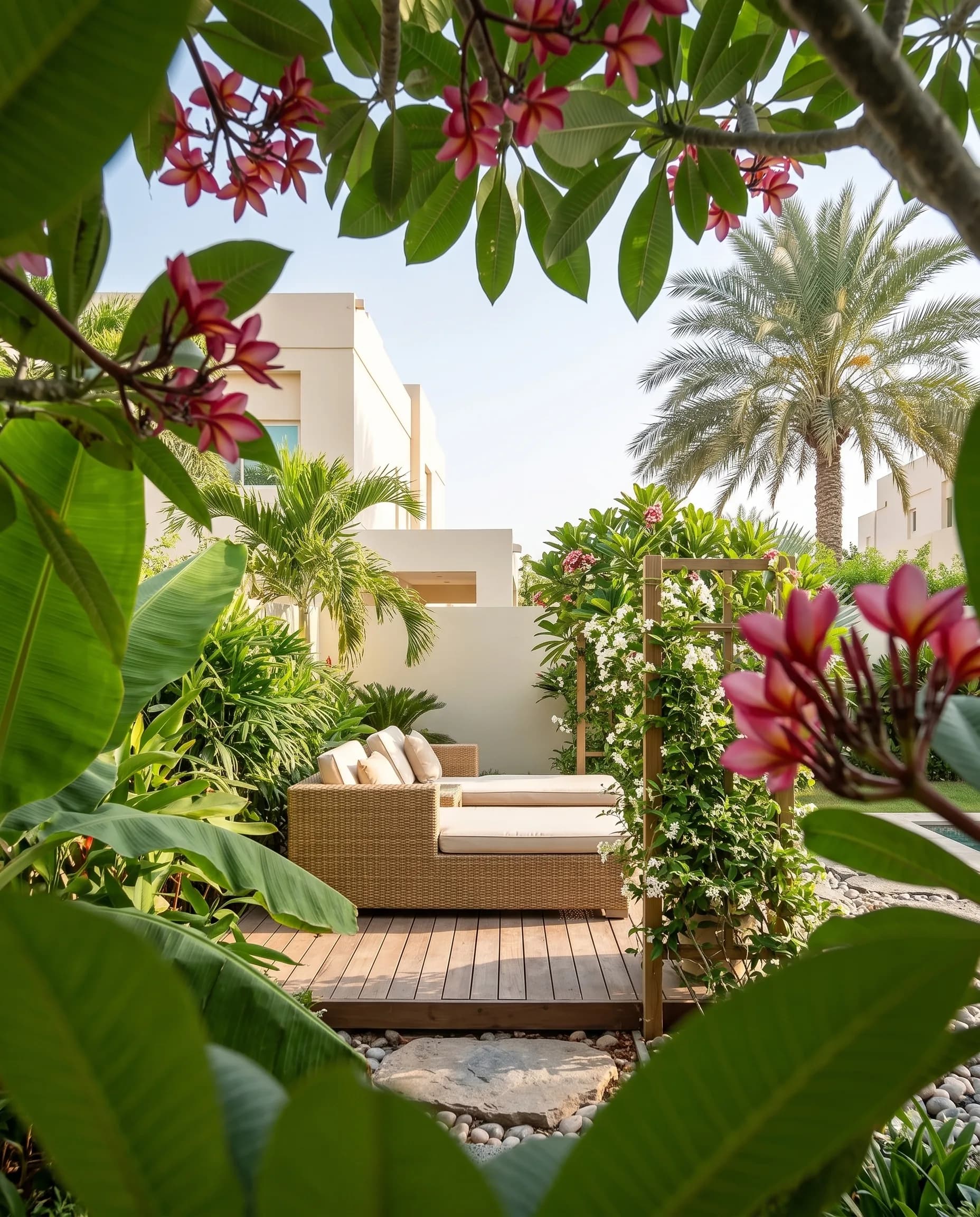
The mood it creates is dense and enclosing rather than airy — broad leaves overlapping into real shade, the rustle and occasional crack of a leaf in the breeze, a clump that thickens into a small grove of its own accord. It's the plant that makes a pool corner feel like somewhere else entirely, provided the wall behind it is doing its job of keeping the wind out.
This is the plant the owner means by "banana-tree-like": a fast-growing, clumping perennial (not a true tree) with huge paddle leaves that can give a courtyard the Bali-villa feel within a single growing season. It's genuinely being grown in Dubai villa gardens today, including specimens fruiting heavily enough to need staking, usually clustered near a pool, pond or shaded wall rather than out in the open lawn.
The trade-off is real. Banana is the least drought-tolerant plant in our library: established clumps in full Dubai sun often need watering daily through summer, and the broad leaves tear along their veins in wind by design, which in an exposed plot means a constantly shredded look rather than the lush, intact canopy in the photos. It also has poor tolerance of salty soil or irrigation water, so keep it away from brackish sources.
Grown well — a sheltered courtyard, a warm wall, generous water and feed — a clump multiplies from suckers into a small grove for free, and a mature stem can genuinely fruit. Grown in an open, windy position it survives but never looks like the reference photos, so treat the wind shelter as a precondition, not a nice-to-have.
Design
This is a plant for the most sheltered spot in the garden, not the most prominent one — a courtyard corner, against a solid wall, or tucked where surrounding structures break the wind, since open exposure shreds the leaves within days. Keep it back from direct pool splash given its poor salt tolerance, but the shade and jungle backdrop it gives a pool deck from a few metres off is exactly the look most owners are after. Give each clump at least 2 m to spread into, since a well-fed plant multiplies into a small grove on its own.
Bird of paradise
A similar bold, banana-like leaf without banana's constant water demand, giving textural variety at a lower irrigation cost nearby.

Elephant ear
Both want shade-to-part-shade, consistent moisture and a sheltered spot, so they share a watering zone easily in the same tropical corner.

Heliconia
Heliconia's narrower, upright foliage and bright flower bracts layer well beneath or beside banana's broad overhead canopy.
Care guide
Summer: Water deeply most days in peak summer — clumps in full sun can need daily irrigation to stop the leaves folding and browning at the edges.
Winter: Cut back to two or three waterings a week; growth slows markedly once it cools below about 15°C.
Establishment: Keep the root zone constantly moist for the first two to three months while new roots establish.
Avoid these
Extra notes
Toxicity: Not known to be toxic; the fruit is edible when the plant is grown well.
FAQ
Not sure how it suits your garden?
Ask about Banana on WhatsAppKeep exploring
Bird of paradise
Strelitzia reginae

Traveller's palm
Ravenala madagascariensis
Elephant ear
Alocasia macrorrhizos
Heliconia
Heliconia psittacorum

Frangipani
Plumeria rubra

Bougainvillea
Bougainvillea glabra

Foxtail Palm
Wodyetia bifurcata
Sources
Last reviewed 2026-09-30 by Ghaf Gardens horticulture desk.
Pool + garden care
From AED 500/month
Price depends on your garden's size, pool and complexity. Prices in AED, excluding 5% VAT.