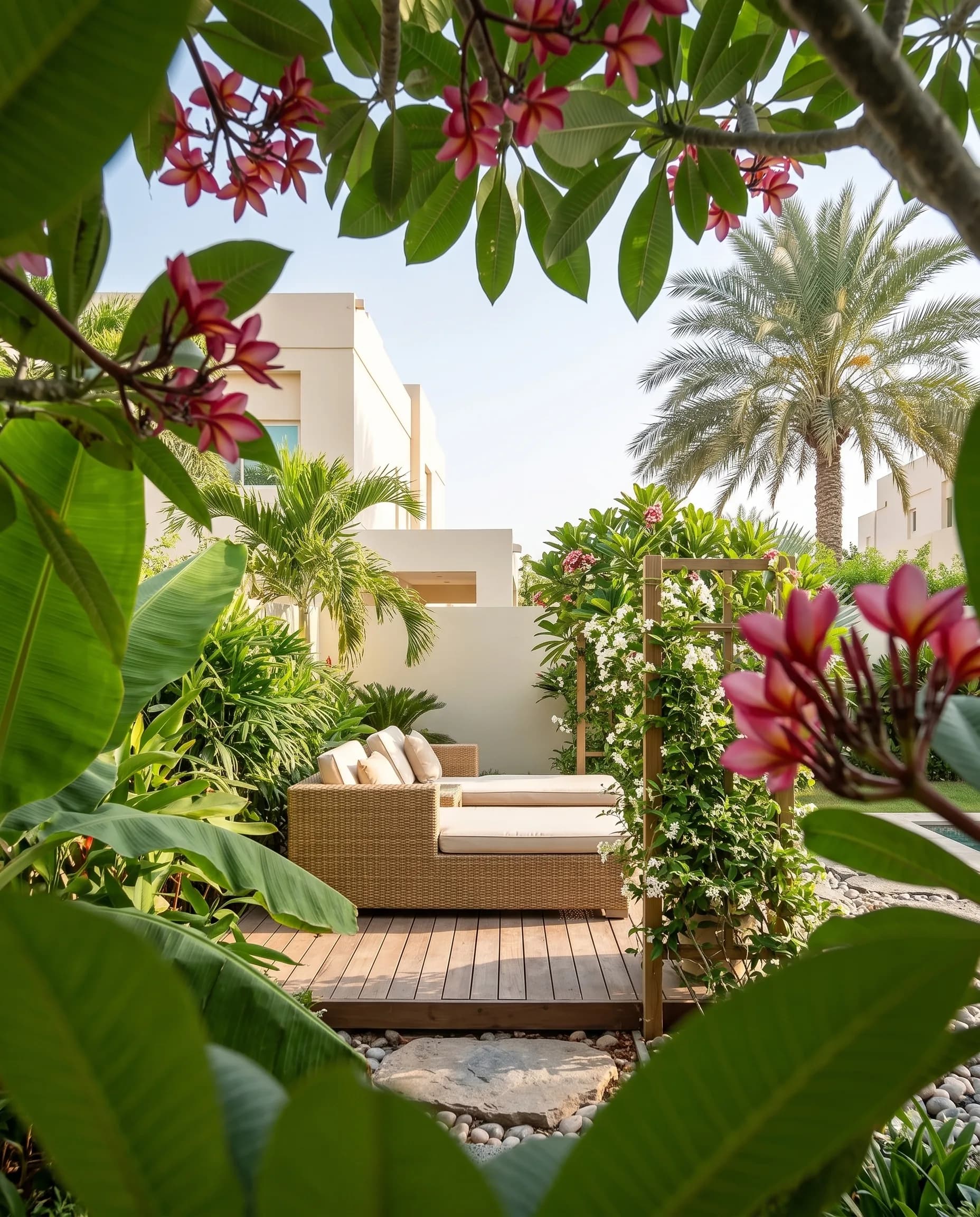

Frangipani
Plumeria rubra
Full sunSalt: 2 of 5
Adapted
Delonix regia
بونسيانة
A wide, flat-crowned tree that turns solid red-orange for weeks around May to July, then gives deep summer shade — but it needs real space and a strong branch structure to stay safe in Dubai's wind.
See it planted
Season
How Royal Poinciana behaves through Dubai's seasons, month by month.
Best planting window
Partial leaf thinning before flowering
Fresh fern-like foliage returns
Peak red-orange bloom
Long bean-like seed pods form and persist
Structural pruning
Best planting window: Oct–Feb
Partial leaf thinning before flowering: Jan–Mar
UAE-specific timing is not well documented; Florida's near-identical subtropical climate shows a similar dry-season thinning before the summer flush (UF/IFAS).
Fresh fern-like foliage returns: Mar–Apr
Peak red-orange bloom: May–Jul
UF/IFAS records a reliable May-to-July bloom in a comparably hot climate; UAE nurseries describe the same summer flowering window.
Long bean-like seed pods form and persist: Aug–Dec
Pods often hang on the tree through winter before dropping in spring.
Structural pruning: Mar–Apr
Prune before spring regrowth to remove weak, low or crossing limbs and reduce wind-break risk.
Royal poinciana thins its leaves through the cooler, drier months, giving a lighter, more open canopy in winter, then pushes fresh fern-like foliage from March. The main event follows fast: peak red-orange bloom runs May to July, when the crown can look almost solid with flower and barely any leaf shows through. Long, flat, bean-like seed pods form through late summer and autumn and often hang on the tree well into winter before dropping in spring, so expect litter to clear under the canopy twice a year — flower drop after bloom, and pod drop before the next flush.
Meet the plant
Meet the royal poinciana, the tree that turns a Dubai skyline into fire for a few weeks every early summer. Nothing else grown here matches the sheer volume of colour: a mature specimen in full bloom reads as a single wide canopy of red-orange, visible from streets away, with barely a leaf showing through the flowers. It is a genuine event in the garden calendar, not a background plant.
Out of flower it is no less generous — a flat, spreading crown, often broader than the tree stands tall, that throws dense shade over a terrace, a drive or a whole lawn. The fern-like foliage moves easily in a breeze, giving the canopy a light, feathery texture even at rest, and the seed pods that follow flowering hang through winter like long dark pendants before dropping.
It is a tree that asks for commitment: real space to spread, patience while it establishes its branch structure, and a willingness to sweep up pods and litter for a tree that rewards you with the single most dramatic bloom available in a UAE garden.
Native to Madagascar, Delonix regia is grown as a specimen and avenue tree across the tropics and subtropics for its dramatic bloom. In Dubai it is planted for its umbrella-shaped canopy, which typically grows wider than the tree is tall, and for the deep summer shade that canopy gives the rest of the year. Few other trees available here put on a floral display at this scale: for several weeks the whole crown reads as a solid sheet of red-orange, visible from a distance rather than as individual flowers.
University of Florida horticulturists record a reliable bloom from May to July in a similarly hot, sunny climate, with flowers persisting a month or more, and UAE nurseries describe the same summer flowering window. It is semi-deciduous, thinning its leaves in the cooler, drier months before the tree pushes out fresh fern-like foliage and its flower buds; exact UAE-specific timing for this leaf drop is not well documented locally, so treat it as a general guide. Young trees can take five years or more to flower for the first time, so a larger nursery specimen shortens the wait considerably.
It needs real space: give it clearance from pools, walls and paving, since its surface roots compete with lawns and can lift paving, and its branches can break in strong wind if the tree was not structurally pruned while young. Assessments of its wind resistance vary — some rate its deep-rooting and strong wood favourably, others flag brittle wood and a genuinely low wind rating — but every source agrees the deciding factor is early formative pruning, not the species alone. Large seed pods persist through winter and drop as litter in spring, so it suits a specimen position in a tropical or luxury garden rather than a tight courtyard.
Because young wood fails first in wind, UF/IFAS extension guidance recommends training the main scaffold branches while the tree is small, keeping any limb to no more than half the trunk's diameter and avoiding late-season feeding that pushes soft, wind-vulnerable growth. A tree trained this way in its first five years carries that investment for the rest of its life.
Design
Plant it as a standalone specimen or avenue tree with genuine room to spread — the canopy regularly grows wider than the tree is tall, so keep it well clear of pools, walls, driveways and any paving that surface roots could lift. Full sun and open ground give the best bloom and the most even canopy. Because a badly formed young tree is the real safety risk in wind, position it where it can be reached for formative pruning in its first five years, and keep it back from structures a storm-damaged limb could reach. It suits a wide lawn, a boundary line or a courtyard entrance where its bloom can be seen from a distance.
Frangipani
Frangipani's smaller, rounded form and different bloom season keep colour going once the poinciana's flush has finished.

Pink Trumpet Tree
A pink trumpet tree extends flowering colour into a different season, avoiding a garden that peaks only in early summer.

Ghaf
Ghaf's narrow, upright habit and very low water needs make a calmer, native counterpoint near a poinciana's wide, thirstier canopy.

Hibiscus
Hibiscus in similar warm tones echoes the poinciana's flower colour at eye level while the tree provides overhead shade and scale.
Care guide
Summer: Established trees appreciate an occasional deep soak in peak summer for the best bloom, even though they can survive on less.
Winter: Little supplemental water needed.
Establishment: Water deeply two to three times a week for the first year or two while the root system develops.
Avoid these
Extra notes
Toxicity: Seed pods and seeds are mildly toxic if eaten in quantity, causing vomiting and diarrhoea in pets; keep fallen pods away from children and animals.
FAQ
Not sure how it suits your garden?
Ask about Royal Poinciana on WhatsAppKeep exploring
Frangipani
Plumeria rubra
Pink Trumpet Tree
Tabebuia rosea
Hibiscus
Hibiscus rosa-sinensis
Ghaf
Prosopis cineraria
Sources
Last reviewed 2026-09-30 by Ghaf Gardens horticulture desk.
Pool + garden care
From AED 500/month
Price depends on your garden's size, pool and complexity. Prices in AED, excluding 5% VAT.