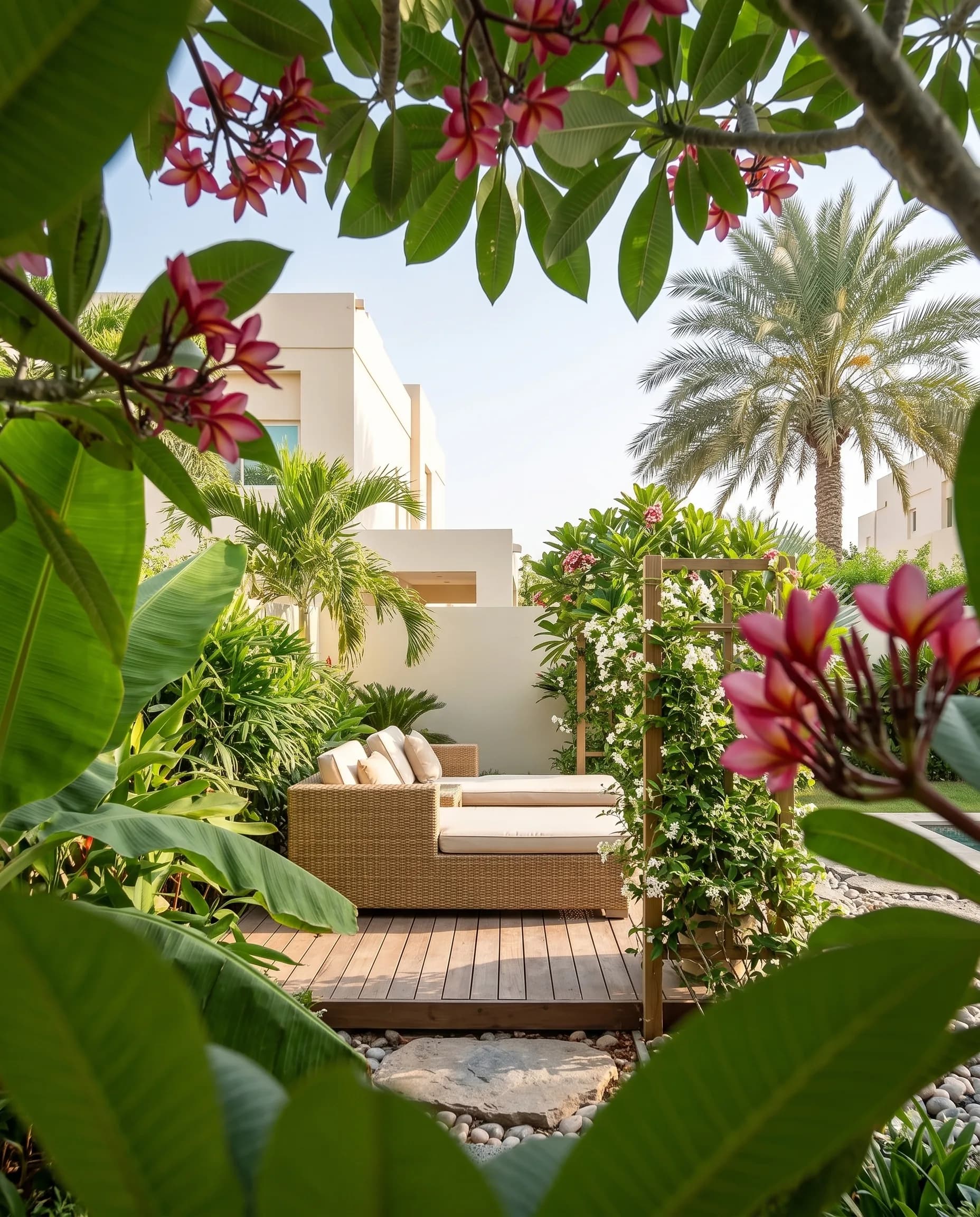

Bismarck Palm
Bismarckia nobilis
Full sunSalt: 3 of 5
Wodyetia bifurcata
نخيل ذيل الثعلب
A neat, self-cleaning palm from Queensland with bushy, foxtail-shaped fronds — a popular villa specimen in Dubai for its moderate size and low mess, though it wants more consistent water than a true desert palm.
See it planted
Season
How Foxtail Palm behaves through Dubai's seasons, month by month.
Best planting window
New frond flush as temperatures warm
Flowers in several flushes a year rather than one set season
Orange-red fruit clusters follow flowering
Tidy any lingering dead material
Red palm weevil monitoring
Best planting window: Feb–Mar, Oct–Nov
Cool-season planting avoids transplant stress during peak heat.
New frond flush as temperatures warm: Apr–May
Flowers in several flushes a year rather than one set season: Mar–Apr, Sep–Oct
Orange-red fruit clusters follow flowering: May–Jun, Nov–Dec
Tidy any lingering dead material: Mar–Apr
Mostly unnecessary — the palm is self-cleaning and drops its own dead fronds.
Red palm weevil monitoring: Jan–Dec
Check trunk and crownshaft for tunnels, ooze, frass or a fermented smell year-round.
Foxtail palm holds a full, bushy green crown year-round, so its seasonal story is one of flushes rather than dramatic change. Spring brings a burst of fresh fronds unfurling a lighter green from the crownshaft, alongside the first of two flowering rounds; a second flowering follows in early autumn. Orange-red fruit clusters ripen in early summer and again around November and December, hanging below the crown until they drop or are cut. Through the fiercest heat of July and August growth slows, but the canopy stays full and green given steady water — nothing about its look announces Dubai's seasons the way a deciduous tree would.
Meet the plant
Meet the foxtail palm, and you are meeting a fairly recent arrival to cultivation. It was identified and formally named only in 1983, found growing wild on a single patch of rocky Queensland scrub, yet within a few decades it has spread into gardens from Florida to the Gulf faster than almost any other ornamental palm in cultivation history. Its fronds curve out symmetrically like a fox's brush rather than lying flat, giving the crown a bushy, almost feathered fullness that instantly reads as different from the date and fan palms lining most Dubai streets.
People plant it because it behaves. Fronds drop cleanly on their own rather than hanging on as a dead, rattling skirt, so a foxtail palm by the pool or front door stays tidy without the seasonal trimming a Washingtonia demands. Its moderate mature height, six to nine metres, keeps it in scale with a two-storey villa rather than towering over it the way an avenue palm does.
In a Dubai garden it sets a mood of relaxed, tropical movement: the plumed fronds catch a breeze and sway as a soft mass, casting a shifting, dappled shadow that a stiffer, fan-leaved palm cannot match. It works as a specimen to soften a hard-edged modern facade, or to mark an entrance or pool corner without the formality of a planted avenue.
Foxtail palm (Wodyetia bifurcata) comes from a single small area of rocky scrubland in northeastern Queensland, discovered and formally named only in 1983, yet it has become one of the most widely planted ornamental palms in warm climates worldwide, upscale Dubai villa gardens included. Its crown carries eight to ten arching fronds whose leaflets radiate around the rachis in every direction instead of lying flat in a single plane, giving each frond the bushy, plume-like silhouette that gives the palm its common name and sets it apart from the stiffer, fan-shaped canopies of most palms grown locally.
It is genuinely low-fuss in one specific way that matters to maintenance budgets: it is self-cleaning, so dead fronds and old flower and fruit stalks drop on their own rather than hanging on as a skirt that has to be cut down by a crew with spikes and a chainsaw. That makes it a sensible, tidy choice near a pool, entrance or outdoor dining area, and it removes one of the common access points red palm weevil uses on untended, skirted palms.
The trade-off is that foxtail palm is a tropical species at heart, not a desert native. It tolerates Dubai's dry heat reasonably well once established but grows fastest, and holds its best colour, with steady water at the root zone rather than the deep-and-dry regime that suits Date Palm or Bismarck Palm. It also prefers slightly acidic, well-drained soil — a native pH range of roughly 5.6 to 7.8 — which in the UAE's alkaline sand means watching for the same iron- and manganese-deficiency yellowing that affects many exotic plants here, corrected with a regular micronutrient feed.
Its fibrous root system is one of its quieter advantages. Like most palms, it lacks the thick, lifting lateral roots of a hardwood tree, so it is a more forgiving choice near pool decks, paving and shallow utility lines than a broad-canopied shade tree would be. Growth is moderately fast for a palm, and mature specimens produce two flowering flushes a year followed by hanging clusters of orange-red fruit that add a second, more casual season of colour below the crown.
Design
Foxtail palm earns its keep as a specimen rather than a crowd plant: a single tree beside a pool deck, framing a villa entrance or centred in a courtyard bed shows off its plumed crown and pale, ringed trunk from every angle. Its fibrous root system carries less risk to paving, pool shells and shallow pipework than a hardwood tree's, though the crown itself still needs four to six metres of clear air to spread without fronds brushing a wall or overhang. Full sun gives the fullest crown and best colour; light, high shade is tolerated without complaint.

Frangipani
Frangipani's low, sculptural branching and fragrant flowers fill the space beneath the palm's clear trunk without competing for its canopy.

Bird of paradise
Bird of paradise's strap-like leaves and bright blooms give ground-level colour and a contrasting texture at the palm's base.

Traveller's palm
The travellers palm's flat, fan-shaped crown reads as a deliberate contrast against the foxtail's rounded, plumed fronds in a mixed palm planting.
Care guide
Summer: Deep water two to three times a week at the base through peak heat; avoid overhead watering, which can encourage leaf-spot fungus in the crown.
Winter: Reduce frequency but do not let the root zone dry out completely.
Establishment: Water generously and consistently for the first year — this species leans tropical and does not establish well on a dry regime.
Avoid these
Extra notes
Toxicity: Not known to be toxic.
FAQ
Not sure how it suits your garden?
Ask about Foxtail Palm on WhatsAppKeep exploring
Bismarck Palm
Bismarckia nobilis

Washingtonia Palm
Washingtonia robusta
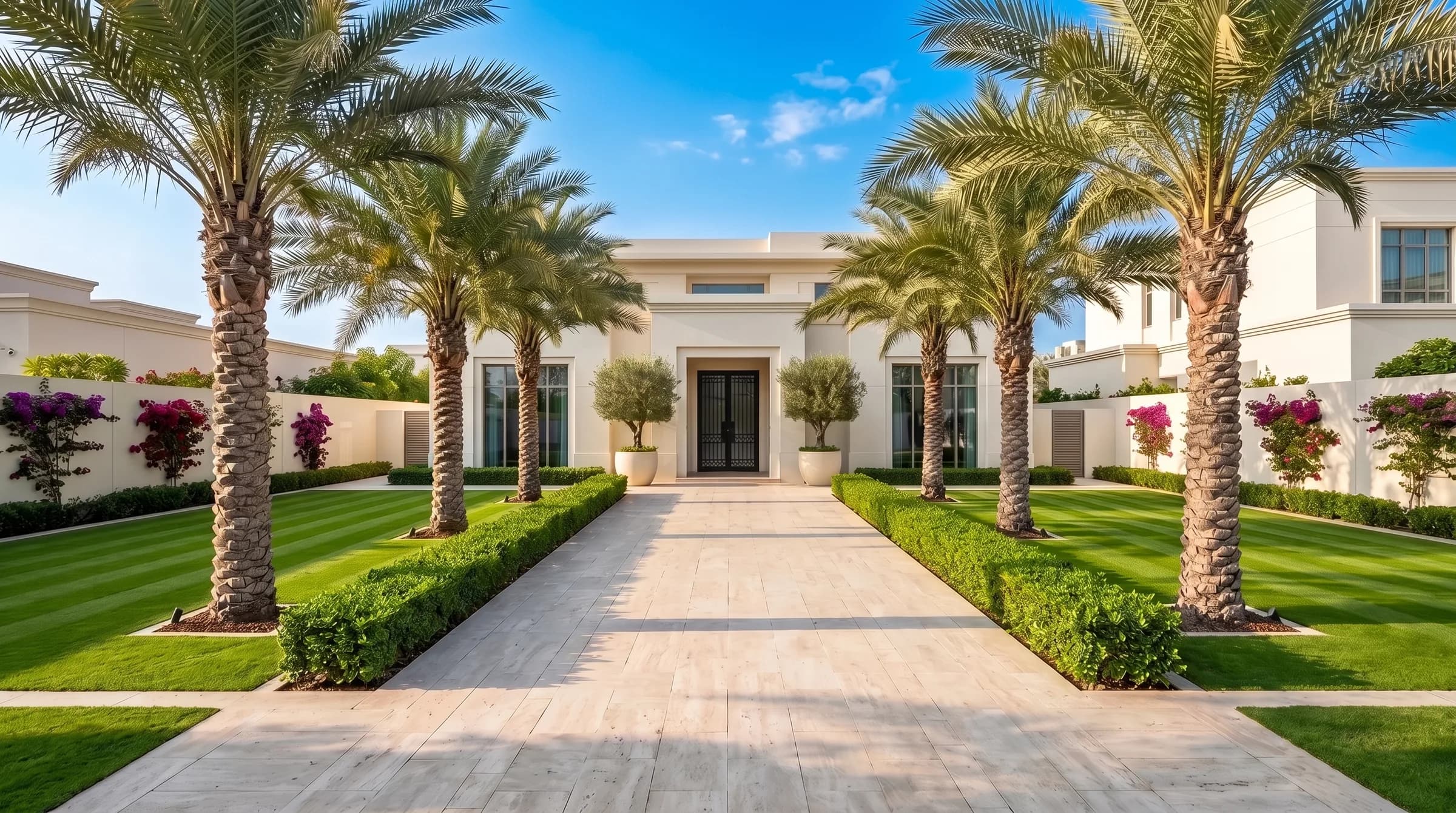
Date Palm
Phoenix dactylifera
Sources
Last reviewed 2026-09-30 by Ghaf Gardens horticulture desk.
Pool + garden care
From AED 500/month
Price depends on your garden's size, pool and complexity. Prices in AED, excluding 5% VAT.