
Ghaf
Prosopis cineraria
Full sunSalt: 4 of 5
Native
Parkinsonia aculeata
شوك القدس
A fine-leaved, thorny desert tree with green stems and fragrant yellow spring flowers, very drought and salt tolerant; it is short-lived, spiny, and a known invader in several countries.
Parkinsonia is a tough, light-canopied desert tree, but it is a documented invader: it is a Weed of National Significance in Australia, University of Florida predicts it will be invasive and does not recommend it, and a study of Fujairah's invasive flora lists it among species found in private and municipal plantings. Its long-lived seed is spread by water and it carries sharp spines. If you plant one, keep it away from drains, wadis and watercourses, remove seed pods before they split, and consider native alternatives such as ghaf, samr or sidr.
Season
How Parkinsonia behaves through Dubai's seasons, month by month.
Best planting window
Fresh fine foliage returns
Fragrant yellow flowers with a red marking
Seed pods form
Structural pruning
Best planting window: Oct–Mar
Plant in the cool season into free-draining soil, away from drains and watercourses.
Fresh fine foliage returns: Feb–Mar
Fragrant yellow flowers with a red marking: Mar–May
University of Florida places bloom in spring; UAE timing is not well documented.
Seed pods form: May–Jul
Remove pods before they split to limit self-seeding; the seed stays viable for many years.
Structural pruning: Dec–Feb
Needed for strong structure; wear gloves and eye protection, since the spines are sharp.
University of Florida describes parkinsonia as deciduous, so the canopy thins at some point in the cool season and renews with fine new foliage in late winter and early spring. Spring is the main event: drooping clusters of bright yellow flowers with a red or orange marking, slightly fragrant, open against the lacy foliage, and seed pods form behind them from early summer. The rest of the year the tree is light, open and low in water demand, which makes winter the best time for structural pruning and for pulling any seedlings that have come up beneath it.
Meet the plant
Meet parkinsonia, a tree that looks like a haze of fine green lace. Its leaves are tiny leaflets strung along flat, slender stalks, and the crown is so open that sunlight filters straight through it. In spring it fills with drooping clusters of fragrant yellow flowers with a red or orange marking, a bright, frothy effect against bare sand and gravel.
That airy look is a desert tree's economy. Tiny leaflets and green, photosynthetic stems keep water loss low, and University of Florida rates both the tree's drought tolerance and its salt tolerance as high.
The same toughness is the reason to be careful. A mature tree makes thousands of seeds, which stay viable for years and float, and in Australia the tree has become one of the country's worst weeds. In a Dubai garden it is a good-looking specimen only if you keep it contained, manage the pods, and accept sharp spines and a modest lifespan.
Parkinsonia aculeata, the Jerusalem thorn or Mexican palo verde, is a fast-growing, multi-trunked tree from Central America, Mexico and South America. University of Florida describes it growing 15 to 20 feet (about 4.5 to 6 m) tall and 20 to 25 feet wide, deciduous, with a light, airy, low-branching crown, short sharp spines along the stems, and bright yellow flowers with a red centre, slightly fragrant, in drooping clusters in spring. Pods 1 to 6 inches long follow.
Its toughness is real. University of Florida rates its drought tolerance and salt tolerance as high, and notes tolerance of clay, sand, loam and alkaline soil, provided drainage is good, while Abu Dhabi Municipality's 2012 plant index lists it among both salt-tolerant and drought-tolerant trees. It dislikes wet, soggy soil, and in dry Dubai gardens that is the main way to lose it. Its open canopy gives dappled, not dense, shade, which suits desert-modern planting with grasses and succulents beneath.
The drawbacks are on the record. University of Florida rates it invasive and not recommended, notes thin bark that is easily injured and compartmentalises decay poorly, and puts its lifespan at about 15 to 20 years. In Australia it is a Weed of National Significance, with a typical mature tree making about 5,000 seeds a year, pods that float, and seed that stays viable for many years. A study of invasive flora in Fujairah also lists it among species found in private and municipal plantings. It is a tree to use with eyes open.
Design
Use parkinsonia where a fine, translucent canopy is wanted over gravel, grasses and succulents, in a dry, sunny, well-drained spot well away from drains, wadis, ponds and watercourses. Keep it clear of paths, seating and play areas because of its spines, and out of any area that is regularly irrigated, since wet soil is what kills it. Plan to sweep up fine litter and pull seedlings, and to replace the tree after about 15 to 20 years.

Texas Sage
Texas sage's silver foliage sits well beneath parkinsonia's fine green canopy, and both want sharp drainage and little water.

Agave
Agave's bold blue-grey rosettes beneath parkinsonia's lace-like canopy give a strong contrast of form in a dry, sunny bed.
Desert grass
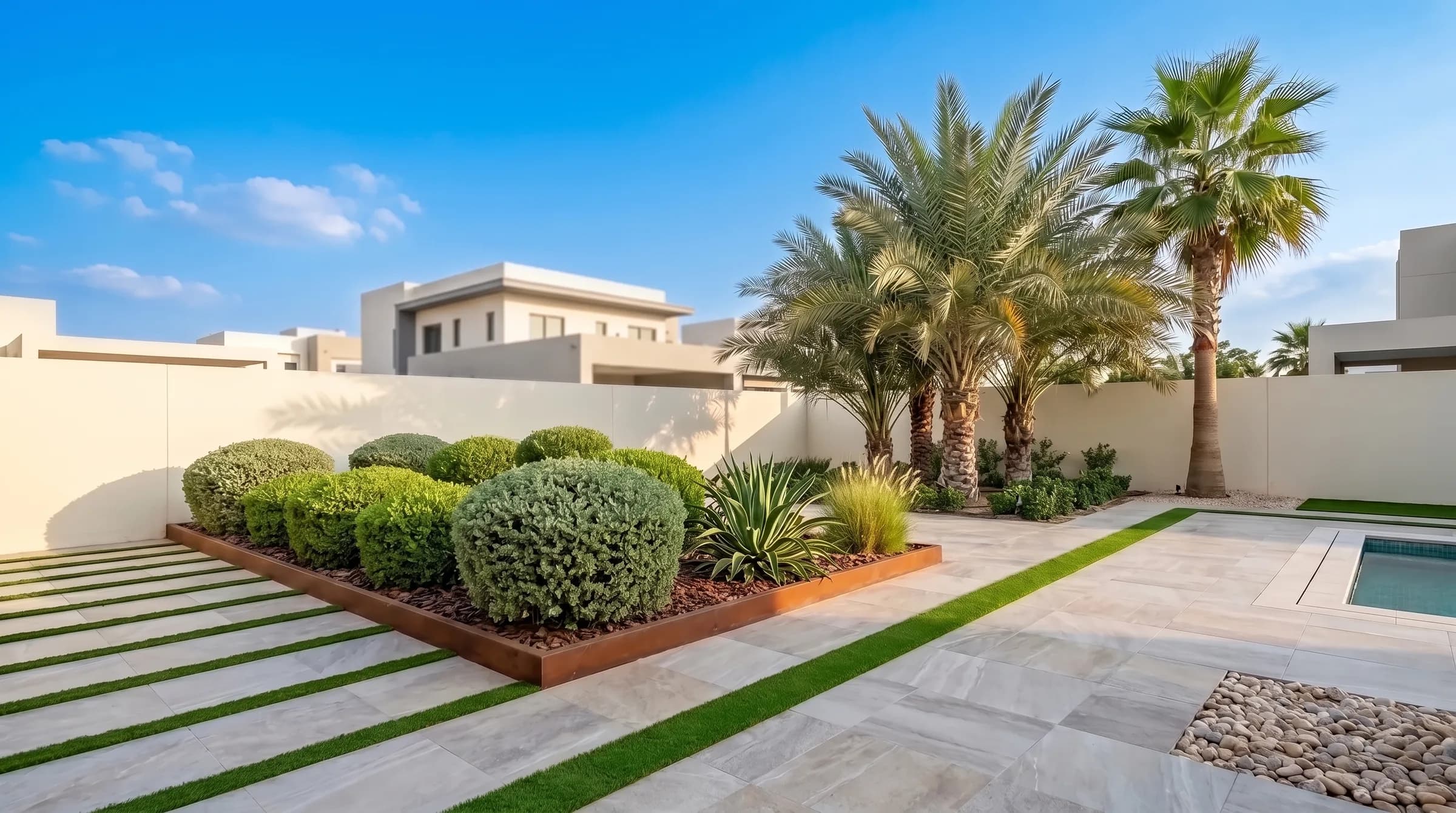
Native desert grass can grow under the light, filtered canopy, building a naturalistic, low-water scheme.
Care guide
Summer: Very little once established; University of Florida rates its drought tolerance as high, and overwatering is the more likely problem.
Winter: None or minimal.
Establishment: Water regularly through the first year so the roots establish, then taper off; do not let the root ball sit wet.
Avoid these
Extra notes
Toxicity: No toxicity is reported in the sources consulted; the hazard is physical, from sharp spines along the stems.
FAQ
Not sure how it suits your garden?
Ask about Parkinsonia on WhatsAppKeep exploring
Ghaf
Prosopis cineraria

Samr
Vachellia tortilis

Sidr
Ziziphus spina-christi
Desert grass
Pennisetum divisum

Tamarisk
Tamarix aphylla
Sources
Last reviewed 2026-10-05 by Ghaf Gardens horticulture desk.
Pool + garden care
From AED 500/month
Price depends on your garden's size, pool and complexity. Prices in AED, excluding 5% VAT.