
Ghaf
Prosopis cineraria
Full sunSalt: 4 of 5
Native
Tamarix aphylla
أثل
A fast-growing native windbreak tree that tolerates some of the saltiest soil and water in the UAE, with feathery evergreen foliage and fine pink-white flower plumes.
Season
How Tamarisk behaves through Dubai's seasons, month by month.
Best planting window
Fresh feathery growth after winter
Fine pink-white flower plumes at branch tips
Formative and windbreak pruning
Best planting window: Oct–Feb
Fresh feathery growth after winter: Feb–Mar
Fine pink-white flower plumes at branch tips: Mar–May
Tamarix aphylla can flower anywhere from spring into autumn depending on conditions; spring is the most reliable UAE display.
Formative and windbreak pruning: Nov–Jan
Prune in the cool season to control size; the tree's fast growth often means a second light trim is needed in spring.
Tamarisk keeps its feathery, scale-like foliage year-round as a genuine evergreen, with the freshest new growth appearing from February into March after the cool season. Fine pink-white flower plumes cluster at the branch tips mainly in spring, though the species can flower intermittently into autumn depending on conditions, giving a soft, hazy texture rather than a single dramatic flush. Through summer it simply holds its shape and keeps growing, tolerating heat that stresses most other trees. The one constant maintenance note across all seasons is the fine salty litter that drops steadily beneath the canopy as the tree secretes excess salt through its leaves.
Meet the plant
Meet Tamarisk, the tree that treats salt as fuel rather than a threat. Its foliage is barely foliage at all — tiny, scale-like leaves pressed close to wiry stems, giving the whole canopy a soft, feathery, almost smoke-like texture that moves easily in wind. Up close, a faint crust of crystallised salt on the branches is a visible sign of the tree actively managing conditions that would poison most other plants.
It is fast and unfussy in a way few native UAE trees are, pushing up quickly into a genuine windbreak or screen where shelter is needed in a hurry. Fine pink-white flower plumes appear at branch tips in spring, a soft counterpoint to the otherwise wiry, textural form, drawing a light dusting of colour rather than a bold bloom.
It brings movement and toughness to a desert-modern garden rather than polish — a tree that looks equally at home holding a line along a boundary or standing alone against open sky, unbothered by wind, heat or the salty ground that stops almost everything else.
Tamarix aphylla, called Athel or Tamarisk in English (the name is an anglicised version of the Arabic أثل), grows wild in wadis, sabkha salt-flat margins and roadside verges across the UAE. It is one of the toughest native trees for genuinely salty ground, tolerating soil and irrigation water saltier than almost any garden plant can survive — studies record it coping with soluble salt levels of up to around 15,000 ppm, roughly the same salinity range that makes Ghaf such a reliable performer near saline groundwater.
Its tiny, scale-like leaves cut water loss and constantly secrete excess salt, which crystallises on the foliage and falls as a fine salty litter beneath the canopy — worth knowing before under-planting anything sensitive. Its roots travel deep and wide toward any available moisture, giving it real drought resilience but also a vigorous root system to plan around.
In a garden it earns its place as a fast windbreak or screen, often used alongside Samr or Ghaf as a wind buffer for a desert-modern planting. Because its roots are questing and fast-growing, keep it well clear of pools, pipes and paving — the same caution that applies to Damas, though Tamarisk is a genuine UAE native that has not triggered the municipal removal campaigns Damas has.
Tamarix aphylla is also the one member of its genus that behaves comparatively responsibly outside its native range: US invasive-species assessments single it out as the least weedy of the commonly planted tamarisks, since it largely fails to reproduce sexually in most of the climates where it has been introduced as a windbreak. That distinction matters for how the species is regarded, even though the same vigorous, salt-secreting roots that make it useful here are exactly what conservationists watch for near natural waterways elsewhere.
Design
Use Tamarisk where wind shelter or a fast screen matters more than a tidy, manicured look — along an exposed boundary, as a buffer row on the windward side of a garden, or wherever saline ground rules out softer trees. Keep it several metres clear of pools, underground pipes and paving given its vigorous, questing root system, and think twice about underplanting directly beneath the canopy with anything salt-sensitive, since the fine salt crust it sheds will accumulate there. It reads best in an informal row or windbreak line rather than as a single manicured specimen.

Samr
Both are fast, tough native trees that combine into a layered windbreak, with Tamarisk's fine texture softening Samr's flatter, more architectural crown.
Ghaf
Ghaf shares Tamarisk's tolerance for saline ground and very low water, making them a natural, water-efficient pairing along a boundary.
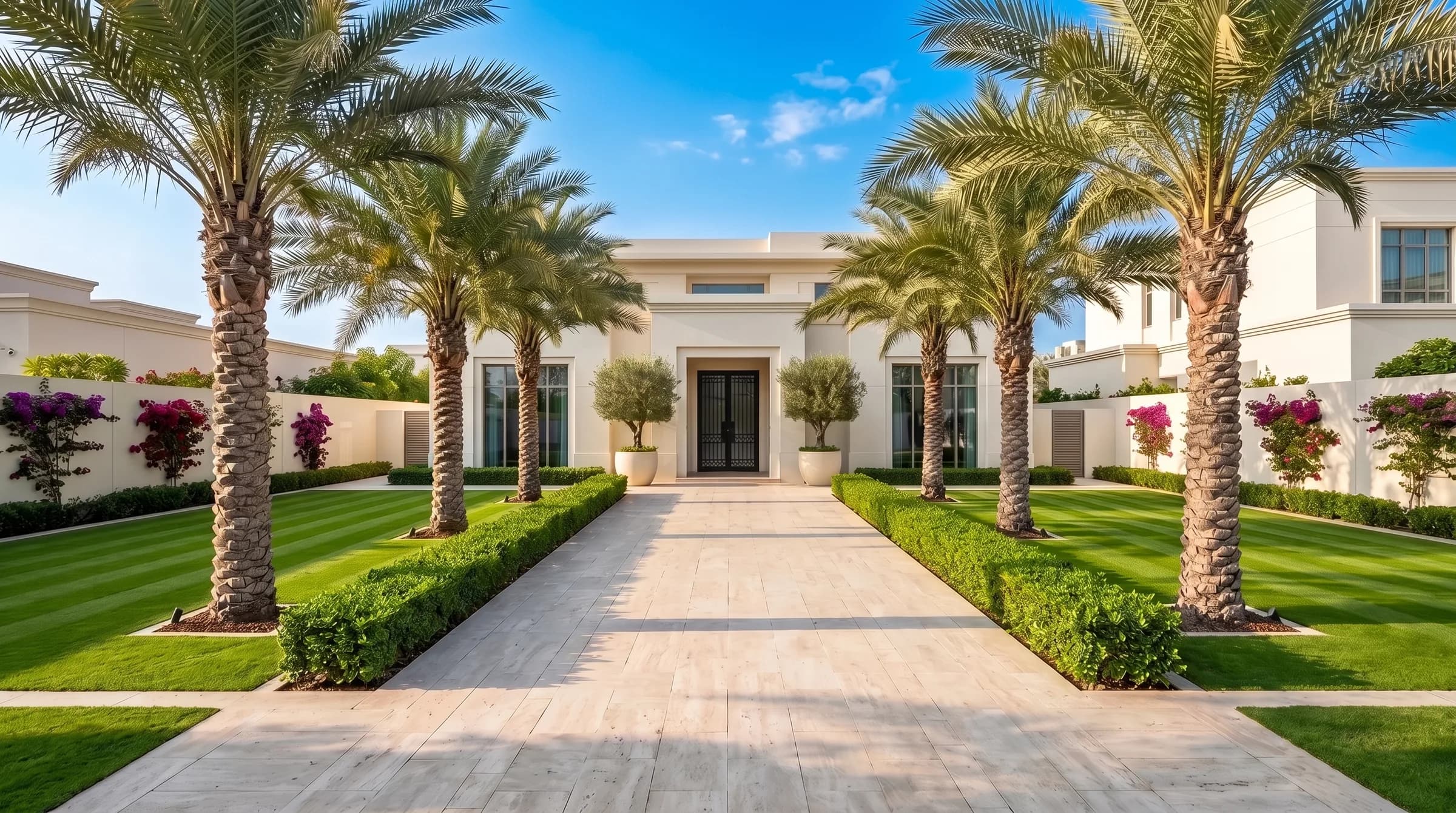
Date Palm
A date palm's strong vertical form stands out well against Tamarisk's soft, feathery screen, and both tolerate the same brackish irrigation.
Care guide
Summer: Established trees need little to no supplemental water; a deep soak once a month is generous.
Winter: None needed beyond rainfall.
Establishment: Water two to three times weekly for the first year to help roots establish, then reduce.
Avoid these
Extra notes
Toxicity: Not known to be toxic to people or pets.
FAQ
Not sure how it suits your garden?
Ask about Tamarisk on WhatsAppKeep exploring
Ghaf
Prosopis cineraria
Samr
Vachellia tortilis

Sidr
Ziziphus spina-christi

Damas
Conocarpus lancifolius
Date Palm
Phoenix dactylifera
Sources
Last reviewed 2026-09-30 by Ghaf Gardens horticulture desk.
Pool + garden care
From AED 500/month
Price depends on your garden's size, pool and complexity. Prices in AED, excluding 5% VAT.