
Ghaf
Prosopis cineraria
Full sunSalt: 4 of 5
Native
Vachellia tortilis
سمر
A native, umbrella-canopied acacia that shrugs off Dubai's heat, drought and saline soil, and is one of the trees Abu Dhabi is actively re-planting and protecting in the wild.
Season
How Samr behaves through Dubai's seasons, month by month.
Best planting window
Fresh feathery leaf flush after winter
Small white, sweetly scented flower clusters
Tightly coiled seed pods form and mature
Careful formative pruning
Best planting window: Oct–Feb
Fresh feathery leaf flush after winter: Mar–Apr
Small white, sweetly scented flower clusters: May–Jun
Species-wide records show flowering peaking in early summer with pods maturing by winter; local UAE timing is not well documented, so treat this as indicative.
Tightly coiled seed pods form and mature: Jul–Dec
Pods are often still present through the cool season.
Careful formative pruning: Dec–Feb
Remove damaged or crossing thorny branches in the cool season; heavy gloves are essential.
Samr holds its fine, feathery foliage through most of the year, with a fresh flush of growth after the cool season in March and April giving the flattest, most umbrella-like crown shape. Small cream-white, honey-scented flower clusters appear in late spring into early summer, drawing native bees at a time when little else nearby is flowering. Tightly coiled, twisted seed pods follow through summer and into winter, often still hanging on the tree well into the cool months — a useful identifying feature even without flowers. Through peak summer heat it simply holds steady, neither growing fast nor showing stress.
Meet the plant
Meet Samr, the tree that is the desert's own umbrella. Its flat, wide crown of fine, feathery leaflets casts a dappled rather than dense shade, letting light through in moving patterns rather than blocking it outright — a very different mood to the solid canopy of an exotic shade tree. It is unmistakably of this place: the same silhouette you see scattered across a gravel plain or a wadi floor, now standing in a garden instead.
Every part of it reads as adaptation rather than decoration. The long, straight thorns, the tiny leaves, the roots that reach deep for water most plants can't find — none of it is there for effect, and all of it is what lets Samr shrug off a Dubai summer that would finish off almost anything else. In late spring its small cream-white flower clusters bring a soft, honeyed scent and a quiet hum of native bees, a genuinely wild note in a cultivated space.
It is not a fast or showy tree, and its thorns mean it asks to be sited with care. What it offers instead is authenticity: a living piece of the Arabian desert, unhurried and self-sufficient, that asks almost nothing of the garden around it.
Samr (formerly classified as Acacia tortilis) grows wild across the UAE's gravel plains and mountain wadis, its flat, wide-spreading crown a defining silhouette of the Arabian desert. Alongside Ghaf and Sidr it is one of the native trees the Environment Agency – Abu Dhabi tags and rehabilitates in the wild through its native tree-tagging programme, and its nectar is a key ingredient of high-quality UAE honey, feeding native bees such as Apis florea in an otherwise florally scarce landscape.
Its adaptations are built for extreme conditions: long straight thorns and small, feathery leaves cut water loss and browsing pressure, while deep, wide-searching roots reach groundwater far below the surface. It tolerates temperatures from near freezing to over 45°C and grows in stony, saline ground that would stop most other trees outright. Flowering follows the wider Vachellia tortilis pattern recorded across its native range — small, fragrant cream-white puffball clusters in the drier part of spring into early summer — though exact UAE timing is not closely documented and varies with local rainfall.
In a garden it gives light, dappled shade over a footprint often wider than the tree is tall, and suits a desert-modern scheme alongside Sidr, Arak and Date Palm. It is slower-growing and harder to source from UAE nurseries than popular exotics, but for a genuinely native specimen tree or windbreak it is hard to beat.
Beyond its own garden value, Samr does quiet ecological work: as a nitrogen-fixing legume it improves the soil it grows in, and its canopy and thorny structure offer the kind of shelter and forage that imported ornamental trees cannot replicate for local birds and insects. Planting it is as close as a Dubai garden gets to restoring a fragment of the natural desert plain.
Design
Site Samr well away from paths, seating, pools and play areas — the thorns are long, sharp and present on every branch, so treat clearance as a safety requirement, not a design preference. It rewards a prominent, sunny position where its wide, flat canopy and dappled shade can be appreciated from a distance, as a specimen on an open lawn edge or as part of a windbreak line along a boundary. It needs no irrigation infrastructure once established, so it suits the driest, most exposed part of a desert-modern garden that other trees would struggle with.
Ghaf
Both are deep-rooted native legumes with a similar dappled canopy, giving a cohesive, authentic desert-modern planting when grouped together.

Sidr
Sidr's denser, thornier crown and Samr's flatter, wider one combine for varied shade and silhouette while sharing the same very low water needs.

Arak
Low, shrubby arak works well beneath Samr's high, dappled canopy without competing for the tree's deep water reserves.
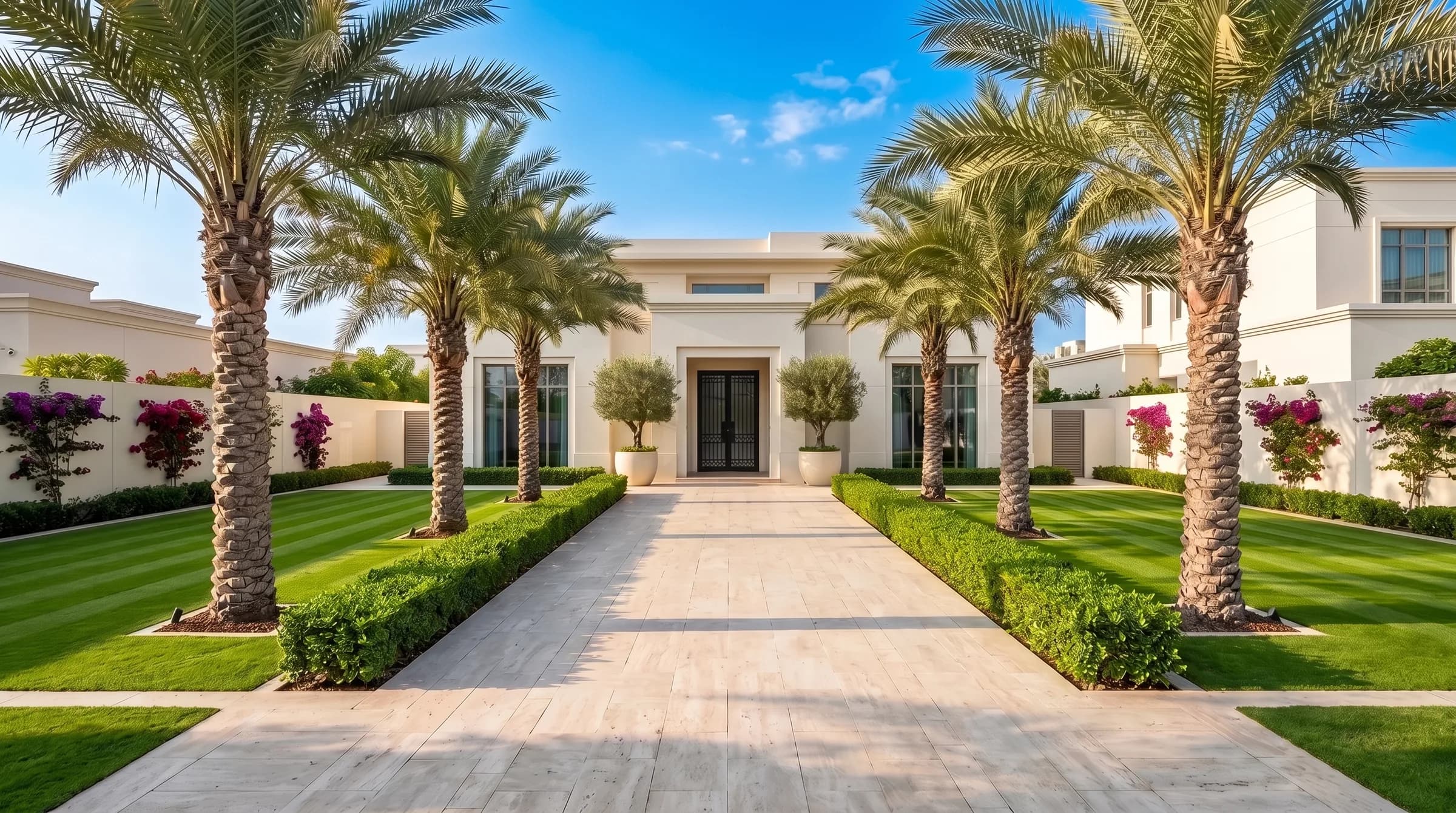
Date Palm
A date palm's vertical form contrasts with Samr's horizontal spread, and both tolerate the same saline, low-water desert-modern conditions.
Care guide
Summer: Established trees rarely need supplemental water beyond an occasional deep soak.
Winter: None needed beyond natural rainfall.
Establishment: Deep-water weekly for the first one to two years while the taproot develops.
Avoid these
Extra notes
Toxicity: Not known to be toxic, but the long thorns are a real physical hazard, especially around children and pets.
FAQ
Not sure how it suits your garden?
Ask about Samr on WhatsAppKeep exploring
Ghaf
Prosopis cineraria
Sidr
Ziziphus spina-christi
Arak
Salvadora persica

Tamarisk
Tamarix aphylla
Date Palm
Phoenix dactylifera
Sources
Last reviewed 2026-09-30 by Ghaf Gardens horticulture desk.
Pool + garden care
From AED 500/month
Price depends on your garden's size, pool and complexity. Prices in AED, excluding 5% VAT.