
Vetiver
Chrysopogon zizanioides
Full sunSalt: 4 of 5
Caution
Cortaderia selloana
The great silver-plumed grass of the Pampas: a spectacular, fast, salt-tolerant giant that is invasive in several countries and needs careful siting, plume control and room to grow.
Pampas grass is rated High for invasiveness by Cal-IPC, which records it spreading in coastal California and the Mojave Desert, and it is a declared weed in parts of Australia. One plume can carry up to 100,000 wind-borne seeds. Plant it only in managed, irrigated beds, cut plumes before the seed ripens, and keep it away from wadis, verges and open land. The blades are razor-sharp and a dry clump is highly flammable.
Season
How Pampas grass behaves through Dubai's seasons, month by month.
Best planting window
Spring growth flush
Feed in the growing season
Silver plume season
Cut back to the base
Best planting window: Oct–Mar
Cooler months give the roots time to establish before summer.
Spring growth flush: Mar–May
Feed in the growing season: Mar–Jun
NC State records that it needs abundant water and fertiliser during the growing season.
Silver plume season: Oct–Dec
NC State records late summer and autumn flowering, with plumes lasting until mid-winter.
Cut back to the base: Feb
Cut plumes before seed ripens, then cut the clump to the base in late winter; wear gloves and eye protection.
Pampas grass is evergreen and builds steadily through the growing season when it has abundant water and feed. In Dubai the silver plumes should appear in autumn, since NC State records late summer and autumn flowering, and they stay attractive until mid-winter. Cut the plumes while they are still in bloom, before seed ripens, then cut the whole clump close to the base in late winter, wearing gloves, long sleeves and eye protection. New growth flushes in spring. Plant in the cooler months, so the roots are established before the peak summer heat.
Meet the plant
Meet pampas grass, the plant that made ornamental grasses glamorous. In late summer and autumn a mature clump throws up silver-white feather plumes that stand a metre or more above its leaves, and one clump can anchor an entire corner of a garden. The genus name comes from the Argentine Spanish for 'cutter', after the razor-sharp blade margins.
The technicality behind the display is reproductive. Plants are separately male and female, and the showy plumes are the female ones. Each plume can carry up to 100,000 seeds that travel on the wind, which is why a plant that is glamorous in a garden has become a weed in other countries.
That duality sets the mood. It is a luxurious, slightly theatrical plant, best used with restraint: a single large specimen, or a pair framing an entrance, with the discipline to cut the plumes before they ripen. Used that way, it gives a garden a sense of scale and drama that few other grasses can match.
Pampas grass is the most theatrical grass in the library: a huge, arching tussock of narrow, razor-edged blades, with silver-white feathered plumes that rise a metre or more above the foliage in late summer and autumn. NC State Extension gives a mature size of 6 to 12 feet tall (about 1.8 to 3.7 m) and 4 to 6.75 feet across, with rapid growth, and notes that it tolerates a wide range of soils, coastal and sandy conditions and is highly salt tolerant and drought tolerant. The showy plumes belong to the female plants; male plants have less showy heads. Compact cultivars such as 'Pumila' (4 to 6 feet) and 'Jet Streams' (3 to 5 feet) bring the look to smaller spaces.
It also has to be discussed honestly, because it is invasive in several countries. Cal-IPC gives it a High rating, records up to 100,000 wind-dispersed seeds per plume and describes it established on dunes, bluffs and coastal shrubland, and in the Mojave Desert. It was introduced from South America as an ornamental and for erosion control. Weeds Australia says seed can travel up to 25 km and notes that it is declared in the ACT, South Australia and Tasmania. We found no UAE record of naturalisation, but the pattern elsewhere is clear enough that the plant should be sited with care.
In a Dubai garden that means a single, deliberate statement planting, managed beds only, and discipline with the secateurs. NC State says it needs abundant water and fertiliser in the growing season and lists a high flammability rating, so give it room, remove dead material and keep it away from walls and fences. If you want height and movement with less ecological baggage, Vetiver in a sterile clone, the burgundy Purple fountain grass and the native Desert grass are better-behaved choices.
Design
Reserve it for a spacious, managed bed in full sun, and plant it as a single deliberate statement or a pair, with about 3 m between clumps, as NC State advises 10 feet of spacing. Keep it well away from paths, play areas and pool decks because of the razor-sharp blades, from walls and fences because of the dry clump's flammability, and from wadis, verges and open desert because of its seed. Plan to cut the plumes before they ripen every year.
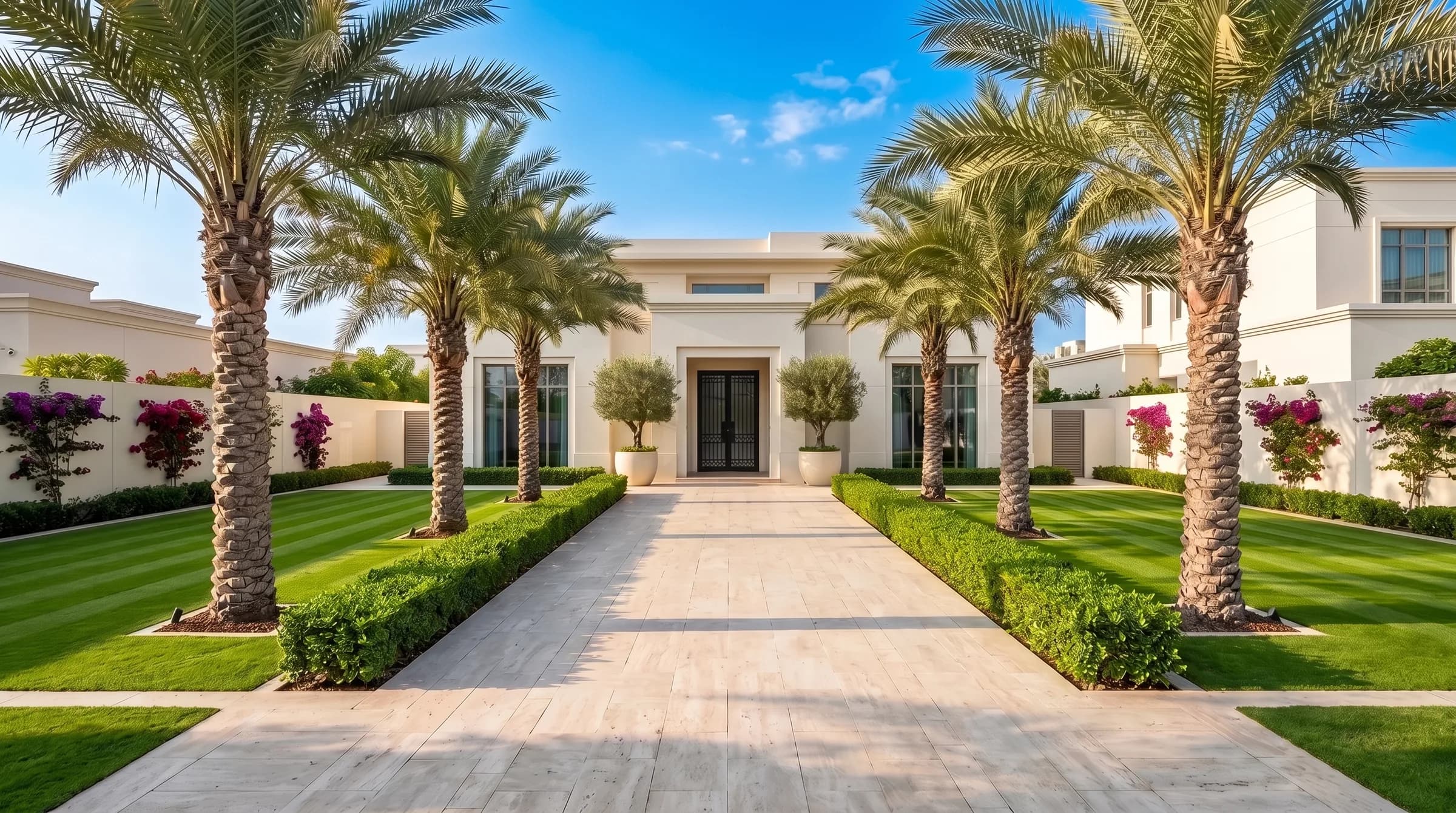
Date Palm
A date palm's vertical trunk and crown give a strong, tall companion for the grass's wide, arching mass, and both tolerate salt and heat.

Agave
Agave's rigid, blue-grey rosettes at the grass's feet make a sharp, sculptural counterpoint to the soft feathery plumes.

Olive
The olive's silver foliage echoes the plumes' tones, giving a restrained, luxurious palette in a sunny courtyard.
Care guide
Summer: Established clumps tolerate drought, but NC State records that it needs abundant water and fertiliser in the growing season, so soak deeply once or twice a week in a Dubai summer.
Winter: Reduce watering; rain and an occasional soak are enough.
Establishment: Water deeply and regularly through the first season while the roots establish.
Avoid these
Extra notes
FAQ
Not sure how it suits your garden?
Ask about Pampas grass on WhatsAppKeep exploring
Vetiver
Chrysopogon zizanioides

Purple fountain grass
Pennisetum setaceum 'Rubrum'
Desert grass
Pennisetum divisum
Date Palm
Phoenix dactylifera
Sources
Last reviewed 2026-10-05 by Ghaf Gardens horticulture desk.
Pool + garden care
From AED 500/month
Price depends on your garden's size, pool and complexity. Prices in AED, excluding 5% VAT.