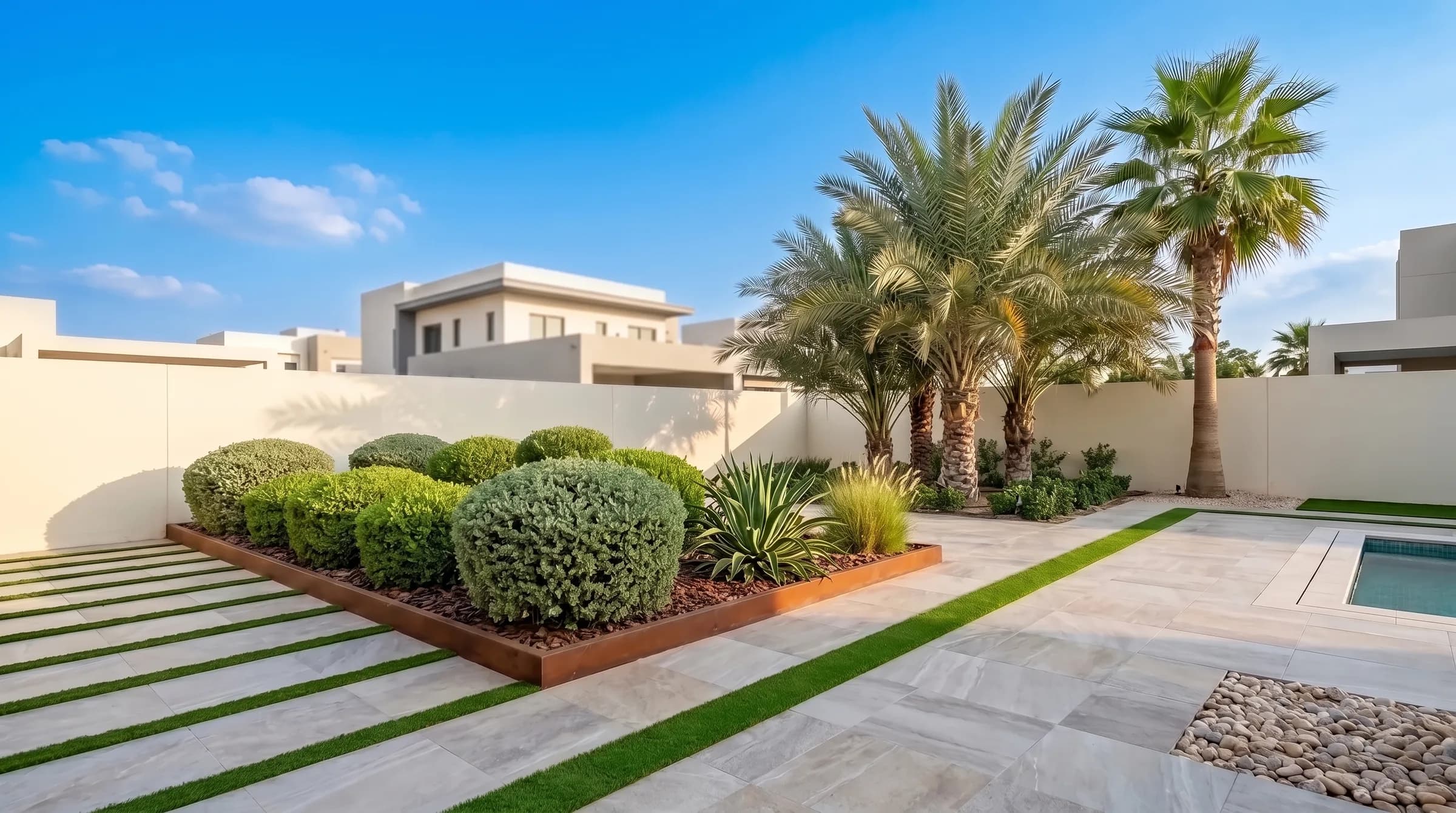
Desert grass
Pennisetum divisum
Full sunSalt: 4 of 5
Native
Pennisetum setaceum 'Rubrum'
Purple fountain grass gives Dubai beds their burgundy plumes and arching movement. The 'Rubrum' form rarely sets seed, but its green parent species is invasive on several continents.
The green species, Pennisetum setaceum (now Cenchrus setaceus), is invasive in Hawaii, Australia, South Africa, southern Europe and southern California, and the EU has banned its import, sale and planting since 2017. The burgundy 'Rubrum' is sterile and not considered invasive, but UAE nurseries sell both forms. Buy 'Rubrum' by name, remove plumes before they shatter, and keep it out of wadis, verges and open desert.
Season
How Purple fountain grass behaves through Dubai's seasons, month by month.
Best planting window
Fresh burgundy growth after the cut-back
Plume season
Cut back hard
Light spring feed
Best planting window: Oct–Mar
Cooler months give the roots time to settle before summer.
Fresh burgundy growth after the cut-back: Mar–Apr
Plume season: Mar–Nov
Plumes appear through the warm months and fade to buff as the weather cools.
Cut back hard: Feb
Cut to about 15 cm before new growth, and wear gloves.
Light spring feed: Mar
A slow-release feed is plenty; rich soil makes the clump floppy.
Plant in the cooler months, October to March, so the roots settle before summer. New burgundy growth pushes after the late-winter cut-back in February, and plumes follow through the warm months, building to a soft haze above the clump. In peak summer it keeps growing if it is irrigated, though the clump can look thinner in the worst heat. In the cooler weeks growth slows and the plumes fade to buff. A hard cut to about 15 cm before spring growth resets the whole plant and keeps the burgundy fresh.
Meet the plant
Meet purple fountain grass, the plant that shows what movement can do for a bed. Its blades are not green but a deep burgundy, and they fall in a loose arc from the crown so that the whole clump reads as a fountain caught mid-fall. Add the bristled plumes of the warm months and a single plant looks as if it is breathing.
The technicality behind the look is a C4 bunch grass: a plant that photosynthesises efficiently in heat and strong light, which is why it keeps growing through weather that stalls cool-season grasses. Its leaves are narrow and its crown is compact, so each clump holds its shape without staking or clipping.
What it brings to a garden is mood rather than mass: a warm-toned softness against stone, glass and gravel. Its one real caveat is the family it belongs to. Choose the sterile burgundy 'Rubrum', manage the plumes, and it is a good neighbour.
Purple fountain grass is among the most widely planted ornamental grasses in the UAE, and the reason is visible from across a garden: arching burgundy blades in a fountain-shaped clump about a metre tall, topped through the warm months with soft, bristled plumes in a deeper purple. 'Rubrum' is a red-leaved cultivar of Pennisetum setaceum, a grass of the open, scrubby country of East Africa, the Middle East and south-western Asia, which many botanists now file under Cenchrus setaceus. That dry-country origin explains why it suits Dubai: full sun, free drainage and very little water once established.
It has to be discussed honestly, because the species is a proven invader outside its home range. The green-leaved Pennisetum setaceum is a serious weed in Hawaii, Australia, South Africa, southern Europe and southern California, where it displaces native plants and raises fire risk; Florida lists it as a Category 2 invasive and the EU prohibits its import, sale and planting. The burgundy 'Rubrum' is the garden answer: Cal-IPC describes it as sterile and not considered invasive, and Missouri Botanical Garden notes it rarely sets seed. The sensible rule is to plant 'Rubrum' by name, deadhead the plumes before they shatter, pull any green seedling that appears and keep it away from wadis and open desert edges.
In the garden it behaves like a short, soft fountain that catches low sun. Plant it in groups of five or seven rather than singly, set against the hard edges of limestone, gravel or Agave, and let it sway beside the silver foliage of Texas Sage. If you want the same fine, arching texture from a species that belongs here, Desert grass is the native counterpart, quieter in colour and slower to bulk up. Wear gloves when cutting it back: UF/IFAS records skin irritation from handling the foliage.
Design
Give it full sun and free-draining soil, and plant it in odd-numbered groups of five or seven, 60 to 90 cm apart, so the clumps knit into a single moving drift. It reads best against hard, pale surfaces such as limestone, gravel or rendered walls, and beside silver or grey foliage that lets the burgundy glow. Keep it in managed beds and pots rather than at the edge of open ground, and deadhead the plumes before they shatter.

Agave
Agave's rigid, blue-grey rosettes give a hard counterpoint to the fountain grass's soft burgundy arcs, and both ask for full sun and little water.

Texas Sage
Silver foliage and purple blooms on texas sage pick up the grass's colour while sharing its taste for free drainage and low irrigation.

Lantana
Lantana's small, bright flower heads add warm colour at the grass's feet through the long, hot season.
Desert grass
The native desert grass offers a similar fine texture and can be drifted among the fountain grass to bring a locally rooted look to the same bed.
Care guide
Summer: Drought tolerant once established, but a deep soak once or twice a week through summer keeps the clump full. Let the surface dry between waterings.
Winter: Reduce sharply; rain and an occasional drink are usually enough.
Establishment: Water every few days for the first month or two, then taper as the roots establish.
Avoid these
Extra notes
FAQ
Not sure how it suits your garden?
Ask about Purple fountain grass on WhatsAppKeep exploring
Desert grass
Pennisetum divisum
Texas Sage
Leucophyllum frutescens
Agave
Agave americana
Lantana
Lantana camara
Sources
Last reviewed 2026-10-05 by Ghaf Gardens horticulture desk.
Pool + garden care
From AED 500/month
Price depends on your garden's size, pool and complexity. Prices in AED, excluding 5% VAT.