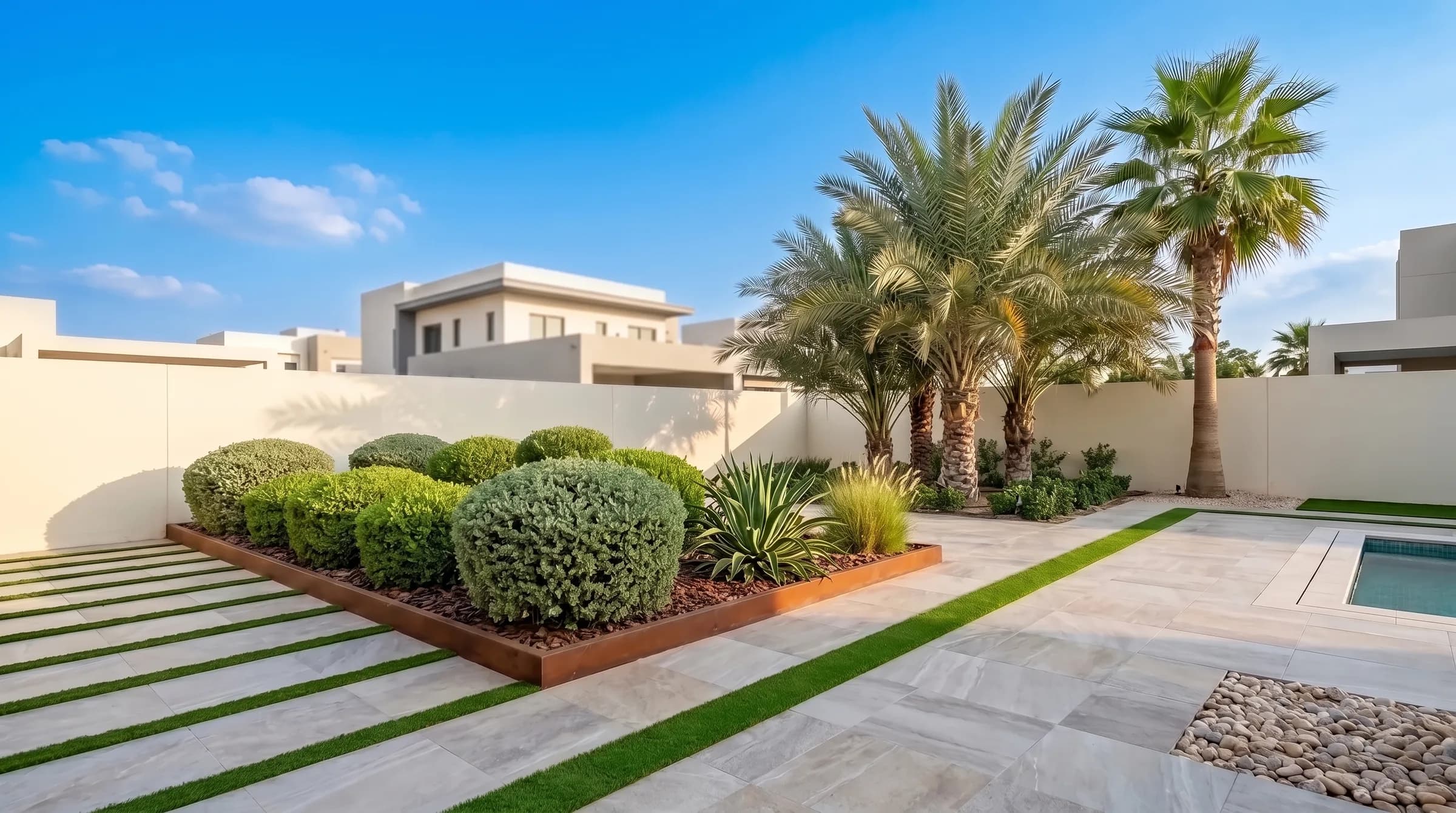
Desert grass
Pennisetum divisum
Full sunSalt: 4 of 5
Native
Muhlenbergia capillaris
A fine-leaved clump grass that spends most of the year as a modest wiry mound, then turns beds into drifts of pink mist in autumn. It is heat, drought and salt tolerant.
Season
How Pink muhly behaves through Dubai's seasons, month by month.
Best planting window
Fresh green growth after the cut-back
Pink plume season
Cut back before spring growth
Keep deeply watered in peak heat
Best planting window: Oct–Mar
Cooler months let the roots settle before summer.
Fresh green growth after the cut-back: Mar–Apr
Pink plume season: Oct–Dec
NC State records September to November bloom in North Carolina; expect autumn into early winter in Dubai.
Cut back before spring growth: Feb
UF/IFAS advises cutting back to the ground in late winter, before the spring flush.
Keep deeply watered in peak heat: Jul–Aug
A deep weekly soak keeps the clump full and green.
Pink muhly is a warm-season grass, so it is at its best from spring through autumn. New green growth follows the late-winter cut-back in February, and the clump builds through spring. In North Carolina the pink plumes open from September to November, and in Dubai you should expect the display in autumn and into early winter as the weather cools. The dried plumes then fade to tan and stay standing for weeks, until the cut-back resets the plant. Through the peak summer heat it needs a deep weekly soak to stay full and green.
Meet the plant
Meet pink muhly, the grass that spends most of the year being modest and then, in autumn, turns a whole bed into pink mist. The leaves are so thin and so dark a green that they almost disappear into the shadow beneath them, and the flowers rise on hair-fine stems so lightly that they seem to hover.
The technicality behind the effect is airiness. Each flower head is a wide, open panicle of tiny spikelets on threadlike branches, so light passes through it and the colour reads as haze rather than as mass. Low autumn sun backlights those heads, and that is when the display is at its strongest.
Its mood is soft and a little romantic, and unexpectedly at home against hard, pale surfaces such as limestone, gravel and black steel. It asks for sun, drainage and not much else, and then gives a season of colour at a time of year when little else in a Dubai garden is flowering at this scale.
Pink muhly is a clumping, warm-season grass native to the central and eastern United States and south to Mexico and Guatemala, where NC State Extension records it on clay and thin rocky soils, on burned, prairie-like ground and in open woodland. For most of the year it is a rounded mound of wiry, thread-like, dark green leaves, 60 to 90 cm tall and about as wide. In autumn the picture changes: airy pink to pinkish-red flower heads, up to about 30 cm long, rise above the foliage and appear to float there, drying afterwards to tan plumes that hold their shape into winter.
The reasons it suits Dubai are practical. NC State lists it as tolerant of heat, humidity, drought, poor soil and salt, and it accepts acid, neutral and alkaline ground provided the drainage is good. UF/IFAS adds that new plants need watering until they are established, after which drought tolerance is good, and that it performs best in a sunny spot. Full sun matters most for flowering: shade gives a thin, floppy clump and little colour. Plant it in numbers, at 60 to 90 cm spacing, because the effect comes from mass rather than from a single tuft.
Design-wise it is the softest possible companion for hard desert-modern surfaces, such as gravel, limestone and dark steel, and it looks best backlit by low autumn and winter sun. Pair it with the silver foliage of Texas Sage, the blue-grey rosettes of Agave and the bright flower heads of Lantana. It is a North American native rather than a UAE one, so if a native-only palette is the goal, Desert grass is the local choice; for the pink display, nothing else here comes close.
Design
Plant it in full sun in groups of at least five, spaced 60 to 90 cm apart, so the plumes merge into a single haze. Put the drift where low autumn and winter sun can shine through the plumes, and set it against hard pale surfaces such as limestone, gravel or dark steel for contrast. Keep it out of shade and out of beds that are watered daily; free drainage and a deep, infrequent soak suit it best.

Texas Sage
Texas sage's silver foliage and purple blooms set off the grass's pink haze, and both prefer free drainage and sparing irrigation.

Agave
Agave's rigid, blue-grey rosettes give a bold, sculptural contrast to the grass's delicate, airy plumes.

Lantana
Lantana's bright flower heads carry colour through summer while the muhly builds towards its autumn display.
Desert grass
The native desert grass is a quieter, locally rooted partner that shares the fine texture and the preference for sun and poor soil.
Care guide
Summer: Established clumps tolerate drought, but in Dubai's peak heat a deep weekly soak keeps the leaves green and the clump full.
Winter: Rain and an occasional drink are usually enough.
Establishment: Water regularly through the first season until the roots are established.
Avoid these
Extra notes
FAQ
Not sure how it suits your garden?
Ask about Pink muhly on WhatsAppKeep exploring
Desert grass
Pennisetum divisum
Texas Sage
Leucophyllum frutescens
Agave
Agave americana

Purple fountain grass
Pennisetum setaceum 'Rubrum'
Sources
Last reviewed 2026-10-05 by Ghaf Gardens horticulture desk.
Pool + garden care
From AED 500/month
Price depends on your garden's size, pool and complexity. Prices in AED, excluding 5% VAT.