Indoor plants
Low-light plants for dim Dubai apartments, hallways and bathrooms
Low light means a plant survives and grows slowly, not that it lives in the dark. What it looks like behind tinted glass, how far from a window each plant can sit, and what fails.
Updated 7 Oct 2026 · 7 min read
On this page
The short answer
A low-light plant will live in a room with no direct sun, such as a hallway, an interior room or a corner well back from the glass. It will grow slowly and look best with some daylight. Almost no plant survives where there is no daylight at all, so a windowless bathroom needs an artificial plant or a grow light. Try cast iron plant, ZZ plant, snake plant, pothos, parlour palm and lady palm first.
50–500 foot-candles
Colorado State Extension's range for low light, roughly 540–5,400 lux. Few plants cope with less than 50.
Colorado State Extension, PlantTalk
5–10%
of the visible light plants need is removed by a low-E coating, over and above normal glass. Tint takes more.
Melinda Myers
What low light means behind Dubai glass
Plant labels say 'low light' to mean no direct sun and clearly less light than a bright window. You do not need a meter. As a rough test, hold your hand about 30 cm above the pot. A faint, soft shadow means low light, and a sharp, dark shadow means bright light.
Tinted and low-E glass lower the number further. A low-E coating alone removes a further 5–10% of the visible light plants need, and added tint removes more, depending on the glass. Deep rooms, balcony overhangs and curtains or blinds kept closed against the heat cut the light again, so the back of a Dubai living room is often much dimmer than the window suggests.
Tolerates is not the same as thrives
A low-light plant survives in a dim spot but grows slowly and makes fewer new leaves. University of Nebraska–Lincoln Extension lists small leaves, long thin stems and paler foliage as signs of too little light. If you see them, move the plant closer to the glass.
How far from the window
Light falls quickly as you move away from the glass. Colorado State Extension counts medium light as roughly 0.6–1.8 m (two to six feet) back from an east- or west-facing window, and lower the further you go. That guidance comes from a different latitude and different glass, so treat the table below as a rule of thumb for a Dubai room, not a measurement.
A rule of thumb for Dubai rooms
| Position | Light you can expect | What to put there |
|---|---|---|
| On the sill or within about 60 cm of clear glass | Bright. West or unshaded glass can bring direct afternoon sun. | Anything, but shade-adapted plants such as Cast iron plant dislike hot direct sun. |
| About 60 cm to 2 m back | Medium | Pothos, Peperomia, Aglaonema, Spider plant, Parlour palm |
| About 2 to 4 m back, or a hallway with a glass door nearby | Low | Cast iron plant, ZZ plant, Snake plant, Lady palm |
| More than about 4 m from daylight, or a room with no window | Very little or none | No live plant will do well. Use a good artificial plant, or an LED grow light (Colorado State Extension recommends grow lights when natural light is too low). |
The distances are our rule of thumb, not measured figures. Clean glass, pale walls and an unshaded view help. Tint, deep overhangs and closed blinds hurt.
Plants that cope with low light
Light notes below come from NC State's plant database, UF/IFAS and the RHS. Pet status is from the ASPCA list only.
Low-light plants at a glance
| Plant | In low light | Watch out for | Pets (ASPCA) |
|---|---|---|---|
| Cast iron plant | Prefers partial to full shade and is intolerant of direct sun | Slow growth. No serious pests reported. | Non-toxic |
| ZZ plant | Grows in very low light, even under fluorescent tubes alone. Does best in bright indirect light. | Overwatering. Scale is the main pest. | Toxic |
| Snake plant | Tolerates very low light | Root rot if overwatered | Toxic |
| Pothos | Survives long periods in low light | Variegation fades and growth slows | Toxic |
| Philodendron | Prefers medium light but tolerates low light, including long periods in very low light | Leggy growth with small leaves; rot if the soil stays wet | Toxic |
| Aglaonema | Green and silver forms adapt to low light | Colourful pink and red forms fade to green in dim light | Toxic |
| Peace lily | Endures deeper shade but grows sluggishly and rarely flowers (RHS) | Brown edges in dry air | Toxic |
| Parlour palm | Tolerates low light and dry air | Spider mites and mealybugs | Non-toxic |
| Lady palm | Withstands deep shade and tolerates low humidity | Slow growth. Mites and scale in indoor settings. | Non-toxic |
| Peperomia | Tolerates low light for several months, especially plain-leaf forms | Overwatering is the main risk | Non-toxic |
| Spider plant | Prefers medium light but tolerates deep shade. Intolerant of direct sun. | Brown leaf tips from low humidity or over-feeding (Iowa State Extension) | Non-toxic in the ASPCA database (see our pet-safe guide for a caveat) |
In a home with a cat or dog, stay with the non-toxic rows and read the pet-safe guide.
Toughest in a dim spot

Cast iron plant
Aspidistra elatior

ZZ plant
Zamioculcas zamiifolia

Snake plant
Dracaena trifasciata

Pothos
Epipremnum aureum

Aglaonema
Aglaonema modestum

Philodendron
Philodendron hederaceum
Dim spots with pets at home (ASPCA non-toxic)

Parlour palm
Chamaedorea elegans

Lady palm
Rhapis excelsa

Peperomia
Peperomia obtusifolia
Hallways, interior rooms and bathrooms
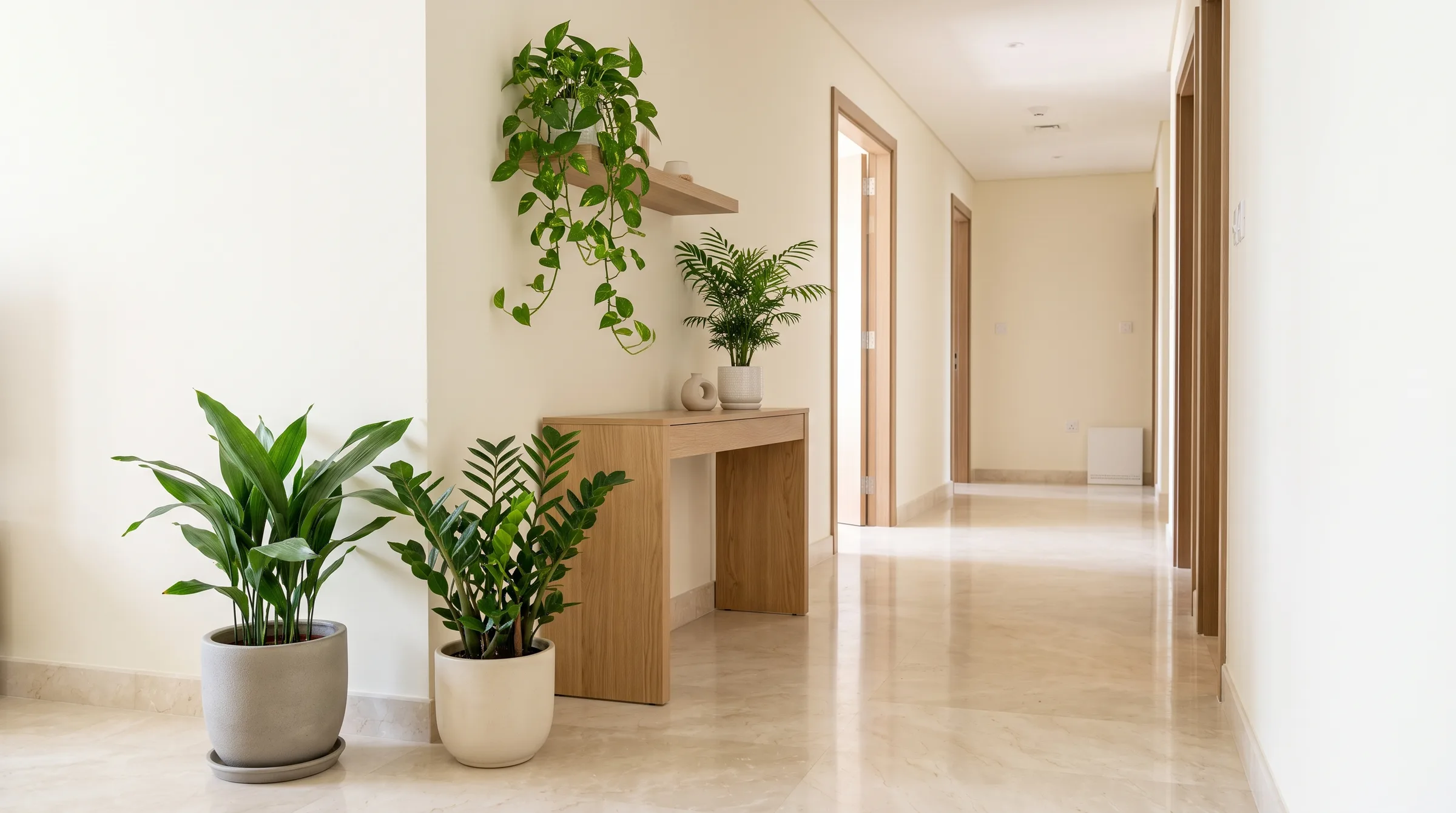
A hallway with a glass front door or a window at one end is usually low to medium light near the glass and low further in. Put cast iron plant, ZZ plant or snake plant in the dim stretch.
A bathroom with a frosted window is usually a low to medium light spot, and a bathroom with no window is not a plant spot at all. Check whether yours has a window before you buy. In a lit bathroom pothos, ZZ plant and snake plant cope with the lower light. Ferns enjoy steam, and NC State suggests placing Boston fern near kitchens and bathrooms for higher humidity. It also says Boston fern thrives in bright indirect light, which most bathrooms do not offer.
Do not add plants to make a damp bathroom more humid. The EPA advises keeping indoor humidity below 60%, ideally between 30 and 50%, to limit mould, and says to run the bathroom fan when showering. A bathroom that stays damp needs ventilation more than plants.
What does not work in low light
Several plants sold as easy indoor plants need strong light. In a dim spot they stretch, drop leaves or rot.
- Ponytail palm, spineless yucca and olive are full-sun plants (NC State). Give them your brightest glass, or a balcony for the olive.
- Moth orchid needs good light, and the RHS says to keep it out of direct summer sun. A bright spot without hot sun suits it. A dim hallway does not.
- Boston fern, prayer plant and alocasia want humid air as well as light. A dim, dry AC room gives them neither.
- Flowering plants in general. Peace lily rarely flowers in deep shade (RHS), so expect green leaves only.
- Colourful and variegated forms. Pothos loses its variegation in low light (NC State), and pink and red aglaonema fade to green.
Looking after a plant in a dim spot
Water by the soil, not the calendar. Push a finger about 5 cm (two inches) into the soil and water only if it is dry (University of Maryland Extension). A plant in low light grows slowly, and overwatering and root rot are a main risk for most of the plants above.
Wipe dusty leaves. Dust blocks light and reduces a plant's ability to photosynthesise (Ohio State Extension), and light is what your plant is short of. In a dusty city, wipe big leaves with a damp cloth every few weeks.
If a plant stretches, pales or its new leaves shrink, it wants more light. Move it closer to the glass. If there is no closer spot, add an LED grow light or swap in a tougher plant from the table. More fixes are in our guide to indoor plant problems.
Find your indoor plants
Choose by light, pets and room, see this month's indoor jobs and browse indoor styles for Dubai homes.
Explore indoor plantsFrequently asked
Can a plant live in a room with no window?
Does tinted glass count as low light?
Which low-light plants also cope with dry AC air?
How do I know my plant needs more light?
Are low-light plants safe for cats and dogs?
Can I put a low-light plant on a sunny windowsill?
Sources
- Colorado State Extension PlantTalk: Interior plants and light
- University of Nebraska–Lincoln Extension: Let there be light for your houseplants
- Melinda Myers: Low-E glass impact on houseplants
- NC State Plant Toolbox: Aspidistra elatior (cast iron plant)
- NC State Plant Toolbox: Zamioculcas zamiifolia (ZZ plant)
- NC State Plant Toolbox: Dracaena trifasciata (snake plant)
- NC State Plant Toolbox: Epipremnum aureum (pothos)
- NC State Plant Toolbox: Philodendron hederaceum
- NC State Plant Toolbox: Chamaedorea elegans (parlour palm)
- NC State Plant Toolbox: Rhapis excelsa (lady palm)
- NC State Plant Toolbox: Peperomia obtusifolia
- NC State Plant Toolbox: Chlorophytum comosum (spider plant)
- NC State Plant Toolbox: Nephrolepis exaltata (Boston fern)
- NC State Plant Toolbox: Beaucarnea recurvata (ponytail palm)
- NC State Plant Toolbox: Yucca gigantea (spineless yucca)
- NC State Plant Toolbox: Olea europaea (olive)
- UF/IFAS Extension: Aglaonema
- RHS: How to grow peace lilies
- RHS: Phalaenopsis growing guide
- Iowa State Extension: Diagnosing houseplant problems
- University of Maryland Extension: Watering indoor plants
- Ohio State Extension: Why you should clean the leaves of houseplants
- US EPA: A brief guide to mold, moisture and your home
- ASPCA: Toxic and non-toxic plants
- ASPCA: These houseplants can cause trouble for your pets
Written by Plant Guide horticulture desk · last reviewed 7 Oct 2026
Related guides
Indoor plants
Indoor plants for Dubai homes: what thrives with AC, low light and pets
Choose by room, not by trend: tough plants for dim flats, sun-lovers for bright villas, picks that cope with AC air, pet-safe options and survivors for summer travellers.
7 Oct 2026 · 7 min read
Indoor plants
Houseplants and air conditioning: keeping plants happy in a cool, dry Dubai home
Air-conditioned rooms are cooler and drier than most houseplants like. Keep plants out of the airflow, water by touch, and use a humidifier, not a spray bottle, for plants that need damp air.
7 Oct 2026 · 8 min read
Indoor plants
Brown tips, yellow leaves and pests: fixing common houseplant problems in Dubai
Match the symptom to its likeliest cause: dry AC air, mineral build-up, too much or too little water, low light, pests or dust. Each row says what to check first and what to do.
7 Oct 2026 · 8 min read
Indoor plants
Pet-safe indoor plants in the UAE (and the toxic ones to avoid)
ASPCA's non-toxic list for cats and dogs, the common UAE houseplants it marks toxic, the 'money plant' naming trap, and what to do if your pet chews a leaf.
7 Oct 2026 · 8 min read
Pool + garden care
From AED 500/month
Price depends on your garden's size, pool and complexity. Prices in AED, excluding 5% VAT.