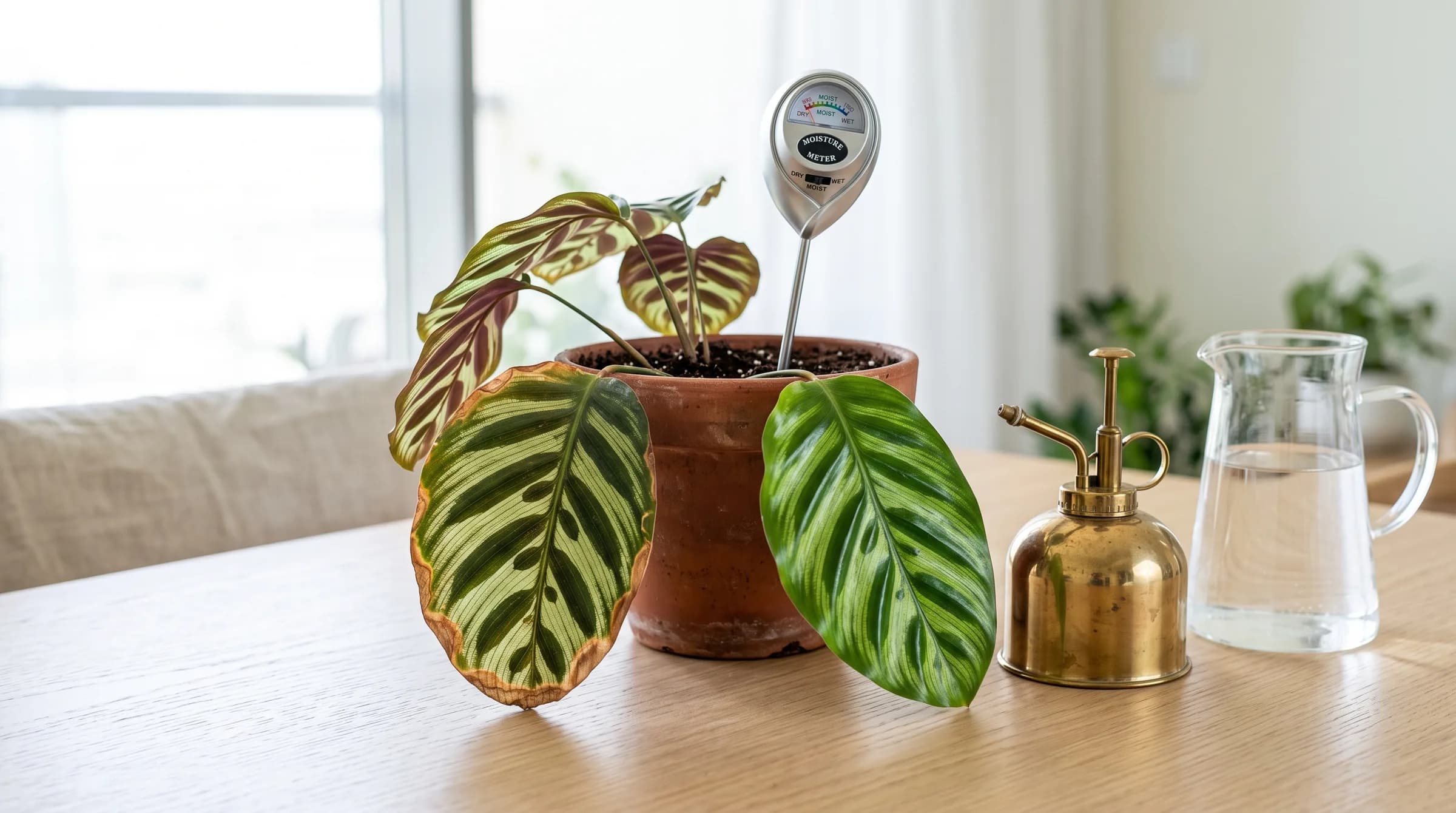
Indoor plants
Brown tips, yellow leaves and pests: fixing common houseplant problems in Dubai
Match the symptom to its likeliest cause: dry AC air, mineral build-up, too much or too little water, low light, pests or dust. Each row says what to check first and what to do.
Updated 7 Oct 2026 · 8 min read
On this page
Most houseplant problems in a Dubai flat trace back to five things: dry AC air, how you water, light behind tinted glass, mineral build-up in the pot, and pests. Iowa State Extension points out that problems often come from several causes at once, so check each in turn rather than blaming one. Find your symptom in the table, then read the section it points to.
Find the symptom
| What you see | Likeliest cause in a Dubai home | What to do first |
|---|---|---|
| Brown, crispy leaf tips or edges | Dry AC air, over-feeding, mineral build-up in the pot, or a draught from a vent. Calathea and spider plants often show it first. | Move the plant out of the airflow, feed less and flush the pot. If tips keep browning, try filtered or reverse-osmosis (RO) water for that plant. Trim the brown with clean scissors; it will not turn green again. |
| White or grey crust on the soil or pot rim | Dissolved minerals and fertiliser salts left behind as water evaporates. | Flush with plain water, at least twice the pot's volume, and let it drain. Scrape off the crust. Repot if it is heavy. |
| Yellowing lower leaves, drooping, a soft stem, soil that stays wet | Overwatering, a pot with no drainage, or low light slowing the plant down. | Test 5 cm (2 inches) down before watering, empty saucers, and repot into fresh free-draining mix if the roots are soft and brown. |
| Drooping, with dry soil pulling away from the pot | Too little water, often after travel or in a pot that dries quickly. | Water thoroughly until it runs from the drainage holes, then go back to the finger test so it does not swing between dry and soaked. |
| Leaves drop soon after you buy or move the plant | A change in light, temperature or airflow. Fiddle-leaf figs, weeping figs and rubber plants are the usual victims. | Pick a bright spot away from the vents and leave the plant there. NC State Extension links leaf drop in fiddle-leaf figs to temperature swings near vents, and in rubber plants to cold draughts and moving the plant. |
| Long, stretched stems, small pale leaves, fading variegation | Too little light: behind tinted glass or far from the window. | Move it closer to the window, wipe the glass and the leaves, or switch to a plant from our low-light guide. |
| Fine pale speckling, dull grey or bronzed leaves, fine webbing | Spider mites, which thrive in hot, dry air. | Isolate the plant and wash it, undersides included, with a jet of water. Repeat for several weeks. |
| White cottony tufts, sticky leaves | Mealybugs, usually brought in on a new plant. | Dab each insect with an alcohol swab after testing one leaf. Repeat and check the plants nearby. |
| Small brown or tan bumps on stems and leaf undersides, sticky leaves | Scale insects. | Rub or pick them off, or dab with alcohol, and check the plant every week. |
| Tiny black flies around the pot | Fungus gnats, which breed in wet soil. | Let the surface dry between waterings and use sticky cards for the adults. The flies are a nuisance more than a threat. |
| Dull, dusty or gritty leaves, especially after windy days | Sand and dust that blow in on the shamal winds and settle on the leaves. | Wipe with a damp cloth, or rinse the plant in the shower. Brush fuzzy leaves, such as African violets, with a soft brush instead. |
Sources: Iowa State Extension, University of Maryland Extension, Colorado State Extension, RHS, NC State Extension, Ohio State Extension.
Salts, minerals and the flush
Tap water in Dubai comes largely from desalination, which the UAE government calls a key source of drinking water. Like any water that is not distilled, it carries dissolved minerals. When water evaporates from the soil, the minerals stay behind, along with any fertiliser salts, and they build up in the pot, often as a white crust. We don't quote a mineral figure for Dubai tap water because the published numbers disagree. A small TDS meter (it measures total dissolved solids) will tell you your own tap's reading.
University of Maryland Extension advises flushing every houseplant with plain water every four to six months. If your flat has a water softener, don't water plants with softened water: it contains more dissolved minerals than other water.
- 1
Take the plant to a sink or shower
The pot needs to drain freely, and the plant should not sit in the runoff.
- 2
Pour plain water through the soil
Use at least twice the pot's volume, poured slowly so it soaks through evenly rather than running down the sides.
- 3
Let it drain completely
Wait until it stops dripping, then empty the saucer. Never leave the pot standing in water.
- 4
Scrape off any crust, and feed lightly afterwards
Over-fertilising browns tips as well (Iowa State Extension), so wait for the plant to look active before you feed again.
If a plant keeps browning after you have sorted airflow, feeding and flushing, switch that plant to filtered, RO or distilled water. NC State Extension advises against tap water for spider plants, and the RHS prefers rainwater or distilled water for calathea. Rainwater is rarely an option in Dubai, so filtered or RO water is the practical choice. Most tougher plants need no special treatment.
Too much water, too little light
Overwatering
Yellow lower leaves, a soft stem and soil that never dries are the usual signs. NC State flags overwatering as the main risk for peperomia, and ZZ plants do not tolerate wet roots. Check 5 cm (2 inches) down before you water, empty saucers, and use a pot with drainage holes. If a plant is already collapsing, slide it out of the pot: roots that are soft and brown are rotting. Trim them off and repot into fresh, free-draining mix, then water less.
Low light
Stretched growth and small, pale leaves point to light. Low-E glass cuts roughly 5–10% of visible light (Melinda Myers), and heavier tint cuts more, so a tinted living room can be dimmer than it looks. Move the plant closer to the window, but not into the airflow. For corners that stay dim, choose a plant that copes: see low-light indoor plants.
Pests: a simple routine
Spider mites like hot, dry air (Colorado State Extension), so they are the pest to expect in an air-conditioned flat. Mealybugs and scale usually arrive on an infested plant. Keep every new plant apart from the others for a couple of weeks, and look under its leaves before it joins the group.
- 1
Isolate
Move the plant away from the others the moment you see a pest.
- 2
Rinse
Take it to the shower and rinse the stems and the undersides of the leaves with lukewarm water. For spider mites, Colorado State Extension advises washing repeatedly with a water jet.
- 3
Swab
Dab mealybugs and scale with an alcohol swab (Colorado State Extension). Test it on a single leaf first, because some plants are sensitive.
- 4
Repeat
One treatment rarely clears a pest. Check the plant weekly for several weeks. The RHS says raising humidity reduces the risk of spider mites but won't control them alone.
- 5
Escalate only if needed
Horticultural oil or soap sprays are the next step (Colorado State Extension). Read the label, keep pets and children away until the spray is dry, and test on one leaf first.
- 6
Know when to stop
A cheap plant with a heavy infestation is sometimes better replaced than treated for months. Bin it in a sealed bag so the pests don't spread.
Check under the leaves every week
Mites, mealybugs and scale all start on the undersides of leaves and in the joints of stems. A two-minute look every week finds them while there are few.
Dust and sand
Dust blocks light and reduces a plant's ability to photosynthesise (Ohio State Extension). Dubai's shamal winds lift desert sand, and notable sandstorms have hit in spring as well as summer. Large leaves, such as monstera and fiddle-leaf fig, show it quickly. Wipe them with a damp cloth, rinse smaller plants in the shower, and brush fuzzy ones. A monthly wipe is a sensible default. Do it again after a dusty spell.
Plants that forgive mistakes
If you are tired of troubleshooting, choose plants that cope with dry air, low light and irregular watering. NC State describes snake plant as durable and difficult to kill, cast iron plant as tolerant of neglect, and ZZ plant as highly drought tolerant.
Forgiving plants for an AC home

ZZ plant
Zamioculcas zamiifolia

Snake plant
Dracaena trifasciata

Pothos
Epipremnum aureum

Cast iron plant
Aspidistra elatior

Ponytail palm
Beaucarnea recurvata

Parlour palm
Chamaedorea elegans
4–6 months
how often to flush a pot with plain water
University of Maryland Extension
2×
the pot's volume: the least plain water to pour through when flushing
University of Maryland Extension
5–10%
visible light that low-E glass cuts, before any tint
Melinda Myers
Find your indoor plants
Choose by light, pets and room, see this month's indoor jobs and browse indoor styles for Dubai homes.
Explore indoor plantsFrequently asked
Why are my plant's leaf tips brown when I water it regularly?
Is Dubai tap water bad for houseplants?
Should I cut off brown leaf tips?
How do I tell overwatering from underwatering?
Are fungus gnats harmful to my plants?
How often should I clean the leaves?
Sources
- Iowa State Extension: Diagnosing houseplant problems
- University of Maryland Extension: Watering indoor plants
- Colorado State Extension: Managing houseplant pests
- RHS: Glasshouse red spider mite
- RHS: Calathea growing guide
- NC State Extension Plant Toolbox: Chlorophytum comosum (spider plant)
- NC State Extension Plant Toolbox: Ficus lyrata (fiddle-leaf fig)
- NC State Extension Plant Toolbox: Ficus elastica (rubber plant)
- NC State Extension Plant Toolbox: Peperomia obtusifolia
- NC State Extension Plant Toolbox: Zamioculcas zamiifolia (ZZ plant)
- NC State Extension Plant Toolbox: Dracaena trifasciata (snake plant)
- NC State Extension Plant Toolbox: Aspidistra elatior (cast iron plant)
- Ohio State Extension (Knox County): Why you should clean the leaves of houseplants
- Melinda Myers: Low-E glass impact on houseplants
- UAE Government (u.ae): Water, desalination as a key source of drinking water
- Wikipedia: Climate of Dubai (shamal winds and sandstorms)
Written by Plant Guide horticulture desk · last reviewed 7 Oct 2026
Related guides
Indoor plants
Houseplants and air conditioning: keeping plants happy in a cool, dry Dubai home
Air-conditioned rooms are cooler and drier than most houseplants like. Keep plants out of the airflow, water by touch, and use a humidifier, not a spray bottle, for plants that need damp air.
7 Oct 2026 · 8 min read
Indoor plants
Low-light plants for dim Dubai apartments, hallways and bathrooms
Low light means a plant survives and grows slowly, not that it lives in the dark. What it looks like behind tinted glass, how far from a window each plant can sit, and what fails.
7 Oct 2026 · 7 min read
Indoor plants
Going away for the summer? How to keep houseplants alive while you travel
Most houseplants manage a week alone. Longer trips in a closed Dubai flat need a plan: water well, move plants off the glass, leave the AC on, and test a wick or self-watering setup first.
7 Oct 2026 · 7 min read
Indoor plants
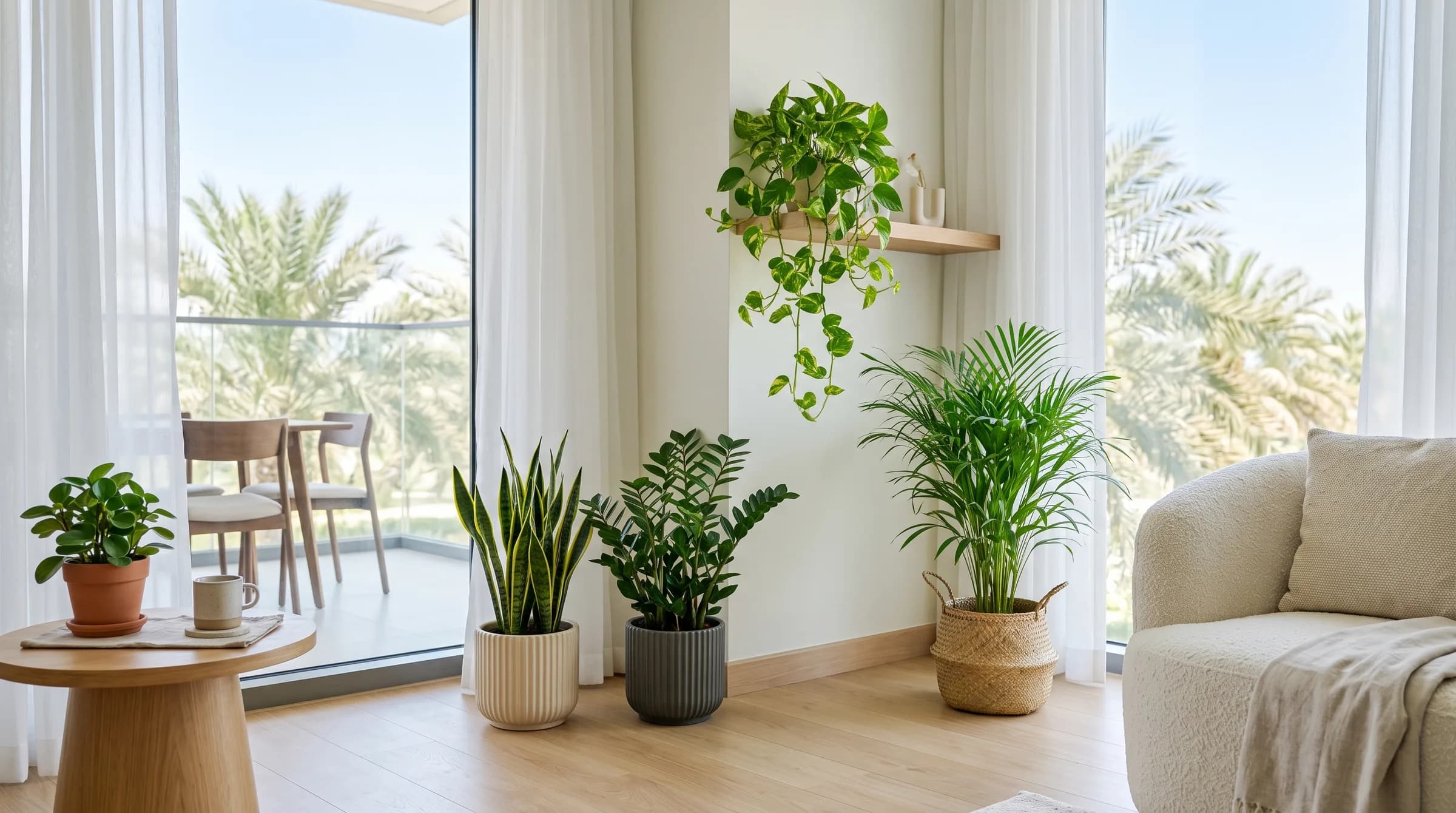
Indoor plants for Dubai homes: what thrives with AC, low light and pets
Choose by room, not by trend: tough plants for dim flats, sun-lovers for bright villas, picks that cope with AC air, pet-safe options and survivors for summer travellers.
7 Oct 2026 · 7 min read
Related plants

Calathea
Goeppertia spp. (syn. Calathea)

Spider plant
Chlorophytum comosum

Fiddle-leaf fig
Ficus lyrata

Rubber plant
Ficus elastica
Pool + garden care
From AED 500/month
Price depends on your garden's size, pool and complexity. Prices in AED, excluding 5% VAT.