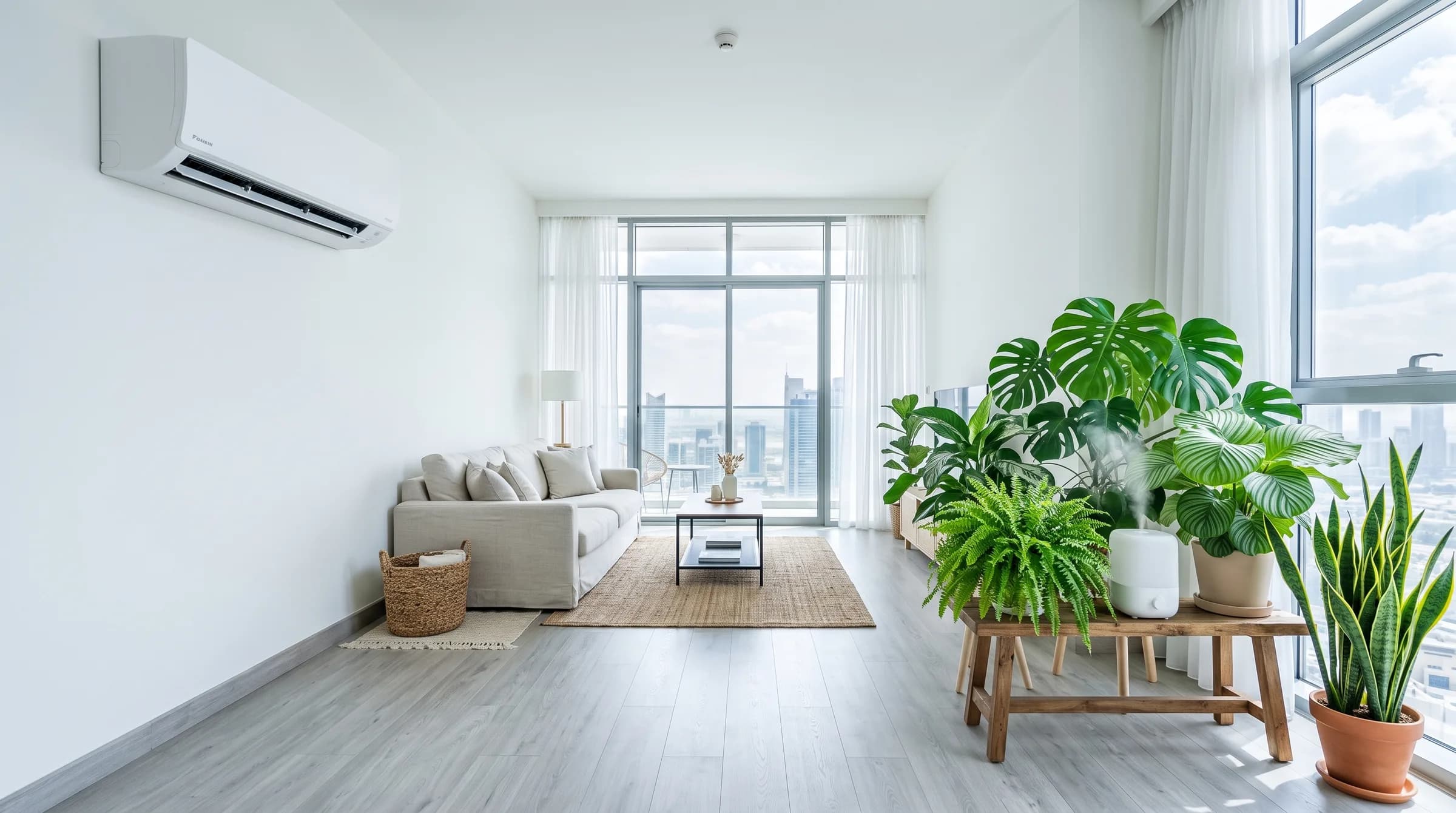
Indoor plants
Houseplants and air conditioning: keeping plants happy in a cool, dry Dubai home
Air-conditioned rooms are cooler and drier than most houseplants like. Keep plants out of the airflow, water by touch, and use a humidifier, not a spray bottle, for plants that need damp air.
Updated 7 Oct 2026 · 8 min read · Best read in May–Oct
On this page
Houseplants come from warm, humid places. A Dubai flat is cool, closed and dry, and the AC runs for months. An interview study of 26 Dubai residents found AC typically switched on continuously through summer, often from May or June to October, with windows opened only for short spells (Murtagh et al., Buildings & Cities). Plants cope with that better than you might expect, if you manage three things: where they sit in relation to the vents, how you water, and the dryness of the air around their leaves.
The short version
Keep leaves out of the direct airflow. Push a finger 5 cm (2 inches) into the soil before you water. Choose plants that tolerate dry air for the driest rooms. Use a humidifier, not a spray bottle, for the few plants that need damp air.
What cool, dry air does to a houseplant
The first sign is usually brown, crispy leaf tips and edges. Iowa State Extension links brown tips to low humidity and to over-fertilising, and the RHS says that for calathea the browning of tips and edges is usually the result of low humidity. In a dry room, a heavy hand with the fertiliser makes it worse.
The second sign is pests. Spider mites thrive in hot, dry conditions (Colorado State Extension). Look for a fine pale mottling on the upper leaf surface, then dull, grey or bronzed leaves and, in a bad case, fine webbing (RHS). They are easy to miss until the plant looks tired, so check the undersides of leaves every week.
How dry is your flat? We don't quote a Dubai figure. The retailer numbers we found disagree with each other and none was measured, and your own room depends on the unit, the flat and how often the doors open. A cheap hygrometer will tell you yours. For a home, the US EPA recommends keeping indoor humidity below 60%, ideally between 30% and 50%, to limit mould.
Vents, draughts and glass
A cool room is rarely the problem. Moving air is. Most houseplants are comfortable at the temperatures people are: the RHS gives 16–21 °C for calathea and 19–30 °C by day for moth orchids, and NC State Extension says alocasia should not drop below about 15.6 °C. The same Dubai study found some residents setting the AC to 18–21 °C, which is still workable. Vent air is colder than the room, and cold air blowing across leaves is what damages them. NC State notes that a fiddle-leaf fig can drop leaves from temperature swings near heating or cooling vents, and that rubber plants lose leaves in cold draughts.
- Keep plants out of the direct airflow. If you can feel moving air at leaf height, or a strip of tissue flutters there, move the plant. We don't give a distance in metres because airflow differs between wall units, ceiling units and ducted vents.
- Do not stand a plant under a vent, in line with a wall unit, or in front of a floor-level outlet.
- Watch the glass. West-facing windows are the hot spot in the afternoon, and NC State advises protecting fiddle-leaf figs and rubber plants from afternoon sun.
- Give calathea, alocasia and ferns the calmest corner: still air, bright light, no direct sun. NC State describes prayer plant (maranta) as intolerant of cold draughts.
Cool rooms are often dim rooms. Low-E glass cuts roughly 5–10% of visible light (Melinda Myers), and heavier tint cuts more. If a plant stretches and pales, light is a likelier cause than the AC. Keep the glass and the leaves clean, and see our low-light plants guide for corners that stay dim.
Which plants cope with dry AC air
Thick, waxy or water-storing leaves shrug off dry air. Thin, patterned or fern-like tropical leaves do not. NC State rates ponytail palm as tolerating heated, dry indoor air exceptionally well, snake plant as tolerating low humidity, parlour palm as doing well in the dry air of interiors, and lady palm as having low humidity requirements. ZZ plant and cast iron plant are both drought tolerant.
Cope well with dry air

ZZ plant
Zamioculcas zamiifolia

Snake plant
Dracaena trifasciata

Ponytail palm
Beaucarnea recurvata

Parlour palm
Chamaedorea elegans

Cast iron plant
Aspidistra elatior

Lady palm
Rhapis excelsa
At the other end are the plants that want damp air. NC State says Boston fern asks for high humidity and can get scale or spider mites if the air is too dry, maranta needs a humidified room, and nerve plant shrivels and drops leaves in dry air, though it recovers after a drink. Alocasia likes warmth and high humidity. If you love one of these, give it the calmest corner and a humidifier, or choose a tougher plant.
Need extra help in an AC room

Calathea
Goeppertia spp. (syn. Calathea)

Alocasia
Alocasia × amazonica

Boston fern
Nephrolepis exaltata

Prayer plant
Maranta leuconeura

Nerve plant
Fittonia albivenis
Humidity: what works and what doesn't
A humidifier is the only common method that changes the air in a room. The rest are local, or don't work. University of Nebraska–Lincoln Extension is blunt about misting: you would need to mist every few minutes to make any difference to room humidity, and constantly wet leaves encourage disease.
Ways to raise humidity for houseplants
| Method | What it does | How to use it |
|---|---|---|
| Humidifier | Raises the humidity of the whole room | Run it in the room with the plants and put a hygrometer next to it. Stop before the reading goes above 60%. |
| Grouping plants | Makes a small, local pocket of damper air as the leaves give off water | Put the plants that like damp air together, well away from vents. |
| Pebble tray | Adds humidity around the foliage only | Stand the pot on stones above the water line, never in the water, or the roots rot. |
| Misting | Doesn't work: the effect lasts minutes | Skip it. |
| A bright bathroom or kitchen | Helps plants such as Boston fern, which NC State suggests placing near bathrooms and kitchens | Only if the room has real daylight. A windowless bathroom is no place for a living plant. |
Sources: University of Nebraska–Lincoln Extension; NC State Extension; US EPA.
Watering in a cooled room
Water by touch, not by calendar. University of Maryland Extension advises testing the soil with a finger to about two inches (5 cm): if it is dry, water. Lifting the pot works too, because dry potting mix weighs much less than wet. No fixed number of days suits every pot, plant and room. A plant in a cool room generally uses water more slowly than the same plant in a hot one, so don't carry a garden routine indoors.
- Water until it runs from the drainage holes, then empty the saucer. University of Maryland Extension says never let a houseplant sit in water.
- Flush the pot with plain water every four to six months, using at least twice the pot's volume, and let it drain fully. Dissolved minerals and fertiliser salts build up in the soil, and brown tips are one sign. The steps are in our houseplant problems guide.
- Feed lightly. Over-fertilising browns leaf tips (Iowa State Extension).
- Check by touch even in rooms you rarely use, such as a majlis or guest room. The room's schedule doesn't change what the soil is doing.
Pests that like a dry room
Spider mites are the pest to expect. Colorado State Extension advises washing the plant repeatedly with a jet of water, and the RHS says raising humidity reduces the risk but won't control them on its own. Mealybugs (white cottony tufts, sticky leaves) and scale (small brown bumps) are removed by hand or with an alcohol swab (Colorado State Extension). Our problems guide has the full routine. Keep new plants apart from the rest for a couple of weeks and look under their leaves first, because mealybugs and scale usually arrive on an infested plant.
A simple routine for an AC home
- 1
Map the airflow
Stand where the plant would sit and hold up a strip of tissue. If it flutters, that spot is in the airflow.
- 2
Move before you buy gadgets
Shifting a plant out of the airflow and off hot afternoon glass costs nothing, and it fixes more problems than any device.
- 3
Read a hygrometer for a week
If the room sits below 30% and you keep ferns, calathea or alocasia, add a humidifier. If it sits above 60%, ventilate or dehumidify, because the EPA links that range to mould.
- 4
Water by touch
Finger test to 5 cm (2 inches), drain well, empty saucers, flush every four to six months.
- 5
Wipe the leaves monthly
Dust blocks light and reduces photosynthesis (Ohio State Extension). Use a damp cloth for big leaves and a soft brush for fuzzy ones.
- 6
Look under the leaves weekly
Catch mites, mealybugs and scale while they are few.
30–50%
indoor relative humidity the EPA recommends for homes, and below 60% to limit mould
US EPA
5 cm (2 in)
soil depth to test with a finger before watering
University of Maryland Extension
4–6 months
how often to flush a pot with at least twice its volume of plain water
University of Maryland Extension
Find your indoor plants
Choose by light, pets and room, see this month's indoor jobs and browse indoor styles for Dubai homes.
Explore indoor plantsFrequently asked
Is air conditioning bad for houseplants?
How far should a plant be from an AC vent?
Does misting help plants in an air-conditioned room?
What humidity do houseplants need in a Dubai home?
Why are the tips of my plant's leaves going brown?
Should I switch the AC off to help my plants?
Sources
- Buildings & Cities: Living with air-conditioning: experiences in Dubai, Chongqing and London (Murtagh et al., 2022)
- US EPA: A brief guide to mold, moisture and your home
- University of Nebraska–Lincoln Extension: Houseplants and humidity
- University of Maryland Extension: Watering indoor plants
- Colorado State Extension: Managing houseplant pests
- RHS: Glasshouse red spider mite
- Iowa State Extension: Diagnosing houseplant problems
- RHS: Calathea growing guide
- RHS: Phalaenopsis growing guide
- NC State Extension Plant Toolbox: Alocasia x mortfontanensis
- NC State Extension Plant Toolbox: Ficus lyrata (fiddle-leaf fig)
- NC State Extension Plant Toolbox: Ficus elastica (rubber plant)
- NC State Extension Plant Toolbox: Beaucarnea recurvata (ponytail palm)
- NC State Extension Plant Toolbox: Dracaena trifasciata (snake plant)
- NC State Extension Plant Toolbox: Chamaedorea elegans (parlour palm)
- NC State Extension Plant Toolbox: Rhapis excelsa (lady palm)
- NC State Extension Plant Toolbox: Zamioculcas zamiifolia (ZZ plant)
- NC State Extension Plant Toolbox: Aspidistra elatior (cast iron plant)
- NC State Extension Plant Toolbox: Nephrolepis exaltata (Boston fern)
- NC State Extension Plant Toolbox: Maranta leuconeura (prayer plant)
- NC State Extension Plant Toolbox: Fittonia albivenis (nerve plant)
- Melinda Myers: Low-E glass impact on houseplants
- Ohio State Extension (Knox County): Why you should clean the leaves of houseplants
- Wikipedia: Climate of Dubai (Dubai International Airport 1991–2020 normals)
Written by Plant Guide horticulture desk · last reviewed 7 Oct 2026
Related guides
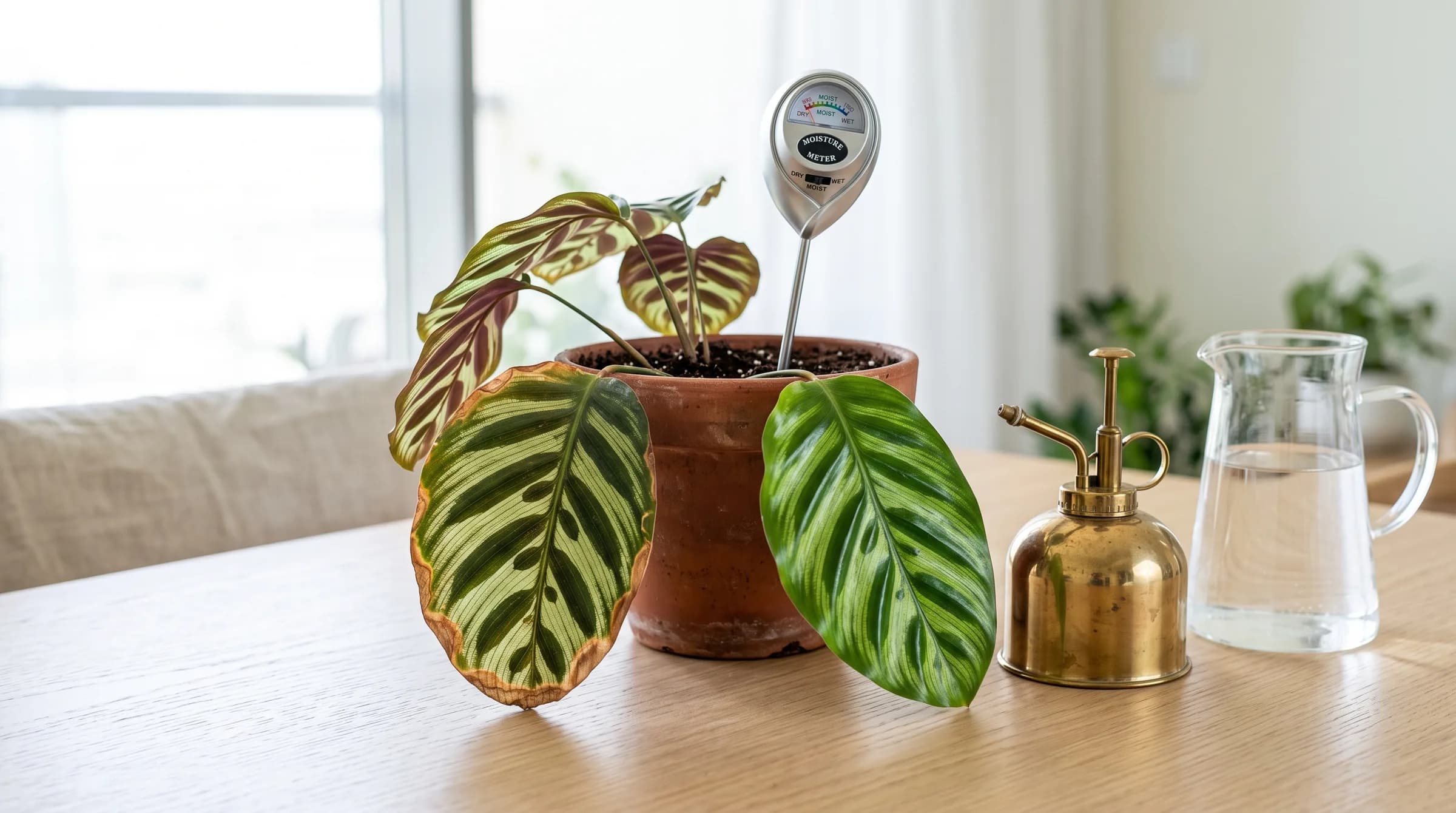
Indoor plants
Brown tips, yellow leaves and pests: fixing common houseplant problems in Dubai
Match the symptom to its likeliest cause: dry AC air, mineral build-up, too much or too little water, low light, pests or dust. Each row says what to check first and what to do.
7 Oct 2026 · 8 min read
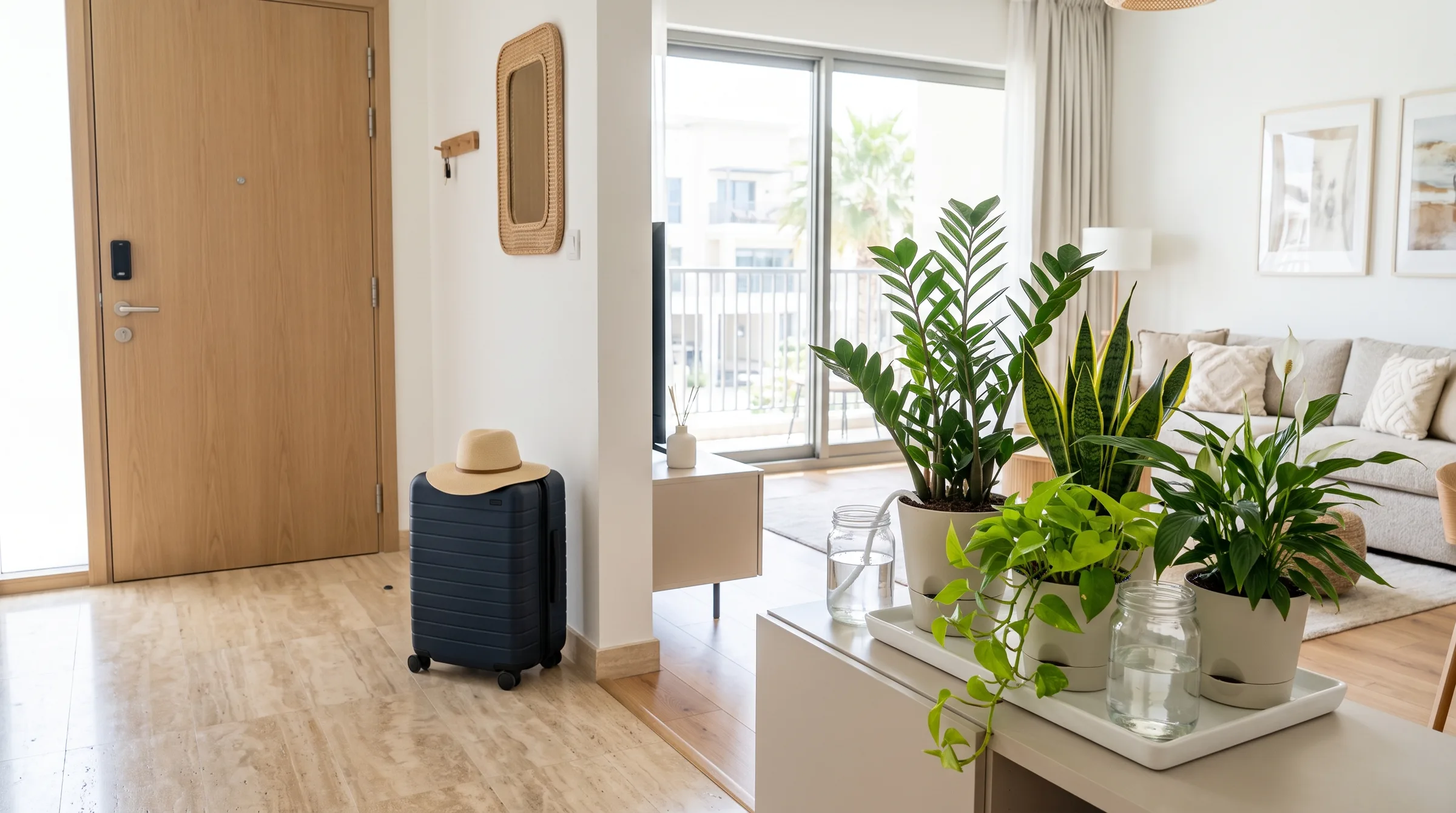
Indoor plants
Going away for the summer? How to keep houseplants alive while you travel
Most houseplants manage a week alone. Longer trips in a closed Dubai flat need a plan: water well, move plants off the glass, leave the AC on, and test a wick or self-watering setup first.
7 Oct 2026 · 7 min read
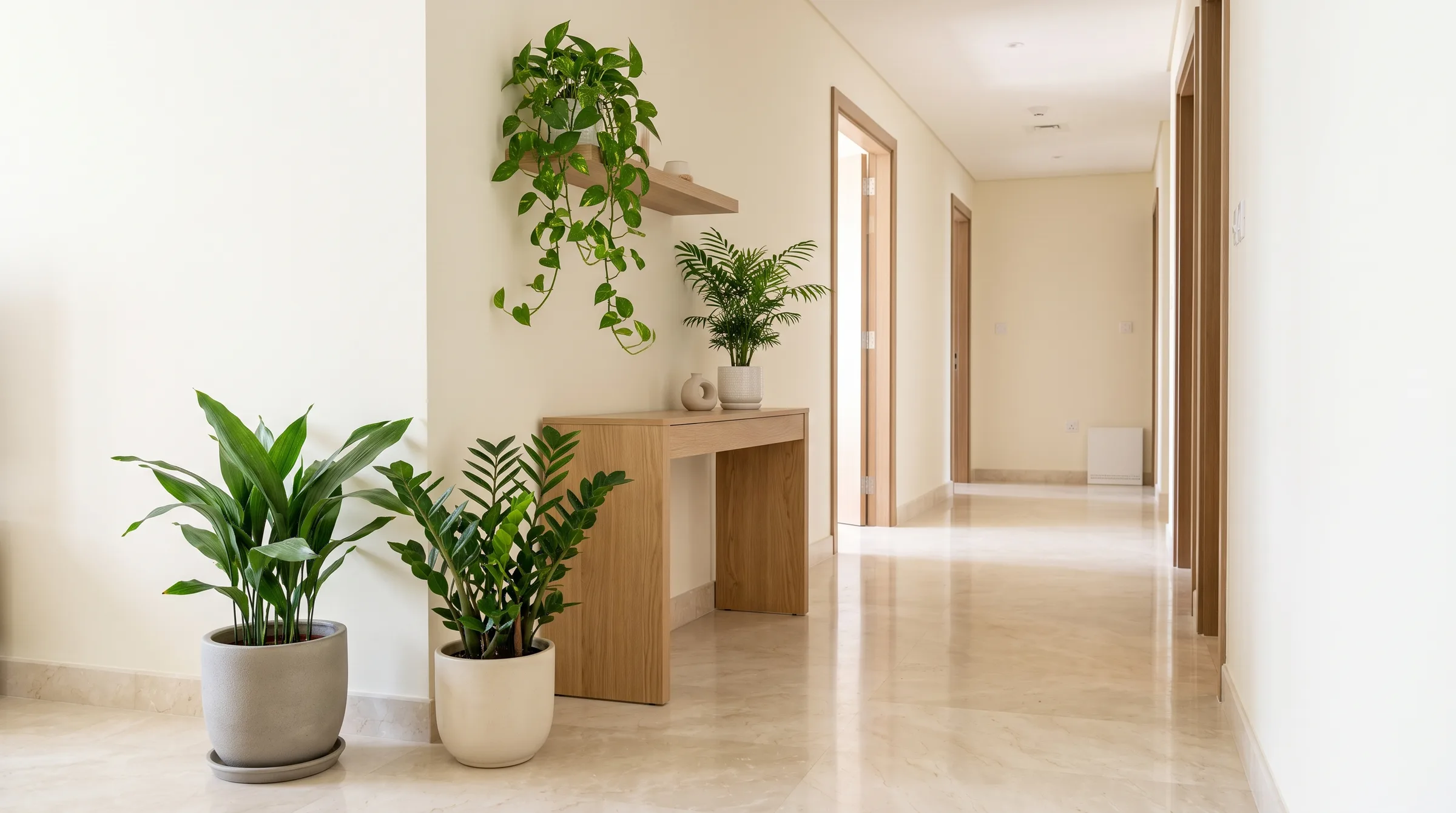
Indoor plants
Low-light plants for dim Dubai apartments, hallways and bathrooms
Low light means a plant survives and grows slowly, not that it lives in the dark. What it looks like behind tinted glass, how far from a window each plant can sit, and what fails.
7 Oct 2026 · 7 min read
Indoor plants
Indoor plants for Dubai homes: what thrives with AC, low light and pets
Choose by room, not by trend: tough plants for dim flats, sun-lovers for bright villas, picks that cope with AC air, pet-safe options and survivors for summer travellers.
7 Oct 2026 · 7 min read
Pool + garden care
From AED 500/month
Price depends on your garden's size, pool and complexity. Prices in AED, excluding 5% VAT.