
Ghaf
Prosopis cineraria
Full sunSalt: 4 of 5
Native
Azadirachta indica
نيم
A fast-growing, dense-canopied shade tree from the Indian subcontinent that copes with Dubai's heat and drought on very little water, giving genuinely deep shade rather than a light dappled cover.
Season
How Neem behaves through Dubai's seasons, month by month.
Best planting window
Small, fragrant white flower clusters
Vigorous spring growth flush
Olive-sized fruit forms, ripening from green to yellow
Structural pruning
Best planting window: Oct–Feb
Small, fragrant white flower clusters: Mar–Apr
Vigorous spring growth flush: Mar–May
Olive-sized fruit forms, ripening from green to yellow: May–Jul
Structural pruning: Nov–Jan
Shape while young to build strong scaffold branches given how fast the tree grows.
Neem holds a dense, deep green canopy through every month of the year, so its seasonal interest lies in small shifts rather than dramatic change. Small, fragrant white flower clusters appear in March and April, drawing bees, followed by a vigorous flush of new leaf growth through spring. Olive-sized fruit sets from May and ripens from green to yellow through early summer, dropping steadily and needing the odd sweep near paving or a pool. Through the cool season the tree changes little to look at, holding its full canopy and giving the same reliable, unbroken shade in December as it does in June.
Meet the plant
Meet neem, the tree that gives Dubai something a true desert native rarely does: proper, unbroken shade. Stand beneath a mature specimen at midday and the difference from a lightly canopied ghaf or acacia is immediate — the crown closes overhead into a dense, rounded dome of deep green that drops the temperature underneath it noticeably, the kind of shade a family actually gathers in rather than merely walks through.
It earns that density fast. Few trees available here reach a genuine shade-tree size as quickly as neem does, and it does so on modest water once established, making it one of the more efficient trades in the whole palette: heavy visual and thermal payoff for relatively low irrigation cost. The trade-off sits below ground and in the canopy itself — roots spread wide and close to the surface seeking water, and the same density that makes such good shade also makes it hard to grow much else beneath the tree.
Its seeds carry a second, quieter usefulness: pressed neem oil is one of the most widely used natural pesticides anywhere, so a single tree in a corner of the garden can genuinely support pest management in beds well away from its own canopy.
Azadirachta indica, native to the Indian subcontinent, has become a familiar shade tree across Dubai's villas, schools and mosques, valued for a dense, rounded crown that gives real cooling shade rather than the light, filtered cover of native desert trees like Ghaf.
It grows in full sun on sandy, well-drained soil, is drought-resistant and moderately salt-tolerant once established, and reaches a good shade-tree size faster than most UAE natives. The National has highlighted Neem alongside other drought-tolerant species in Dubai to show that a lush, leafy garden does not have to mean a high water bill.
Below ground it is an active forager: neem develops a strong root system with a short taproot and long, penetrating lateral roots that seek out water, capable of extending well beyond the canopy's edge. That water-seeking habit is part of what makes it such an efficient, low-water shade tree, but it also means mature specimens are better sited with real distance from pools, paving and building foundations rather than tucked in close.
In practice neem works well as a stand-alone shade tree or windbreak, though its dense canopy and wide-ranging roots make it harder to grow much beneath it than under a lighter-canopied native. Neem oil pressed from its seeds is also a well-known, widely used natural pesticide, so a neem tree can genuinely earn its keep elsewhere in the garden — handled diluted and kept away from children and pets, since concentrated oil is a different matter from the tree's shade.
Design
Neem wants open ground away from smaller plants it will simply out-shade: a large lawn edge, a school or villa courtyard, or as a windbreak along an exposed boundary, always with enough distance from pools, paving and utility lines to accommodate its wide, water-seeking surface roots as the tree matures. Underplanting is largely impractical once the canopy closes, so treat the ground beneath a mature neem as shaded hardscape, seating or mulch rather than a bed for shrubs or lawn.
Ghaf
Planted apart rather than together, neem's dense shade and ghaf's open canopy give a large plot two genuinely different kinds of tree cover to plan around.

Moringa
Moringa's airy, fast-pruned form and edible harvest complement neem's permanent, purely shade-giving role in a mixed productive-and-shade planting.
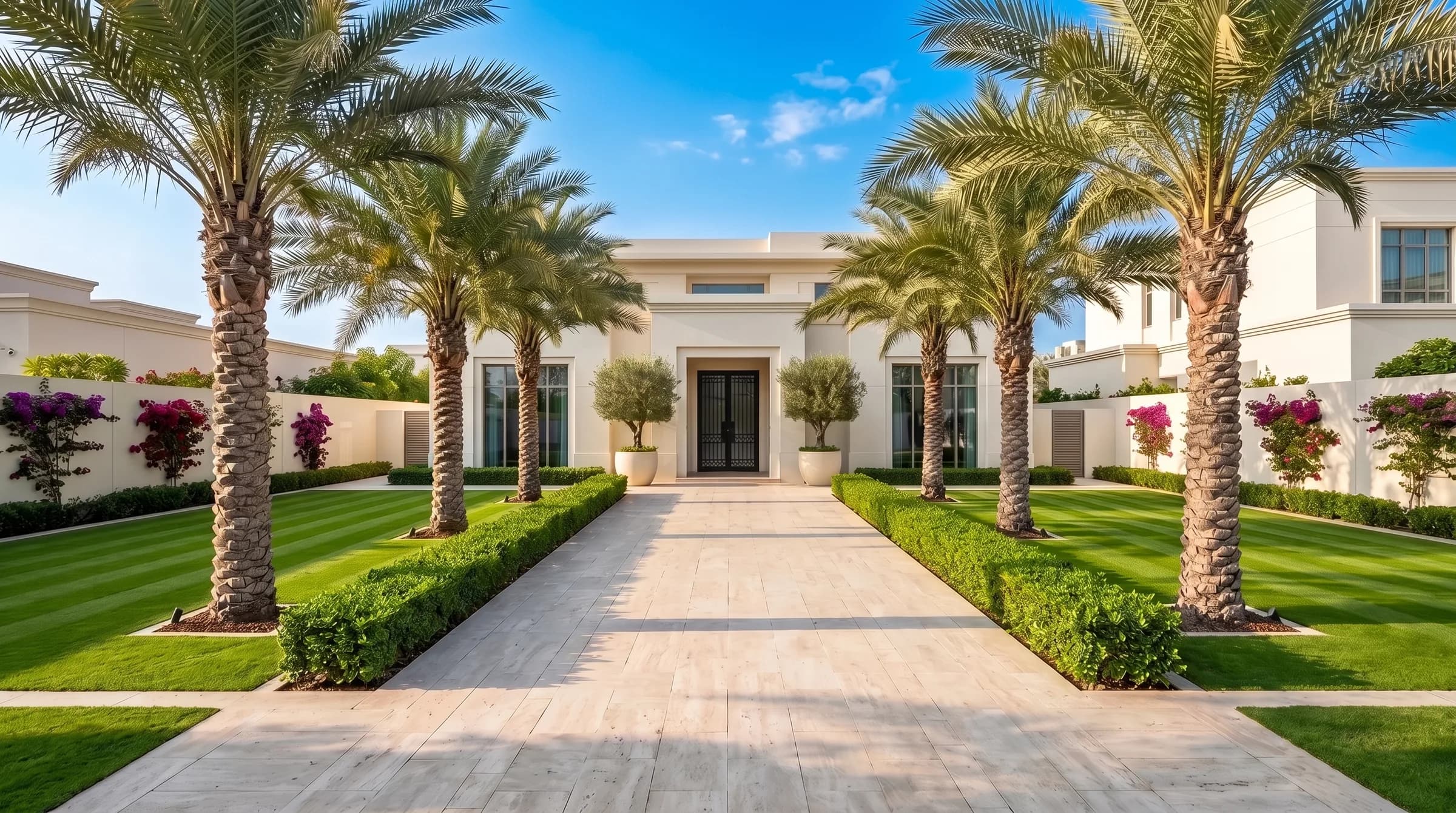
Date Palm
A date palm's narrow, vertical footprint can share a generous plot with neem's broad canopy without the root competition a second broad-canopied tree would bring.
Care guide
Summer: Established trees do well on a deep soak every 7–14 days.
Winter: Little to no supplemental water needed.
Establishment: Water two to three times a week for the first year.
Avoid these
Extra notes
Toxicity: Neem leaves and oil are used medicinally in small, prepared amounts, but concentrated neem oil or a large ingestion of seeds can cause vomiting and toxicity in pets and children; keep fallen seeds and pruned material out of reach.
FAQ
Not sure how it suits your garden?
Ask about Neem on WhatsAppKeep exploring
Sources
Last reviewed 2026-09-30 by Ghaf Gardens horticulture desk.
Pool + garden care
From AED 500/month
Price depends on your garden's size, pool and complexity. Prices in AED, excluding 5% VAT.
