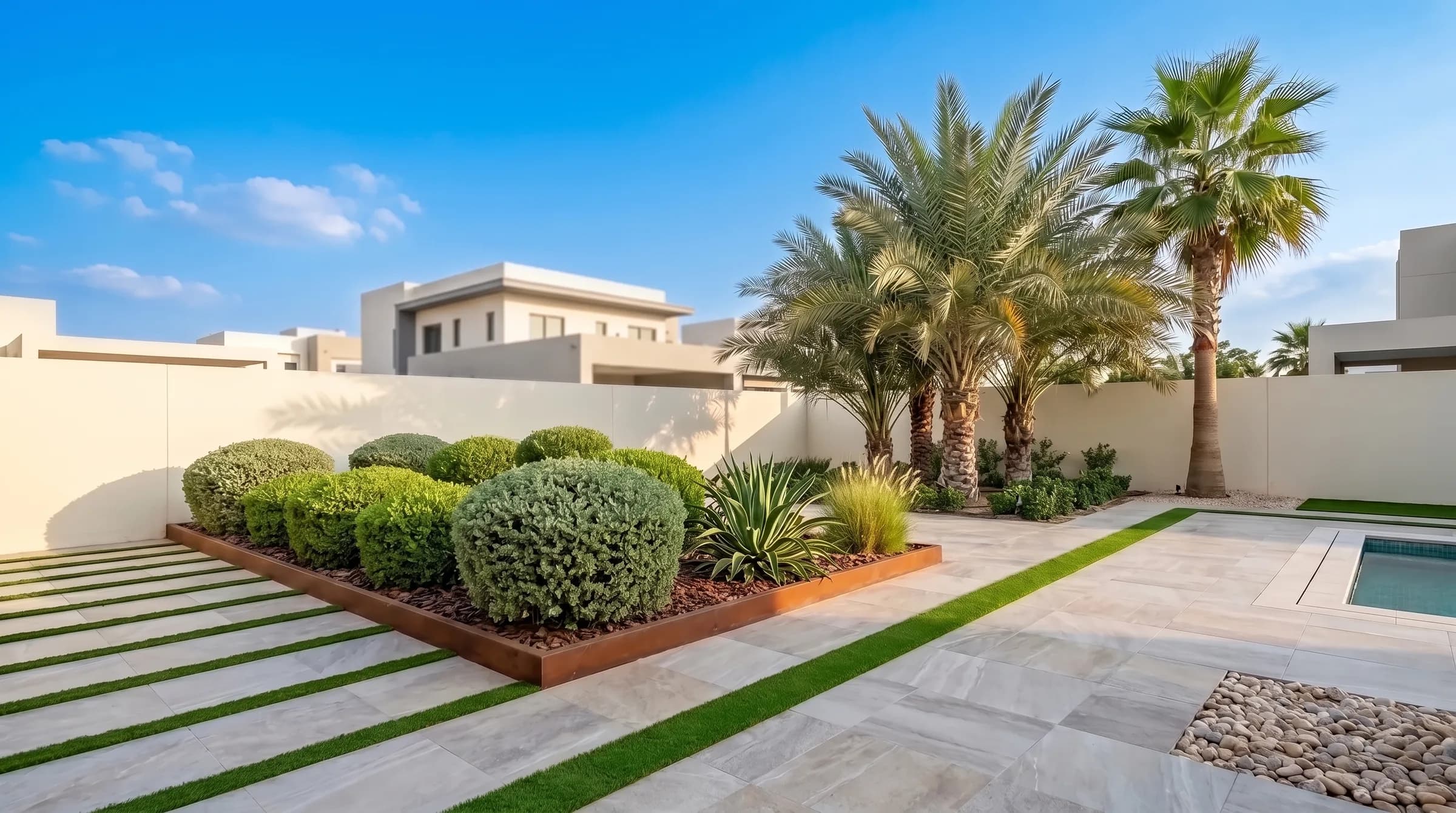
Desert grass
Pennisetum divisum
Full sunSalt: 4 of 5
Native
Sphagneticola trilobata
A fast, yellow-flowered groundcover that will cover bare ground almost anywhere in Dubai — but it's rated among the world's worst invasive plants, so plant it with real caution.
Sphagneticola trilobata is listed among the IUCN's 100 of the world's worst invasive alien species and classed as a category II invasive plant by the Florida Exotic Pest Plant Council. It spreads readily from rooting stem fragments. If you plant it, keep it strictly contained in edged beds or pots and never dispose of trimmings into open ground, wadis or drains.
Season
How Wedelia behaves through Dubai's seasons, month by month.
Best planting window
Peak flowering
Edge and cut back
Best planting window: Mar–Apr, Sep–Oct
Establishes readily most of the year given Dubai's heat, but mild shoulder seasons are easiest.
Peak flowering: Mar–May, Sep–Nov
Can flower almost year-round in Dubai's mild climate, with the heaviest bloom in spring and autumn.
Edge and cut back: Mar, Jun, Sep, Dec
Essential, not optional, given how readily cut stems root — bag and bin trimmings rather than leaving them on bare ground.
Wedelia grows and flowers almost year-round in Dubai's mild climate, with small yellow daisy flowers appearing most heavily in spring and autumn (roughly March to May and September to November) and continuing at a lower level through summer and winter. Growth is fastest in the warm shoulder seasons, which is also when its spreading habit needs the closest watching. Regardless of season, its ability to root from any stem fragment that touches soil means edging and trimming is a constant, not a seasonal, task — letting it go even briefly allows it to spread beyond a bed's edges.
Meet the plant
Meet wedelia, a groundcover that does exactly what it's asked to do — arguably too well. Glossy, three-lobed leaves knit into a dense, low mat studded with small, cheerful yellow daisies for much of the year, covering bare ground faster than almost anything else sold for the purpose. In a contained bed it looks effortless: uniform, weed-suppressing, low.
That same talent is why it carries a serious asterisk. Every piece of stem that touches soil can root and spread, which is precisely the mechanism that has made it one of the world's most cited invasive groundcovers outside cultivation. A cutting tossed over a garden wall or dumped near a wadi is not a harmless offcut — it's a new colony waiting to start.
It brings fast, uncomplicated yellow colour and total ground coverage to a garden, but that convenience only stays contained with real discipline: edged beds, regular clipping and trimmings that go in the bin, never onto open ground.
Wedelia (Sphagneticola trilobata, still widely sold under its older name Wedelia trilobata) is a mat-forming groundcover originally from Central America and the Caribbean, grown across the UAE for its glossy, three-lobed leaves and cheerful yellow daisy flowers that appear for much of the year.
It has to be discussed honestly: the IUCN lists it among the 100 worst invasive alien species in the world, and it is a recognised invasive groundcover in Florida and across much of the tropics and subtropics, including parts of Hong Kong, South Africa, Australia, Indonesia and Sri Lanka where it has escaped cultivation. It spreads aggressively from stem fragments that root wherever they touch soil, and it can escape gardens into wadis, verges or vacant land if cuttings are dumped rather than binned. It is still widely available in UAE nurseries, but a homeowner should weigh that record before planting it.
Where it is used, it earns its popularity honestly: almost nothing grows faster to cover a bare bank or slope, or to suppress weeds under trees and shrubs in a contained bed. Its dense, low mat effectively excludes competing weeds once established, which is exactly the trait that makes it so valuable in cultivation and so problematic once it escapes containment.
If you choose it, treat regular edging and clipping as essential maintenance rather than optional tidying — and seriously consider whether a non-invasive alternative such as Portulaca, Vinca or a clipped Hopbush hedge would do the job with less risk. None of the horticultural convenience it offers changes its status on the world's most cited invasive species list, and that status is the single most important fact to know before planting it.
Design
If used at all, confine wedelia strictly to edged beds, raised containers or hard-bordered areas well away from wadis, verges, drains or any open, unmanaged ground it could escape into. It suits a contained bank, a bordered slope, or a pot where its fast coverage and low care genuinely earn their keep without the containment risk. Do not plant it as an unedged filler beneath trees or shrubs where stems can root into surrounding open ground, and never site it near a boundary shared with unmanaged land. Given the availability of non-invasive alternatives with similar coverage and care needs, many Dubai gardens are better served choosing one of those instead.

Portulaca
Portulaca offers similarly fast, colourful, low-water groundcover without wedelia's invasive risk, and is worth considering as a direct substitute in most planting plans.

Vinca
Vinca covers comparable ground over a summer season with bright flower colour and none of wedelia's containment concerns, making it a common recommended alternative.

Hopbush
A clipped hopbush hedge can supply the same weed-suppressing, low-maintenance structure at a larger scale, without the rooting-stem-fragment risk wedelia carries.
Care guide
Summer: Once established, weekly watering is usually enough.
Winter: Rainfall or occasional watering is usually enough.
Establishment: Water 2–3 times a week for the first month.
Avoid these
Extra notes
Toxicity: Not known to be toxic to people or pets.
FAQ
Not sure how it suits your garden?
Ask about Wedelia on WhatsAppKeep exploring
Desert grass
Pennisetum divisum
Portulaca
Portulaca grandiflora
Vinca
Catharanthus roseus
Hopbush
Dodonaea viscosa
Sources
Last reviewed 2026-09-30 by Ghaf Gardens horticulture desk.
Pool + garden care
From AED 500/month
Price depends on your garden's size, pool and complexity. Prices in AED, excluding 5% VAT.